Introduction to Tints Featured Image

Introduction To Lenses – Tints

You cannot work in optical store without encountering requests for sunglasses on a daily basis. Hence, it is important to know about all the different ways that lenses can be tinted.
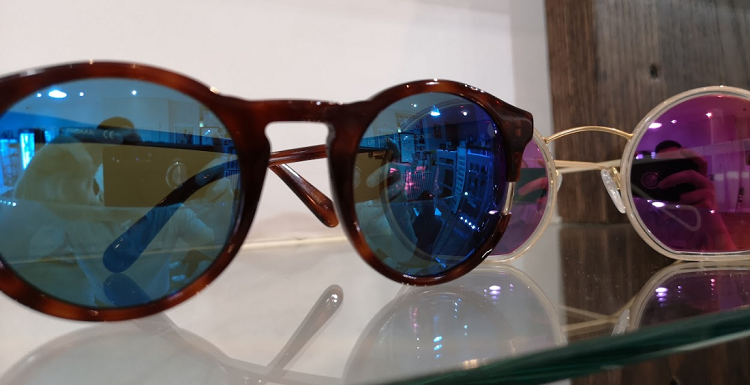
blue and pink sunglasses

How Do Sunglasses Work?

First, let’s consider what sunglasses actually do. You might say they:

  • Make everything darker
  • They protect your eyes from the sun
  • They reduce glare
  • They make everything a different color
  • They make you look cool

They are all correct answers. In this lesson, you will learn how sunglasses do all of these things as well as why the word ‘sunglasses’ is actually an umbrella term for many different types of tinted lenses.

How Sunglasses Make Everything Darker – Absorption & Transmittance

To understand how sunglasses make the work darker, we must understand the concepts of absorption and transmittance.

Absorption is a measure of how much a material stops light from passing through.

Transmittance is a measure of how much a material allows light to pass through.

A clear lens (non-sunglasses) does not darken vision at all. That is because they allow all the light that enters the lens to pass through. None of the light is absorbed, all of the light is transmitted. Therefore, a clear lens has an absorption rate of 0% and a transmittance rate of 100%. 
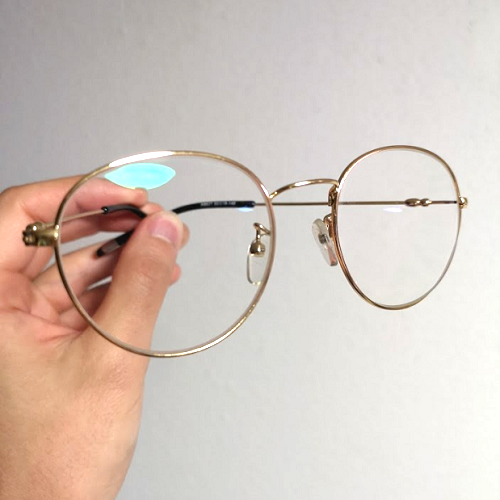
Clear lenses

Absorption rate: 0%

Transmittance rate: 100%

An occluder is a tool used by optometrists to temporarily block one’s vision. An occluder does not let any light pass through it. All of the light hitting the occluder is absorbed, none of the light is transmitted. Therefore, an occluder has an absorption rate of 100% and a transmittance rate of 0%.
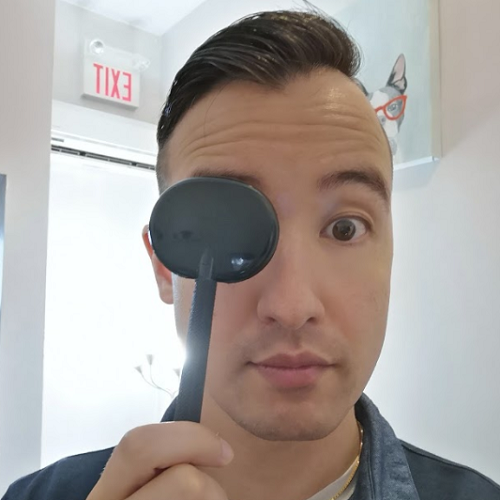
Man holing an occluder

Absorption rate: 0%

Transmittance rate: 100%

Sunglasses darken the vision, but still allow you to see through the lenses. This means that some light is absorbed by the lenses and some light is transmitted. Typically, sunglasses have an absorption rate of ~80% and a transmittance rate of ~20%.
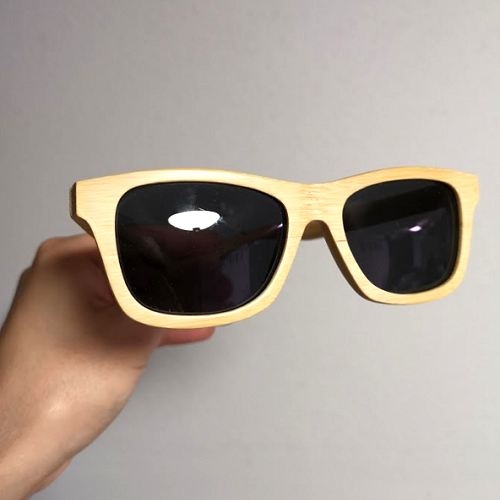
Wooden Sunglasses

Absorption rate: 80%

Transmittance rate: 20%

If a customer tries on sunglasses and feels that they are too dark or not dark enough, sun-glass lenses can be ordered with the exact absorption and transmittance rates specified by a customer.
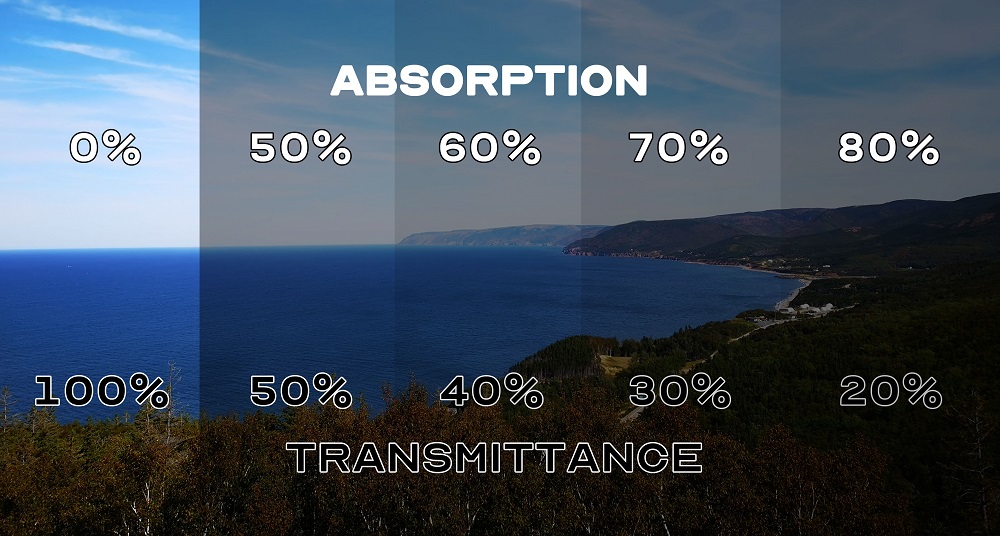
Absorption and Transmittance Gradient

How Absorption is Achieved

In order to achieve the desired absorption rate, lenses under go a tinting process. Tinting lenses is a fairly simple process or submerging them into a chemical dye. The longer they remain in this dye solution, the darker the lenses will be when they emerge.

Here is a video of the process taking place.

Full Tint Vs Gradient Tint

Note that in this this video, the lenses were not completely submerged in the dye, but instead dipped about half way in. This is in order to create a gradient tint.

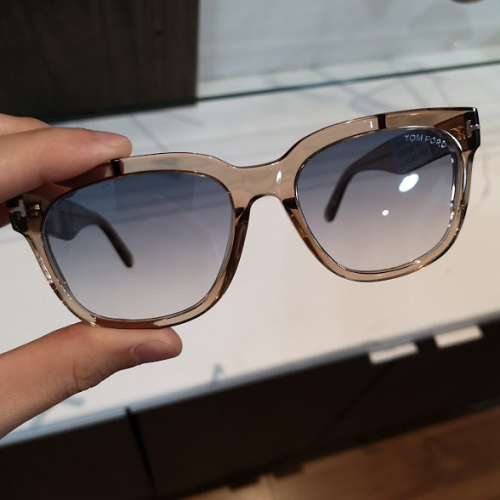
Gradient tints have the darkest tint at the top of the lens, and they gradually get lighter towards the bottom. Gradient tints are useful for blocking out the sunlight from above while not diminishing the overall brightness of vision too much. Additionally, they offer a unique look that many find desirable in their sunglasses.
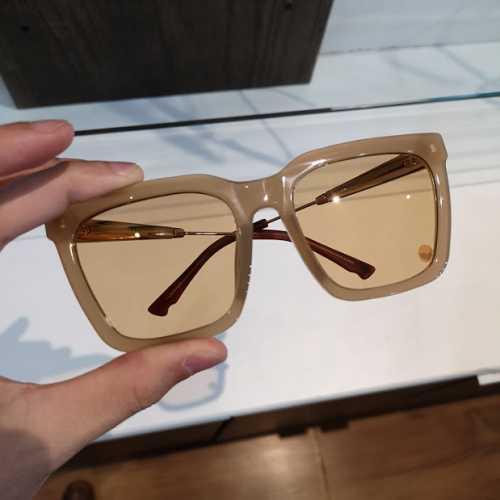
 

Light brown sunglasses Tom Ford Gradient Lenses


Colored Tints

Sun-glass lenses need not just be grey or brown. They can be tinted almost any color imaginable. The video above showed a blue gradient tint. The following video shows a red full-lens tint.

Here is a set of different colored full and gradient lenses readily available on the market. Can you can differentiate the full tints from the gradient tints?
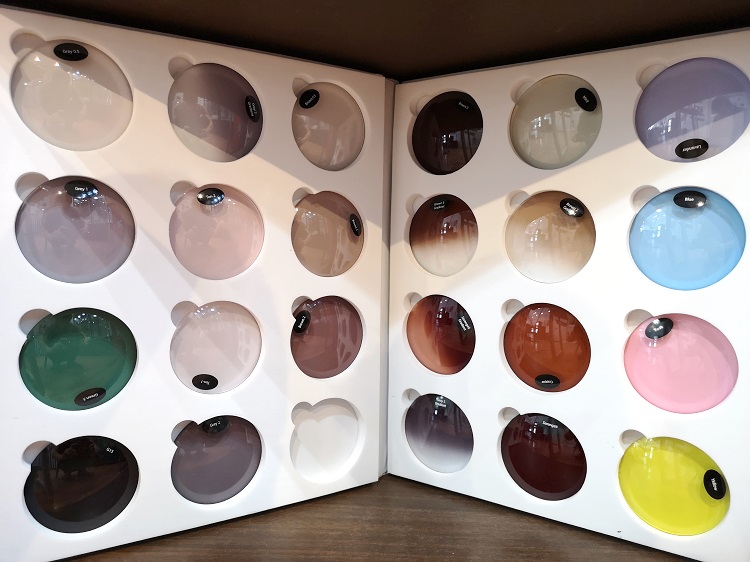
Collection of lens tints and gradients

Here is another image showing a collection of ready-made sunglasses. Can you can differentiate the full tints from the gradient tints in this one?
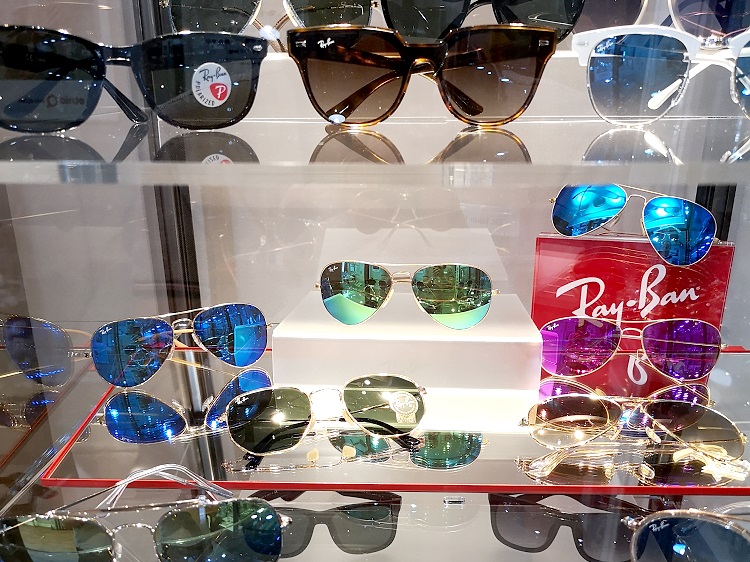
Display Case Showing a Collection of Ray-Ban Sunglasses

How Sunglasses Protect Your Eyes

Perhaps the top reason for wearing sunglasses is the fact that they protect your eyes from the harmful effects of UV light constantly being emanated from the Sun. There are 2 types of UV light which any standard pair of sunglasses must protect against. These are called UVA and UVB rays. Sunglasses must block at least 99% of these UVA and UVB in order to be labelled with UV400, which means they are safe to use.

It is important to understand that tinting lenses in itself does not provide any protection from UV light. In addition to tinting, lenses must be treated with special coatings or layers that block the UV light. In fact, if tinted lenses are worn without the UV blocking treatments, it is even more harmful to they eyes than not wearing sunglasses at all.

Also keep in mind that certain lens indexes like 1.6, 1.67, 1.74 provide 100% UV protection even without any special treatment.

Why Tinted Glasses That Don’t Block UV Light Are Dangerous

You might think that if sunglasses don’t block out UV light, then it’s no more dangerous then simply not wearing sunglasses at all, right? No, Wrong!

Here’s why:
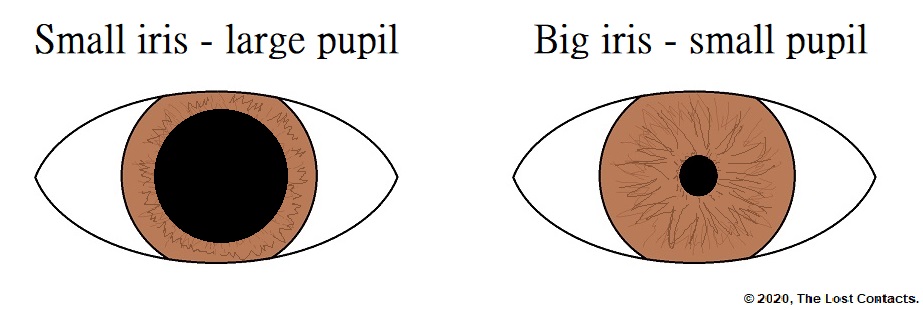
Diagram of large vs small pupil

  • We know that UV light from the sun entering the eyes causes damage.
  • Without sunglasses, when in bright sunlight, the pupils constrict which restricts the amount of UV light entering the eyes.
  • With sunglasses, because they make everything darker, the pupils dilate, allowing more UV light to enter the eyes.
  • Therefore, when sunglasses are worn, if they don’t block UV light, the eyes will be exposed to more UV light than if no sunglasses were worn at all.

What Are Photochromic Lenses?

Photochromic Lenses are lenses that remain clear in the absence of UV light, but darken in the presence of UV light. They are more commonly known by the industry leading company Transitions®.

When offering customers Transitions® lenses, it is important to realize that there are many different versions and variations. If the store where you work offers Transitions®, I would highly recommend becoming familiar with their portfolio of options.
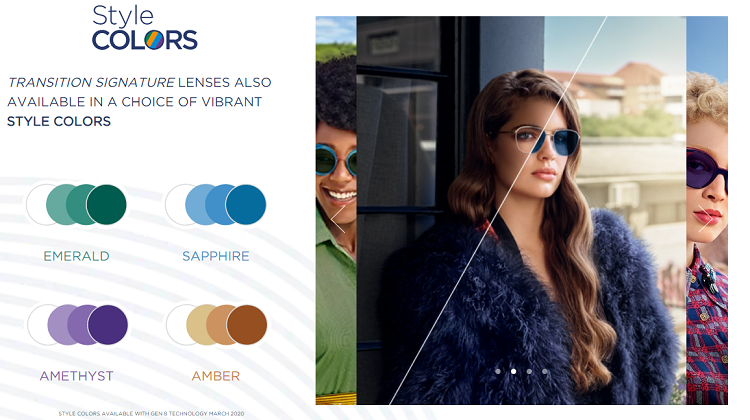
A few of the different colors available in Transitions lenses
A few of the different colors available in Transitions lenses.

Mirror Coatings

Mirror coatings can be applied to sunglasses to reflect light off of the lenses and to give them a unique look.
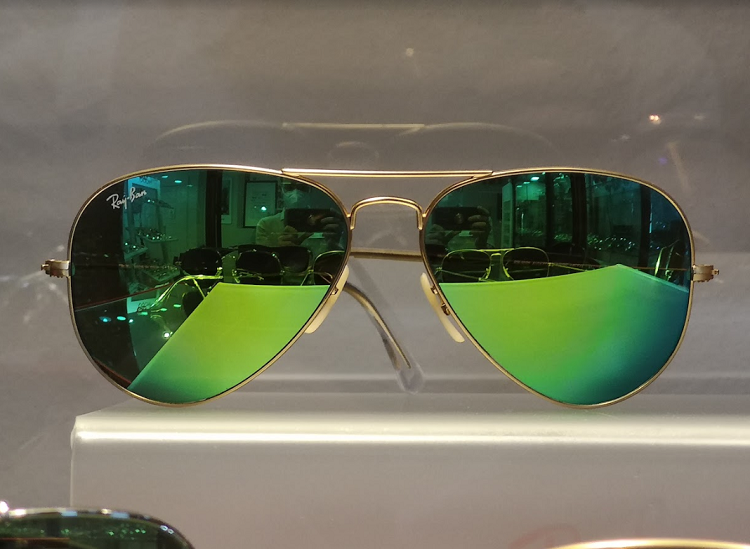
Ray-bans with green mirror lenses

Polarized Lenses

And last but not least, we come to polarized lenses. Polarized lenses offer a unique advantage over regularly tinted sunglasses. They not only reduce brightness and block 100% of UV, but they also filter out glare.

Regular sunglasses block a certain percentage of light from passing through them, darkening the overall vision. Polarized sunglasses darken the vision by selectively blocking out the light that causes glare thus making vision better and more comfortable.

Polarized sunglasses are extremely useful during activities where glare can be distracting and bothersome such as driving, biking, fishing, boating, skiing, etc.

Here is a type of promotional image often used to advertise the effect of polarized sunglasses.

Polarized Vs Non-Polarized

Unfortunately, these are always made in Photoshop and exaggerated. It gets the main point across but can make it seem too good to be true.

Here’s a more realistic look.

I recommend comparing regular sunglasses and polarized sunglasses back to back in an outdoor environment to get a feel for the differences yourself. That way you can better explain it your customers.

Summary

We have covered many different types of sunglasses in this article, all of which are important to be familiar with. So let’s recap.

  • Full tint
  • Gradient tint
  • Colored tints
  • Transitions
  • Mirror coatings
  • Polarized

Make sure you are able to explain the difference between all of these, and become familiar with which ones are offered at the store/office where you work.
Introduction to Lenses The Index - Featured

Introduction To Lenses – The Index

Hello and welcome to the first lesson of The Lost Contacts’ Introduction To Optical Dispensing course! Before tackling this course, please keep in mind that it is meant to build on the knowledge laid out in The Lost Contacts’ The Optics of Vision course. Please make sure you are familiar with the topics in that course before taking this one.

Today’s topic will be something known as a lens index. But let’s make sure we’re familiar with a few things first.

What is a Lens?

Basically, a lens is a clear (transparent) & curved material used for the purpose of refracting light.

Please review The Optics of Vision – Lesson 2: Introduction to Lenses for more information about what lenses are.

What is Refraction?

Refraction is what happens to light when it passes from one medium to another.

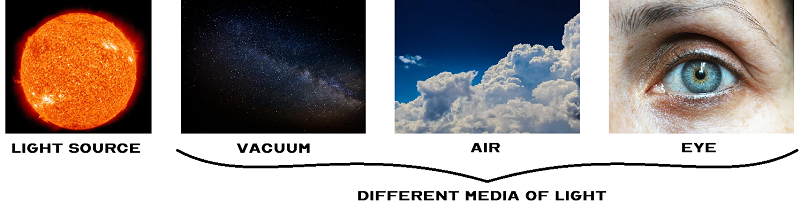
A medium in this context is anything that light can travel through. For example, the first medium for light produced by the sun is the vacuum of outer space.  Eventually it reaches Earth and then switches medium from space to Earth’s atmosphere (air). Then it switches medium again when it enters your eyes.

Different media of light

Other common examples of media that light can travel through are: water, glass & clear plastics.

Whenever light passes from one medium to another, the trajectory of the light changes. This change in trajectory is referred to as refraction. Lenses (usually plastic or glass) are a different medium than the air around them. So as light passes through lenses, it is refracted.

Generally speaking, the denser the medium is, the more it will change the trajectory of the light. Every medium has a different index of refraction, which is a number describes how much it changes the path of light.

The Index of Refraction

In this lesson, we will learn about one of the most important properties of a lens; the index of refraction.

Nowadays, lenses for glasses are made from plastic – not glass. But there isn’t just one plastic that’s used for all lenses. We have a lot of different plastics at our disposable when making a pair of glasses.

The reason for having so many types of plastics to make lenses is to take advantage of their different indices of refraction.

Let me explain.

As mentioned before, different media with different indices of refraction will alter the trajectory of light passing through them by varying amounts.

  • Plastic lenses that have a lower index of refraction will not bend light as much and therefore the focal point will be further away.
  • Plastic lenses that have a higher index of refraction will bend light more and therefore the focal point will be closer.

You may recall from The Optics of Vision – Lesson 3: Lens Power, that the curvature of lenses also affects where the focal point will be.

  • Plastic lenses that have a lower curvature will result in the focal point being further away.
  • Plastic lenses that have a higher curvature will result in the focal point being close.

This means that we now have 2 tools with which to adjust the position of the focal point; the curvature of lens and the index of refraction of the lens.

In the every day operations of an optical store, the index of refraction is simply referred to as ‘the index’.

Why Is The Index Important?

As you may already intuitively know, the more curved a lens is, the thicker it will be. That means that people with prescriptions for strong lenses will have thick lenses. But when it comes to lenses that we wear on our heads all day long, we don’t want those lenses to be too thick.

The solution is to increase the index. Doing this allows us to reduce the curvature (which reduces the thickness) without affecting the focal point of the lens.

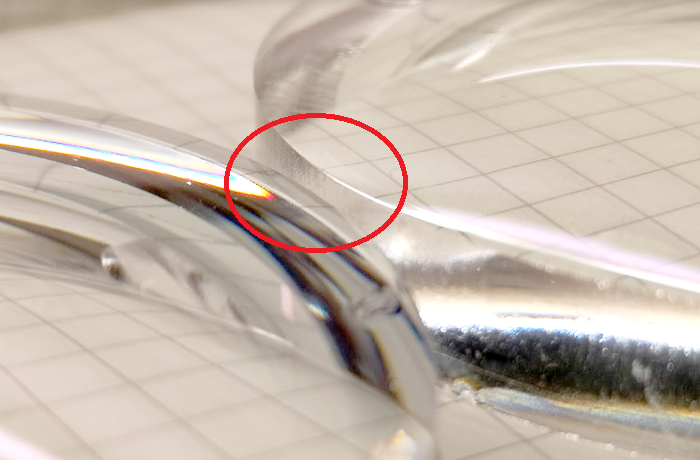
Here are two lenses of the same power side by side. Notice that one of them is significantly thicker than the other. This is because they are made from two different lens indices.

-4.00 normal versus high index lens
Notice the difference in edge thickness in the red circle.

Different Lens Indices


1.50 Index

  • Also known as CR-39.
  • 1.50 CR-39 is the ideal lens index for low prescriptions. It is the least expensive lens material, but also the thickest.
  • Recommended for prescriptions between +2.00 and -3.00
  • 1.50 CR-39 lenses block some but not all UV light.

Keep in mind that 1.5 is not very impact resistant and should not be sold to people who are prone to breaking their glasses/lenses.

Be careful when mounting 1.50 CR-39 lenses into certain frames as they are prone to chipping.


1.53 Index

  • Also known as Trivex.
  • 1.53 Trivex is a light-weight and highly impact resistant lens material. It is more expensive than 1.5 CR-39, but also a little thinner.
  • 1.53 Trivex blocks 100% of UV light.

1.59 Index

  • Also known as polycarbonate.
  • 1.59 polycarbonate is also light-weight and highly impact resistant. It is slightly thinner than 1.53 Trivex but also slightly heavier.
  • 1.59 polycarbonate blocks 100% of UV light.

1.53 Trivex and 1.59 polycarbonate have very similar uses. They are generally used for children’s glasses & safety glasses.


1.61 Index

  • 1.61 index lenses and above are considered to be ‘high index’ lenses. 1.61  index offers considerably thinner lenses than 1.50.
  • Recommended for prescriptions +2.50 to +4.50 and -3.00 to -5.00.
  • 1.61 index lenses block 100% of UV light.

1.67 Index

  • 1.67 index is similar to 1.61 index but used for even strong prescriptions.
  • Recommended for prescriptions +4.50 or higher and -5.50 or higher.
  • 1.67 index lenses block 100% of UV light.

1.74 Index

  • 1.74 is the thinnest and also most expensive lens material offered by most optical stores. The benefits of 1.74 are marginal as it does not make lenses considerably thinner than 1.67, but it does make them considerably more expensive.
  • It can be used instead of 1.67 if customers insist on the thinnest lenses possible.
  • 1.74 index lenses block 100% of UV light.

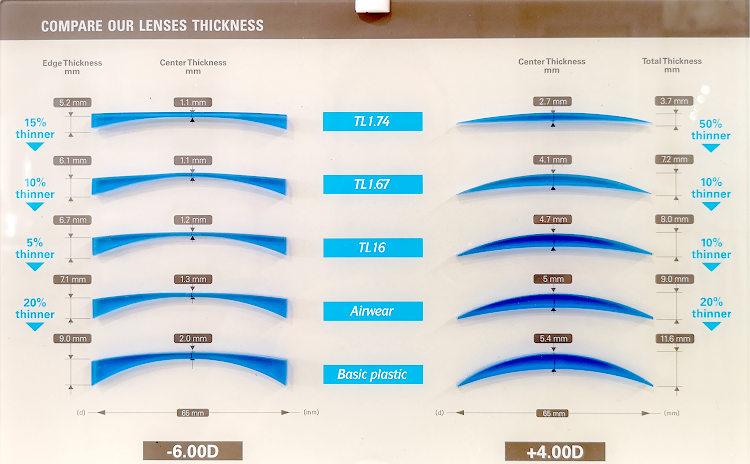
Here is a diagram showing the relative thicknesses of different lens indices.

Lens Index Comparisons
From bottom to top the lens indices shown above are 1.53, 1.59, 1.6, 1.67, 1.74

Clear Lenses Can Block 100% of UV light?

Yes, all lens indices except for 1.50 CR-39 block 100% of UV light and yet they are not tinted. This is something that most people aren’t aware of as we usually think of lenses that block UV light to be sunglasses (tinted lenses).

Despite the fact that clear lenses can block 100% of UV light, that does not mean that sunglasses aren’t necessary. Sunglasses are generally larger and hence offer more protection then regular glasses as well as increased visual comfort from reducing the overall brightness.

Remember to Look at the Cylinder

Recommended power rangers for different lens indices typically just show the ‘sphere’ power. But what if your customer has ‘sphere’ and ‘cylinder’ in his/her prescription?

FOR EXAMPLE

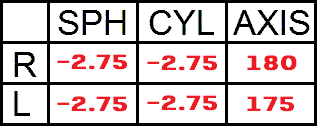
If this is your customer’s prescription:

example prescription of compound myopic astigmatism

You see a bunch of -2.75 everywhere so you might think that 1.50 index would work fine for this prescription. But this would be incorrect.

What a prescription with cylinder is really saying is that half of the lens contains the ‘sphere’ power only, and the other half has the ‘sphere’ + ‘cylinder’ power.

This means that the strongest portion of the lenses in this example prescription above would be -5.50 (-2.75 + -2.75).

Making these lenses with 1.50 index would result in half the lenses being very thick. Therefore, 1.67 index would be a more appropriate.

Remember to Look at the Add

The ‘add’ power is similar to the ‘cylinder’ power in that it get’s added to the ‘sphere’ power when making reading glasses.

FOR EXAMPLE

If this is your customer’s prescription:

example prescription of hyperopia and presbyopia

If you only look at the sphere or the add you might think that 1.50 index would be appropriate for this prescription. But that would be incorrect.

An ‘add’ is always added to the ‘sphere’ when making reading glasses.

This means that the strength of the reading glasses in this example would be +4.00 (+2.00 + +2.00).

Making these reading glasses with 1.50 index would result in glasses that are thick and heavy. Therefore, 1.61 index would be more appropriate.

The Index of Refraction of Other Materials

If you’re interested in learning what the index of refraction of other materials like air, water, glass, ice, diamonds, & more, click here.

Summary

When making glasses, we select the most appropriate lens index for the every prescription in order to maximize the satisfaction of the customer. Knowing the different lens indices and when to use them will make you a much better eye-wear consultant and optical associate.  Please take the time to memorize the different indices and be sure to keep a reference chart for each index’s prescription range somewhere in your store.

Next in this lesson series we will learn about something called the base curve.

==> CLICK HERE TO READ ‘INTRODUCTION TO LENSES – THE BASE CURVE’ <==