Introduction to Lenses The Index - Featured

Introduction To Lenses – The Index

Hello and welcome to the first lesson of The Lost Contacts’ Introduction To Optical Dispensing course! Before tackling this course, please keep in mind that it is meant to build on the knowledge laid out in The Lost Contacts’ The Optics of Vision course. Please make sure you are familiar with the topics in that course before taking this one.

Today’s topic will be something known as a lens index. But let’s make sure we’re familiar with a few things first.

What is a Lens?

Basically, a lens is a clear (transparent) & curved material used for the purpose of refracting light.

Please review The Optics of Vision – Lesson 2: Introduction to Lenses for more information about what lenses are.

What is Refraction?

Refraction is what happens to light when it passes from one medium to another.

A medium in this context is anything that light can travel through. For example, the first medium for light produced by the sun is the vacuum of outer space.  Eventually it reaches Earth and then switches medium from space to Earth’s atmosphere (air). Then it switches medium again when it enters your eyes.
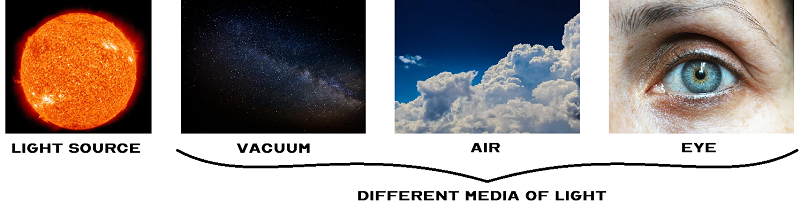
Different media of light

Other common examples of media that light can travel through are: water, glass & clear plastics.

Whenever light passes from one medium to another, the trajectory of the light changes. This change in trajectory is referred to as refraction. Lenses (usually plastic or glass) are a different medium than the air around them. So as light passes through lenses, it is refracted.

Generally speaking, the denser the medium is, the more it will change the trajectory of the light. Every medium has a different index of refraction, which is a number describes how much it changes the path of light.

The Index of Refraction

In this lesson, we will learn about one of the most important properties of a lens; the index of refraction.

Nowadays, lenses for glasses are made from plastic – not glass. But there isn’t just one plastic that’s used for all lenses. We have a lot of different plastics at our disposable when making a pair of glasses.

The reason for having so many types of plastics to make lenses is to take advantage of their different indices of refraction.

Let me explain.

As mentioned before, different media with different indices of refraction will alter the trajectory of light passing through them by varying amounts.

  • Plastic lenses that have a lower index of refraction will not bend light as much and therefore the focal point will be further away.
  • Plastic lenses that have a higher index of refraction will bend light more and therefore the focal point will be closer.

You may recall from The Optics of Vision – Lesson 3: Lens Power, that the curvature of lenses also affects where the focal point will be.

  • Plastic lenses that have a lower curvature will result in the focal point being further away.
  • Plastic lenses that have a higher curvature will result in the focal point being close.

This means that we now have 2 tools with which to adjust the position of the focal point; the curvature of lens and the index of refraction of the lens.

In the every day operations of an optical store, the index of refraction is simply referred to as ‘the index’.

Why Is The Index Important?

As you may already intuitively know, the more curved a lens is, the thicker it will be. That means that people with prescriptions for strong lenses will have thick lenses. But when it comes to lenses that we wear on our heads all day long, we don’t want those lenses to be too thick.

The solution is to increase the index. Doing this allows us to reduce the curvature (which reduces the thickness) without affecting the focal point of the lens.

Here are two lenses of the same power side by side. Notice that one of them is significantly thicker than the other. This is because they are made from two different lens indices.
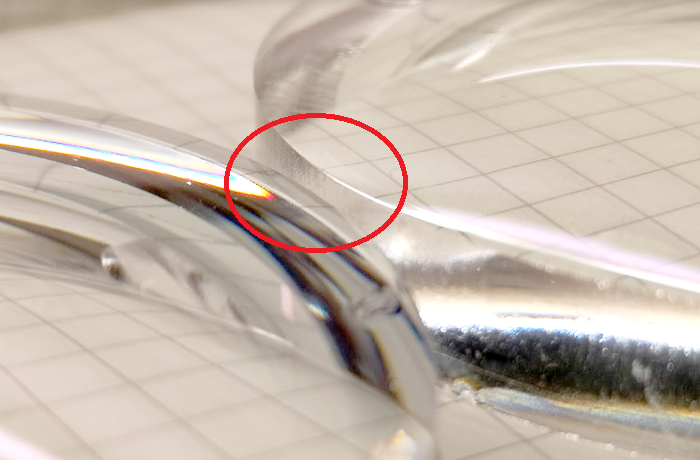
-4.00 normal versus high index lens
Notice the difference in edge thickness in the red circle.

Different Lens Indices


1.50 Index

  • Also known as CR-39.
  • 1.50 CR-39 is the ideal lens index for low prescriptions. It is the least expensive lens material, but also the thickest.
  • Recommended for prescriptions between +2.00 and -3.00
  • 1.50 CR-39 lenses block some but not all UV light.

Keep in mind that 1.5 is not very impact resistant and should not be sold to people who are prone to breaking their glasses/lenses.

Be careful when mounting 1.50 CR-39 lenses into certain frames as they are prone to chipping.


1.53 Index

  • Also known as Trivex.
  • 1.53 Trivex is a light-weight and highly impact resistant lens material. It is more expensive than 1.5 CR-39, but also a little thinner.
  • 1.53 Trivex blocks 100% of UV light.

1.59 Index

  • Also known as polycarbonate.
  • 1.59 polycarbonate is also light-weight and highly impact resistant. It is slightly thinner than 1.53 Trivex but also slightly heavier.
  • 1.59 polycarbonate blocks 100% of UV light.

1.53 Trivex and 1.59 polycarbonate have very similar uses. They are generally used for children’s glasses & safety glasses.


1.61 Index

  • 1.61 index lenses and above are considered to be ‘high index’ lenses. 1.61  index offers considerably thinner lenses than 1.50.
  • Recommended for prescriptions +2.50 to +4.50 and -3.00 to -5.00.
  • 1.61 index lenses block 100% of UV light.

1.67 Index

  • 1.67 index is similar to 1.61 index but used for even strong prescriptions.
  • Recommended for prescriptions +4.50 or higher and -5.50 or higher.
  • 1.67 index lenses block 100% of UV light.

1.74 Index

  • 1.74 is the thinnest and also most expensive lens material offered by most optical stores. The benefits of 1.74 are marginal as it does not make lenses considerably thinner than 1.67, but it does make them considerably more expensive.
  • It can be used instead of 1.67 if customers insist on the thinnest lenses possible.
  • 1.74 index lenses block 100% of UV light.

Here is a diagram showing the relative thicknesses of different lens indices.
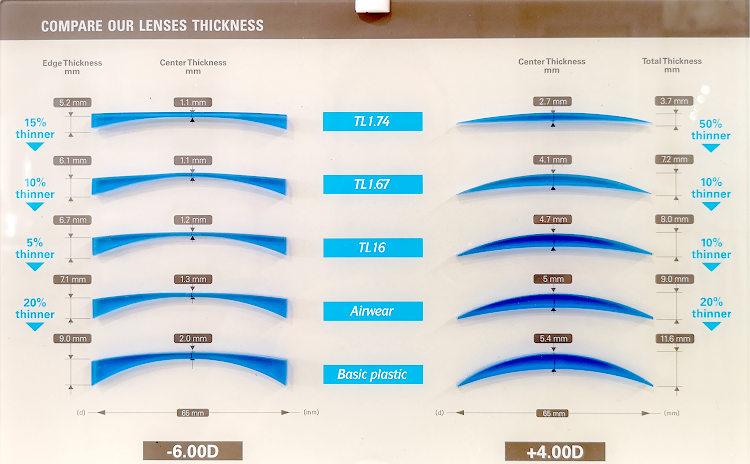
Lens Index Comparisons
From bottom to top the lens indices shown above are 1.53, 1.59, 1.6, 1.67, 1.74

Clear Lenses Can Block 100% of UV light?

Yes, all lens indices except for 1.50 CR-39 block 100% of UV light and yet they are not tinted. This is something that most people aren’t aware of as we usually think of lenses that block UV light to be sunglasses (tinted lenses).

Despite the fact that clear lenses can block 100% of UV light, that does not mean that sunglasses aren’t necessary. Sunglasses are generally larger and hence offer more protection then regular glasses as well as increased visual comfort from reducing the overall brightness.

Remember to Look at the Cylinder

Recommended power rangers for different lens indices typically just show the ‘sphere’ power. But what if your customer has ‘sphere’ and ‘cylinder’ in his/her prescription?

FOR EXAMPLE

If this is your customer’s prescription:
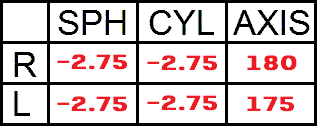
example prescription of compound myopic astigmatism

You see a bunch of -2.75 everywhere so you might think that 1.50 index would work fine for this prescription. But this would be incorrect.

What a prescription with cylinder is really saying is that half of the lens contains the ‘sphere’ power only, and the other half has the ‘sphere’ + ‘cylinder’ power.

This means that the strongest portion of the lenses in this example prescription above would be -5.50 (-2.75 + -2.75).

Making these lenses with 1.50 index would result in half the lenses being very thick. Therefore, 1.67 index would be a more appropriate.

Remember to Look at the Add

The ‘add’ power is similar to the ‘cylinder’ power in that it get’s added to the ‘sphere’ power when making reading glasses.

FOR EXAMPLE

If this is your customer’s prescription:

example prescription of hyperopia and presbyopia

If you only look at the sphere or the add you might think that 1.50 index would be appropriate for this prescription. But that would be incorrect.

An ‘add’ is always added to the ‘sphere’ when making reading glasses.

This means that the strength of the reading glasses in this example would be +4.00 (+2.00 + +2.00).

Making these reading glasses with 1.50 index would result in glasses that are thick and heavy. Therefore, 1.61 index would be more appropriate.

The Index of Refraction of Other Materials

If you’re interested in learning what the index of refraction of other materials like air, water, glass, ice, diamonds, & more, click here.

Summary

When making glasses, we select the most appropriate lens index for the every prescription in order to maximize the satisfaction of the customer. Knowing the different lens indices and when to use them will make you a much better eye-wear consultant and optical associate.  Please take the time to memorize the different indices and be sure to keep a reference chart for each index’s prescription range somewhere in your store.

Next in this lesson series we will learn about something called the base curve.
==> CLICK HERE TO READ ‘INTRODUCTION TO LENSES – THE BASE CURVE’ <==

Ordering Trial Contact Lenses - Featured

Ordering Your Patient’s Free Contact Lens Trial Pair

This is the 5th installment of my Fitting Contact Lenses Course. So far we’ve learned:

The next step is to get your patient a free trial contact lenses so that you can assess their fit and performance.

This lesson is going to be centered around ordering your patient/client’s first pair of free contact lens trials. I wrote it assuming your don’t have trial fitting sets in your office and have to order your trial lenses from the companies. If you do have the fitting sets, you can just get your trials from there (assuming they are well maintained).

Working With What’s Available

At this point, you’ve successfully converted your patient/client’s glasses prescription to contact lenses and you know what contact lens trial pair you want to order. However, the exact numbers that you calculated in your conversion is not always available for you to order. To avoid problems and unnecessary delays, it’s important to order contact lens trials that are actually available.

Limitations in Sphere Power

+6.00 to -6.00

If the sphere number you want for your patient’s contact lens trails is between +6.00 and -6.00, you shouldn’t have any problems finding what you are looking for. Contact lenses generally come in 0.25 steps in that range.

Dailies TOTAL1 trial contact lenses
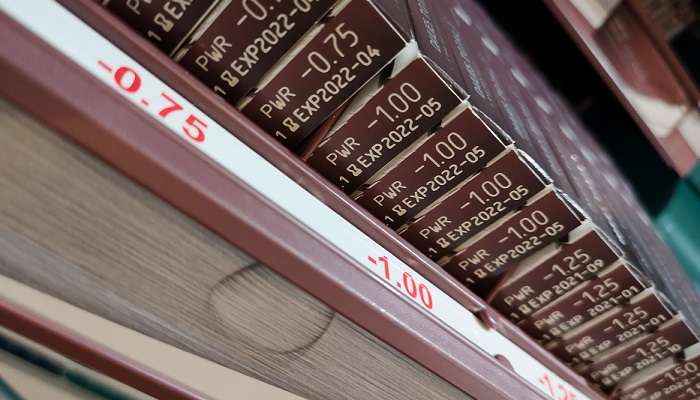
A Dailies TOTAL1 fitting set showing sphere power increasing in 0.25D increments.

The problem you may come across in this range is when your glasses to contact lens conversion gives you a sphere power that ends in an eighth diopter step, i.e., .12, .37, .62 & .87. You will have no choice but to choose from one of the two nearest quarter diopter step, i.e., .00, .25, .50 & .75.

If this happens, you can use your professional judgement to choose the one you think would work best for you patient. However, if there’s some uncertainty you can always order and try them both.

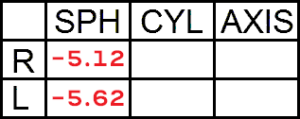
For example, if your glasses to contact lens conversion is:

Example Eighth Diopter Glasses Prescription

Since neither of those sphere powers are available in contact lenses, a safe bet would be to order -5.00 and -5.25 for the right eye, and -5.50 and -5.75 for the left eye.

Over +/-6.00

If you need a contact lens trail with a power that is higher than +6.00 or -6.00, you will be more limited. Outside of the +/-6.00 range, most contact lens brands become available only in steps of 0.50, i.e., -6.00, -6.50, -7.00, -7.50, -8.00 etc.

So if you’re looking for trail contact lenses with a sphere power ending in .25 or .75, what do you do? Well, at this point you should be expecting to have to try 2 or 3 different combinations of powers before you find the one the works best for your patient. The best thing to do would be to order the contact lens trials in both powers that bracket what you calculated in your conversion.

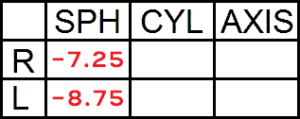
For example, if your glasses to contact lenses conversion is:

Example Converted Glasses Prescription

Since neither of the those sphere powers are available in typical (non-extended range) contact lens brands, a safe bet would be to order -7.00 and -7.50 for the right eye, and -8.50 and -9.00 for the left eye.

Start by having the patient try on the lower power and see if holding a -0.50 trial lens over the eye makes a significant difference in the vision. If it does, you’ll be happy that you ordered the stronger power.

It’s A Trial & Error Process

Keep in mind that it may still be possible that despite this, your patient will be need something that’s even lower or higher that what you have ordered. There are many factors that influence this such as specific contact lens designs, patient age, patient visual demands, etc.

Additionally, it is important to keep in mind that whatever sphere power ends up working best for any given brand does not necessarily translate to other brands. Every time you try a different brand, it is advisable to re-test the vision and perform a contact lens over-refraction to find the best sphere power for each brand you try.

Limitations in Cylinder Power

What’s Available

Cylinder power is perhaps the most limited parameter in contact lenses. There are 3 cylinder powers that every contact lens for astigmatism have. They are:

  • -0.75
  • -1.25
  • -1.75

Many brands also have:

  • -2.25

A few brands have:

  • -2.75

As you can see, the cylinder powers in contact lenses are quite limited and only appear in 0.50 diopter steps. This is due to manufacturing limitations as well as the fact that when the cylinder is only slightly off, it doesn’t affect the vision all that much.

Clariti 1 day toric trial contact lenses
A clariti-1day toric fitting set showing -0.75, -1.25 and -1.75 cylinder options.

To Round Up Or Down?

If you need a cylinder power that isn’t available, should you pick the closest lower one or the closest higher one? In this situation it’s typical to round down to the nearest available cylinder power. People who wear contact lenses for astigmatism do best when they have the lowest possible cylinder power that still allows them to see 20/20.

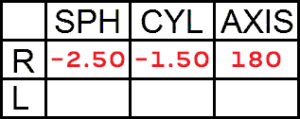
For example, if your glasses to contact lenses conversion is:

Example Glasses to Contact Lenses Prescription

The right eye’s contact lens cylinder power should be -1.50 but due to restricted availability we have to pick between -1.25 and -1.75. It is quite possible that the patient would be able to see perfectly and equally well with either one. If that is the case, it would be best to opt for the lower cylinder of -1.25.

It’s also possible that when you convert a glasses prescription to contact lenses, the cylinder ends in a eighth diopter step. When this happens, simply choose the nearest available cylinder (a cylinder ending in an eighth diopter step never falls squarely between two available cylinders.

For example, if your glasses to contact lens conversion is:

Example Eighth Diopter Cylinder Prescription

For the right eye: -1.62 falls between -1.25 and -1.75 but it much close to -1.75.

For the left eye: -1.37 falls between -1.25 and -1.75 but it much close to -1.25.

Limitations in Axis

Excluding extended range and specialty contact lens brands, contact lenses for astigmatism are available in axes of steps of 10.

Bauch Lomb ULTRA for astigmatism trial contact lenses
A Bausch + Lomb ULTRA for Astigmatism fitting set showing axis increments of 10 degrees.

When you convert a glasses prescription to contact lenses, the axis does not change. This means that you could end up with an axis that’s any number between from 1 – 180.

When picking the contact lens free trial for your patient, what you have to do is choose the axis that is the closest to the glasses axis.

Of course, you’re going to encounter many prescriptions where the axis ends in a 5. When this is the case, I tend to order both axes that straddle the glasses axis so that I don’t have to wait on another delivery if that one I ordered wasn’t the right one.

Assessing The Vision/Examining The Fit

Once you’ve ordered all the contact lens trials you think you’ll need for your patient, the next step is to have the patient try them on assess their performance. This is where you’ll make the decision as to whether what you’ve ordered is adequate, or if you have to make adjustments.

This is what I discuss in the next installment of my Fitting Contact Lenses Course.

Convert a Glasses Prescription to Contact Lenses Astigmatism - featured

How To Convert A Glasses Prescription To Contact Lenses: Astigmatism

In the previous lesson: “How To Convert A Glasses Prescription to Contact Lenses“, I covered only situations that did not involve any astigmatism correction. In this lesson, I will only be discussing how to convert a glasses prescription to contact lenses when there is astigmatism to deal with.

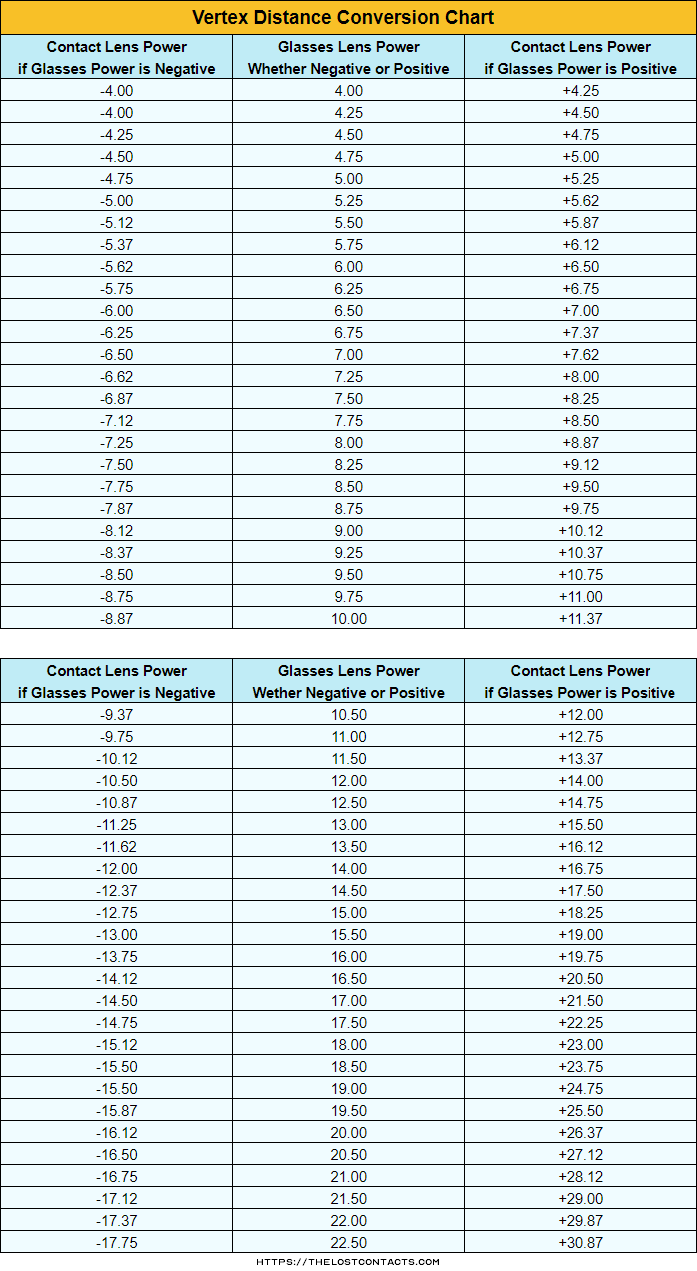
Before I get into it I just want to say that some of this may appear to be difficult. Sure, it does take a little longer, but it’s literally nothing more than a little bit of addition, subtraction, as well as looking up numbers on our vertex distance conversion chart.

Here it is again for you to reference throughout this lesson.

Vertex Distance Conversion Chart
*Note that this chart is based on a 14mm vertex distance.

Now let’s get right into it. Everything is done one eye at a time so complete steps 1- 5 for the right eye and then again for the left eye.

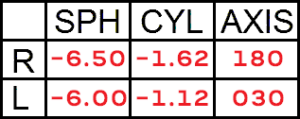
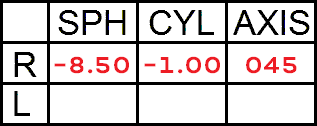
Here is the glasses prescription we will be working with:

Example Glasses Prescription For Power Cross

Step 1: Draw 180° and 90° Reference Lines

The power cross is the main tool used in visualizing and organizing the calculations involved in this conversion process.

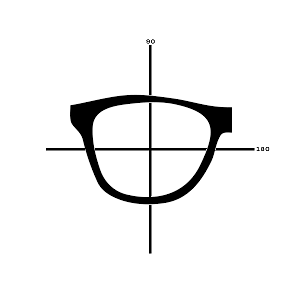
Here we will draw two reference lines 180° and 90°.

The Blank Power Cross

Think of this cross as overlaying the lens of the glasses prescription you’re working with, like this:

The Blank Power Cross over glasses frame

Step 2: Add The Sphere Power Line

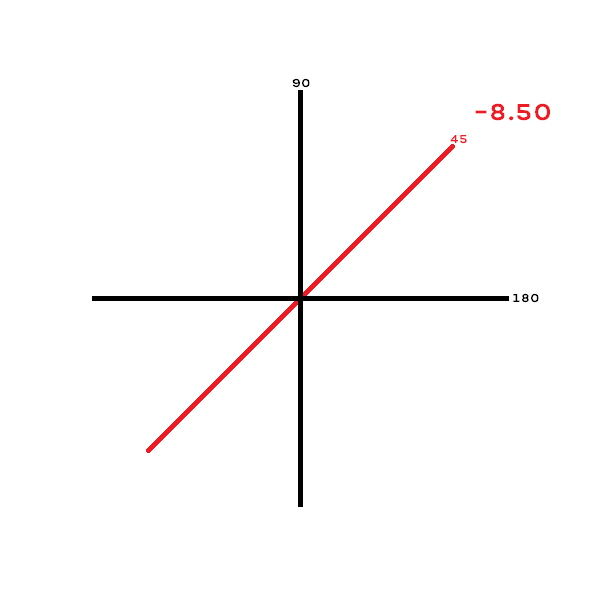
Look at the glasses prescription that you’re working with and locate the ‘Axis’ number. This number represents a degree value and will be somewhere between 1 and 180. Now draw a line in the direction of the Axis .

In our example prescription, that’s 45. That means that a line at 45° must be drawn on the power cross. This is the Sphere Power Line. It represents the sphere power so write it down next to that line.

The Blank Power Cross Sphere

Step 3: Add The Sphere+Cylinder Power Line

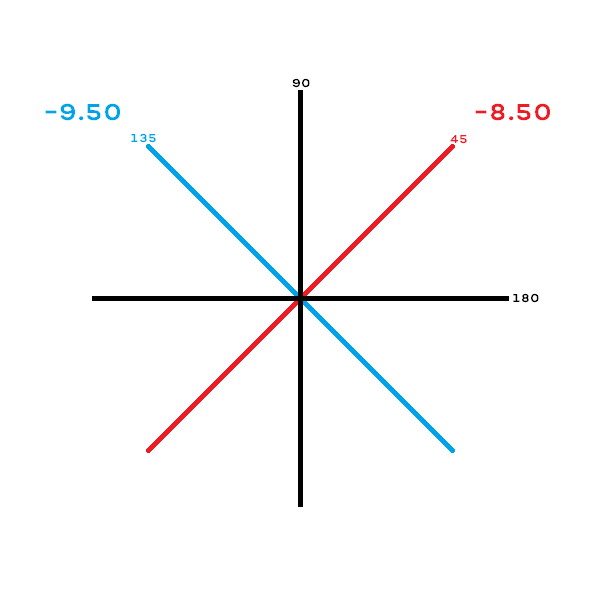
Next add 90 to the axis number and draw another line in that direction. For the example prescription above that would be 90 + 45 = 135.

This new line is the Sphere+Cylinder Line.

Now, as the name implies, to find the power of this line we must add the sphere and cylinder together.

For the example prescription above that would be -8.50 + (-1.00) = -9.50.

The Blank Power Cross Sphere and Cylinder

This the completed power cross.

Step 4: Covert The Powers

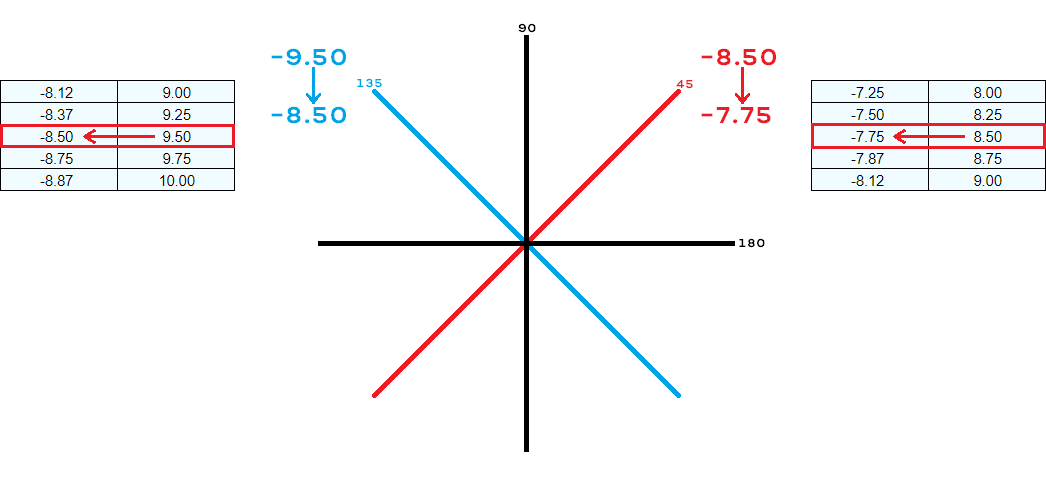
This is the step where we actually convert the glasses prescription to contact lenses. Now that we’ve laid out both the sphere and the sphere+cylinder powers, use the vertex distance conversion chart above to convert them and write those down as well.

The Blank Power Cross Sphere and Cylinder Converted

Step 5: Returning To Prescription Format

At this point, the glasses prescription is converted to contact lenses, but it’s not in the correct Sphere/Cylinder/Axis format. To return to the correct format, follow these 3 rules:

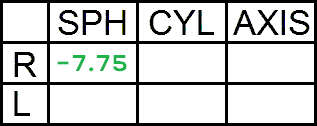
    1. The converted sphere power becomes the contact lens sphere power.
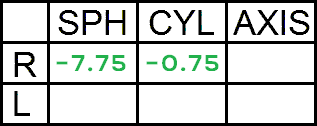
      Example Converted Glasses Prescription Sphere Only 775
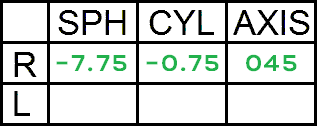
    2. The converted sphere+cylinder number minus the converted sphere number becomes the contact lens cylinder power.

      -8.50 – (-7.75) = -0.75

      Example Converted Glasses Prescription Sphere and Cylinder 775

    3. The original glasses axis becomes the contact lens axis (it doesn’t change)Example Converted Glasses Prescription 775

And that’s it!

You’ve done it! Not bad right?


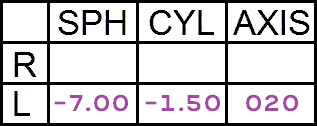
Let’s work through the left eye together.

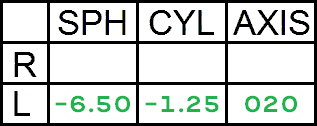
Example Left Eye Glasses Prescription


Step 1: Draw 180° and 90° Reference Lines

The Blank Power Cross

Step 2: Add The Sphere Power Line

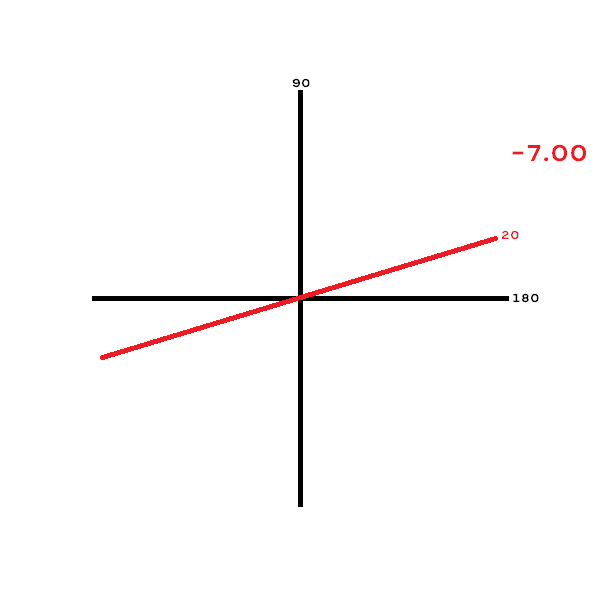
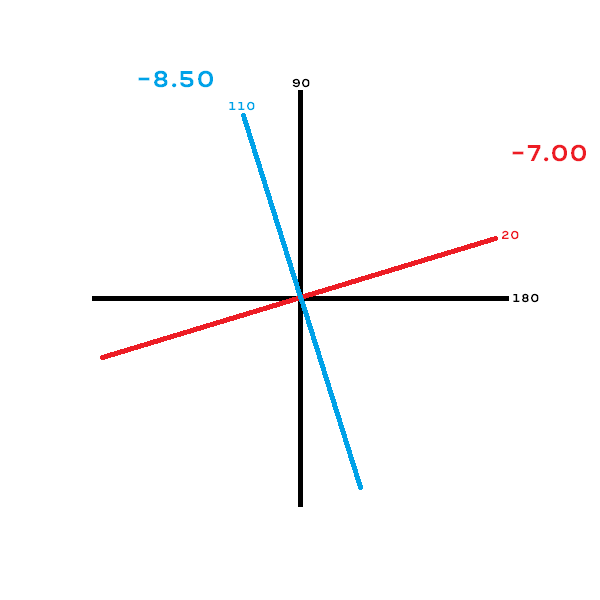
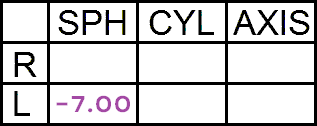
This time the axis is 020 so the sphere power line must be drawn at 20°. The sphere power is -7.00 so that will go next to the sphere power line.

Power Cross To Convert a Glasses Prescription To Contact Lenses

Step 3: Add The Sphere+Cylinder Power Line

Next, add 90 to the axis on the prescription. In this case it’s 90 + 20 = 110, so the sphere+cylinder power line must be drawn at 110°.

The sphere+cylinder power for this prescription is -7.00 + (-1.50) = -8.50, so that will go next to the sphere+cylinder line.

Power Cross To Convert a Glasses Prescription To Contact Lenses

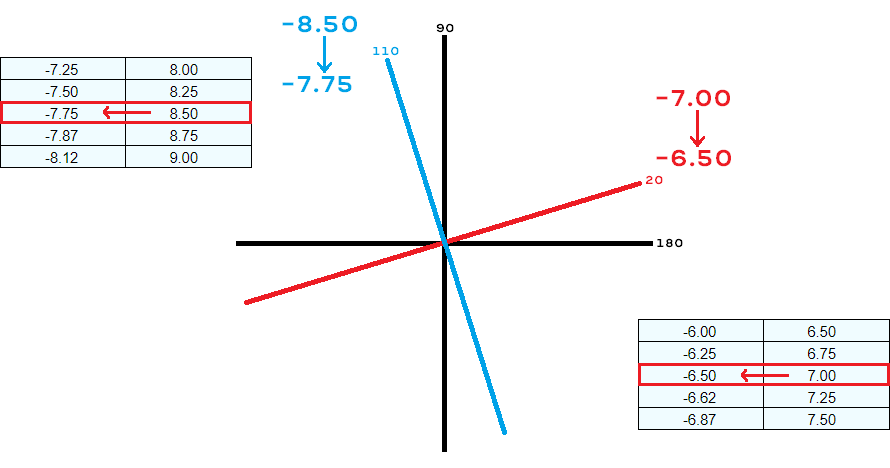
Step 4: Covert The Powers

The vertex distance conversion chart is now used to convert both the sphere power and the sphere+cylinder power. The converted powers are written down to help with the next step.

Power Cross To Convert a Glasses Prescription To Contact Lenses

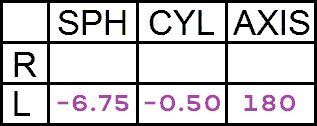
Step 5: Returning To Prescription Format

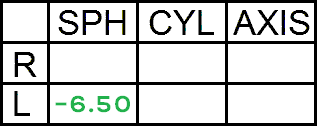
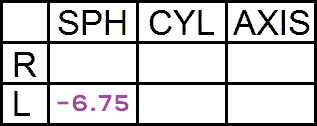
  1. The converted sphere power becomes the contact lens sphere power.
    How To Convert A Glasses Prescription To Contact Lenses Example
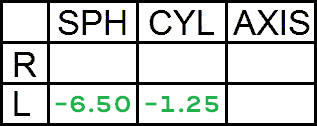
  2. The converted sphere power minus the converted sphere+cylinder power becomes the contact lens cylinder power.

    -7.75 – (-6.50) = -1.25

    How To Convert A Glasses Prescription To Contact Lenses Example

  3. The original glasses axis becomes the contact lens axis (it doesn’t change).
    How To Convert A Glasses Prescription To Contact Lenses Example

And that’s how to convert a glasses prescription to contact lenses!

Important Shortcuts

Despite the simplicity of converting a glasses prescription with astigmatism to contact lenses using the 5 step process outlined above, it’s not always necessary. There are some shortcuts that can save a lot of time in a real-world practice setting.

When The Glasses Cylinder is -0.25

If the cylinder on the glasses prescription that is being converted to contact lenses is -0.25, there is no need to go through the 5-step power cross procedure. In fact, most of the time there is no need to do anything at all.

With a cylinder of -0.25, after the conversion process the cylinder will either stay -0.25 or become even less. Since there are absolutely no contact lens company that offer a contact lens for astigmatism with a cylinder correction of -0.25, it is a pointless exercise to convert.

Instead, the most common solution is to ignore it altogether. Simply, the cylinder and axis are removed from the contact lens prescription and only the glasses sphere is converted according to these guidelines.

When The Glasses Cylinder is -0.50

This is perhaps the trickiest situation. Contact lenses are not available in cylinder power of -0.50, yet, a cylinder power of -0.50 is significant enough that it can’t just be ignored. So what is the solution?

The -0.50 cylinder & axis are still dropped from the contact lens prescription, however, to compensate for it, and additional -0.25 is added to the glasses sphere. That is, you do not have to use the power cross method. Simply:

  1. Remove the -0.50 cylinder & axis.
  2. Add -0.25 to the glasses sphere.
  3. Convert the new glasses sphere using a vertex distance conversion chart.

*Side note, this is called taking the spherical equivalent of a prescription.

Here’s an example:

Example Glasses Prescription with 050 Cylinder

      1. Remove the -0.50 cylinder & axis.
        Example Glasses Prescription Cylinder dropped
      2. Add -0.25 to the glasses sphere.
        Example Glasses Prescription Sphere Adjusted
      3. Convert the new glasses sphere using a vertex distance conversion chart.
        Example Glasses Prescription Converted To Contact Lenses With Conversion Chart

And there you have it. You now have all the tools and knowledge necessary to convert any glasses prescription to contact lenses. But are you now ready to start prescribing contact lenses? Not quite yet! Actually, at this point we’re still in the very early stages of the contact lens fitting.

Next Steps

You know how to convert a glasses prescription to contact lenses, even if it has astigmatism, but what if contact lenses aren’t available in the numbers that you calculated?

Have you noticed that many of the conversions on the vertex distance conversion chart end in weird numbers like 0.12, 0.37, 0.62, & 0.87? Have you noticed that only certain cylinder powers and axis are available for contact lenses?

If the conversion you calculated doesn’t match what is available in contact lenses, there will be additional adjustments needed in order for trials to be ordered for the patient/client. And that’s what we’re going to learn about next!

If you have any questions about the process laid out in this article, please let me know in the comments and I’ll help you through it.