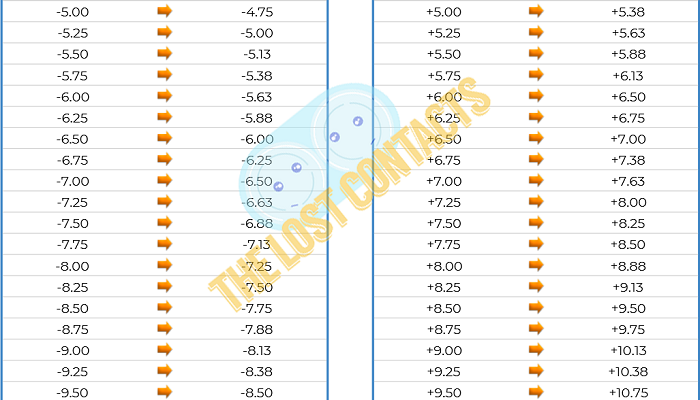
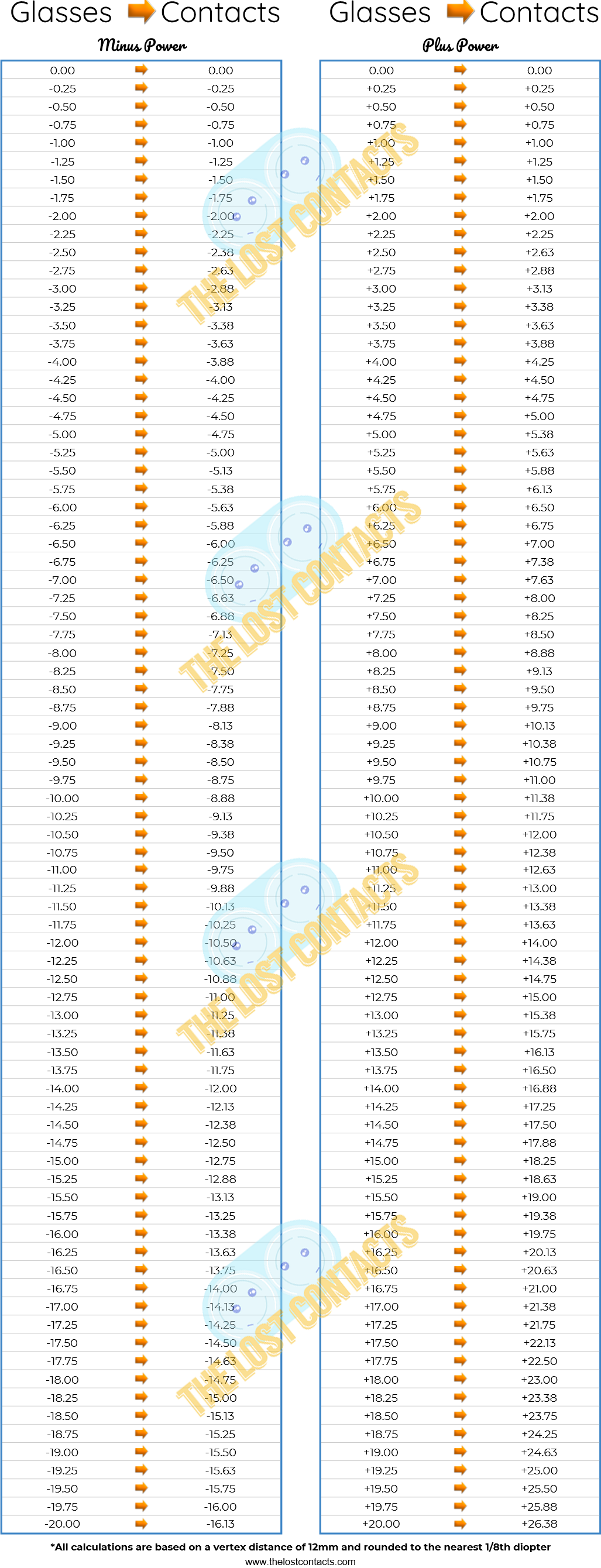
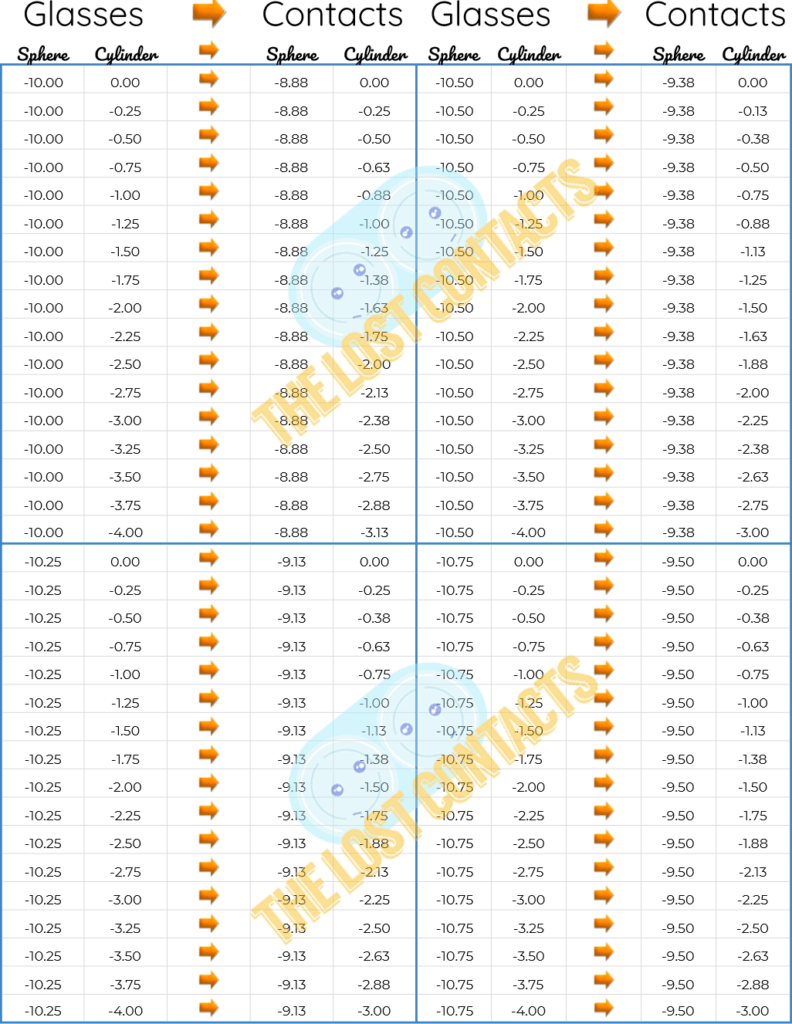
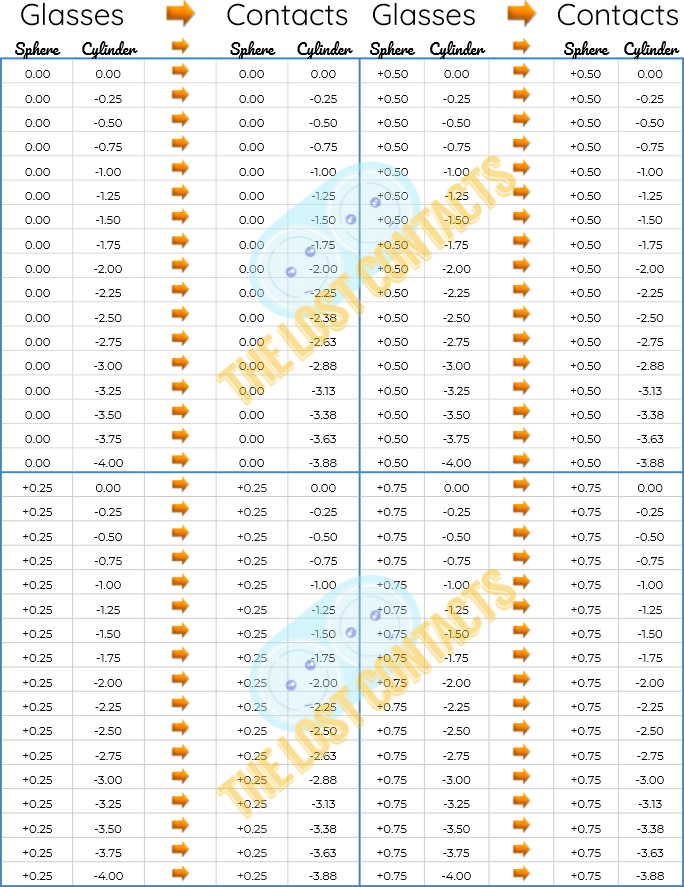
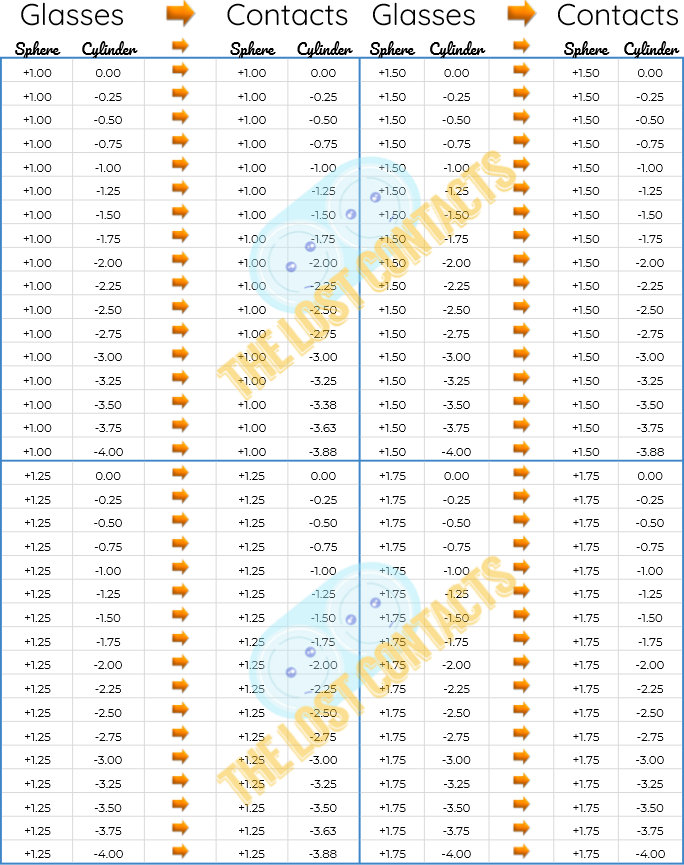
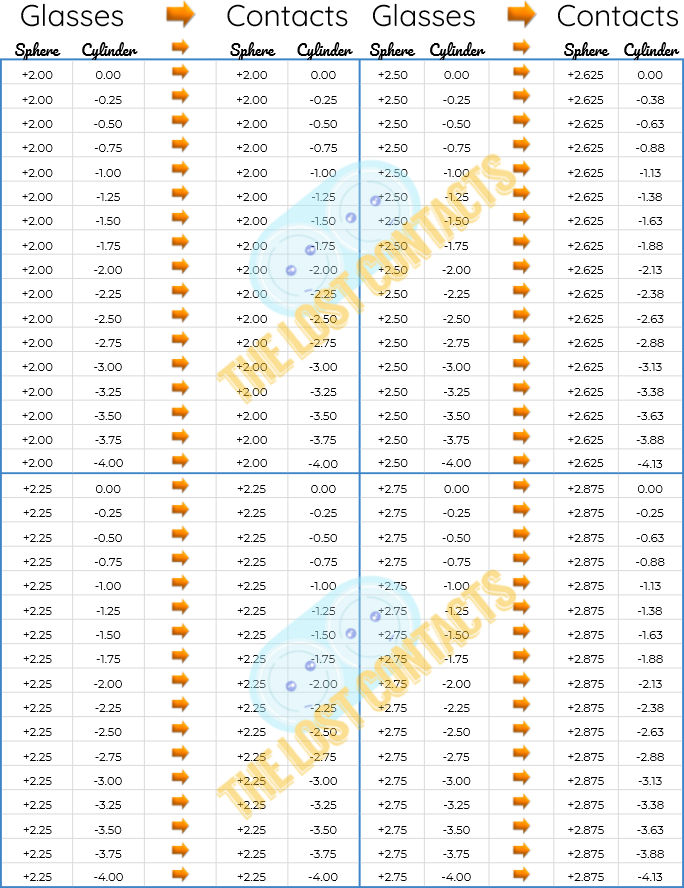
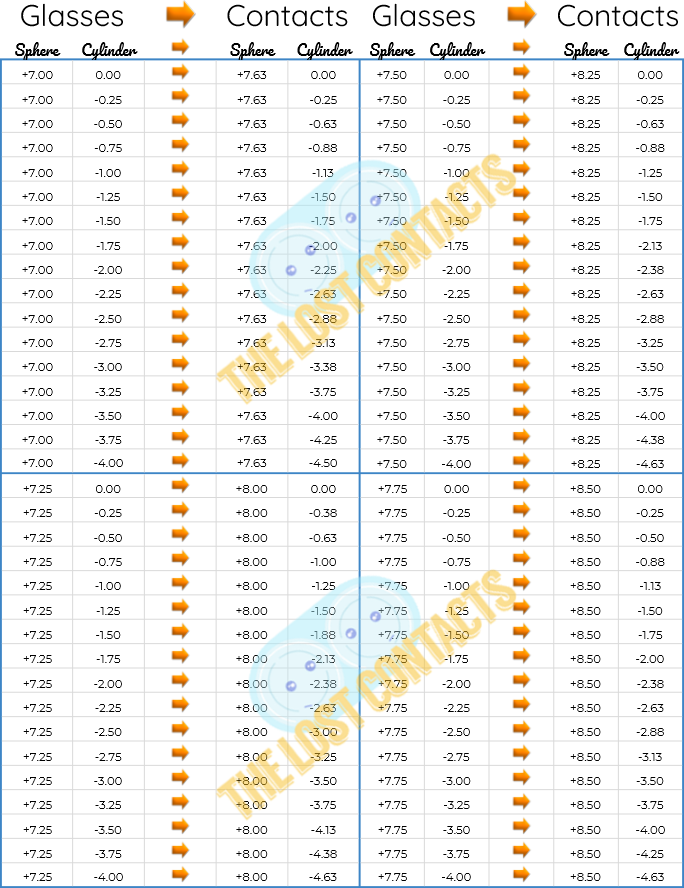
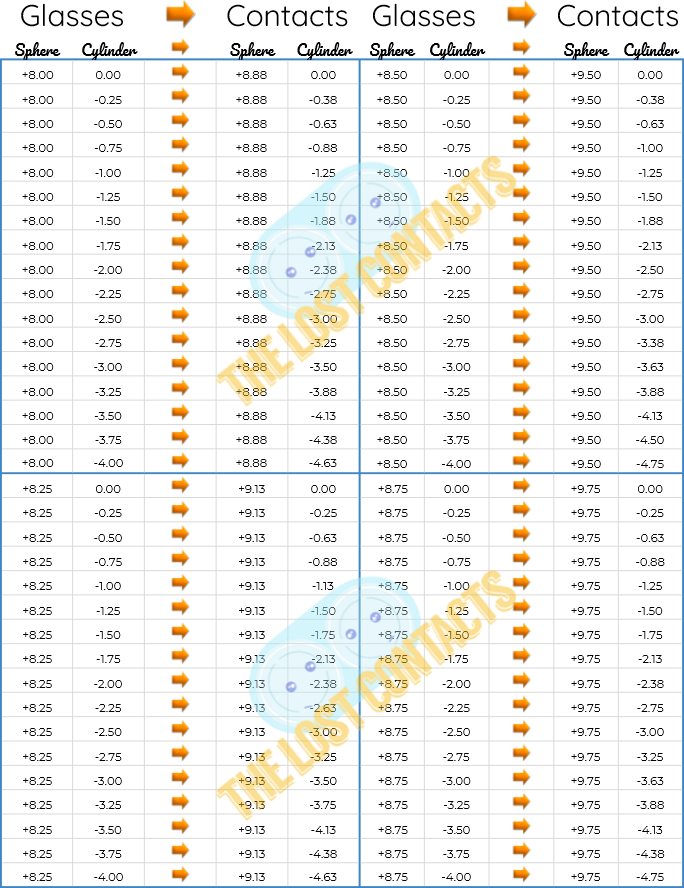
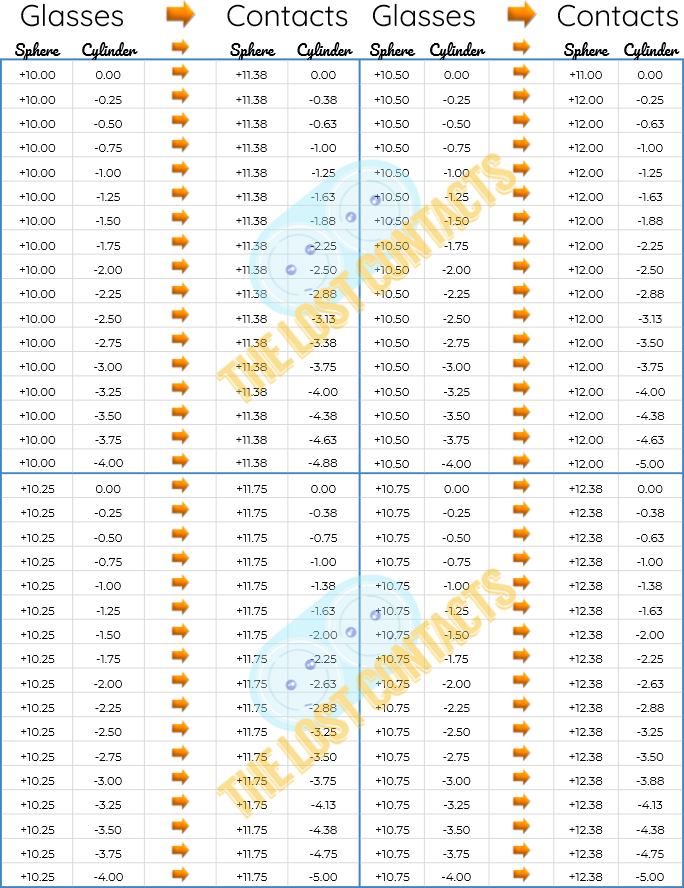
If you’re looking for a vertex distance conversion charts, you’ve found the motherload. Here you will find vertex distance conversion charts for single powers (i.e Sphere power only), as well as for astigmatism (Sphere + Cylinder combinations).
Lets start your typical Sphere Power Only Vertex Distance Conversion Chart.
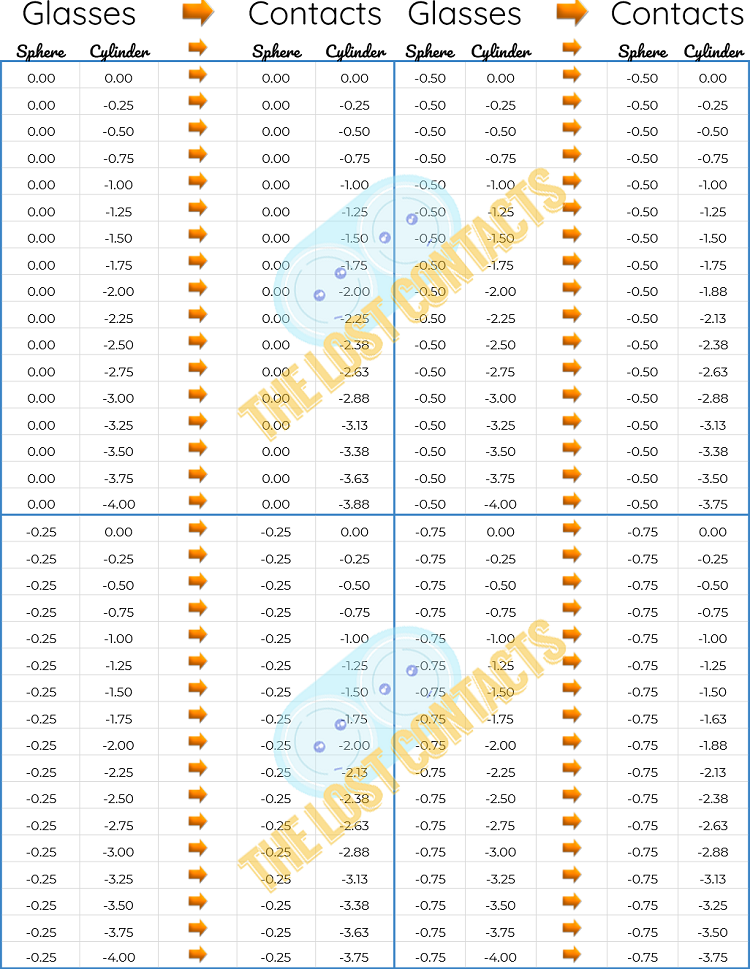
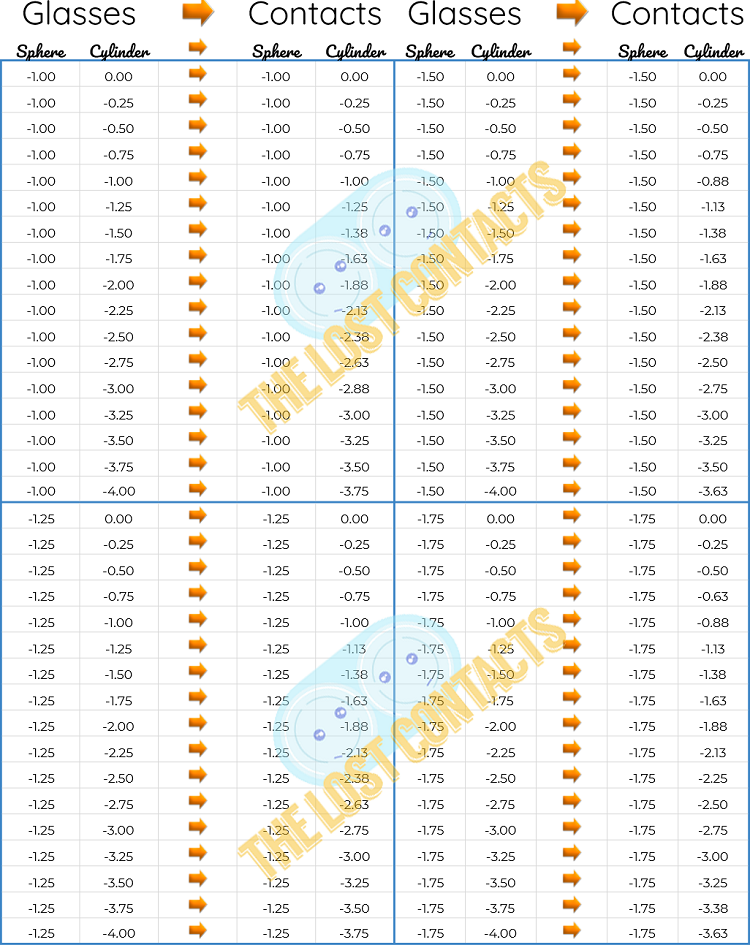
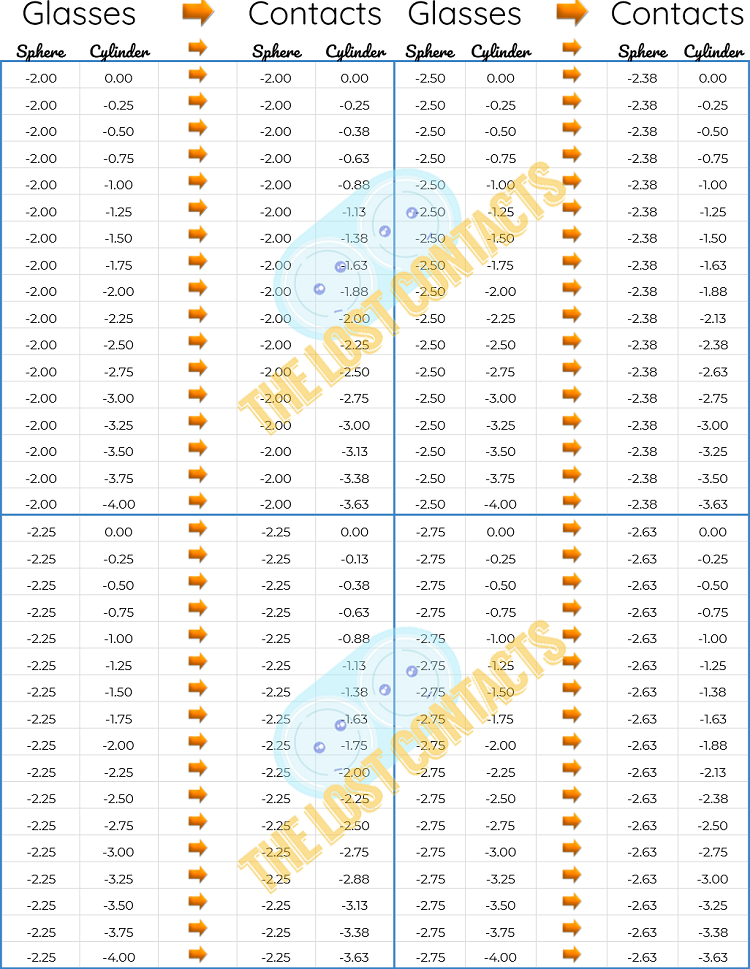
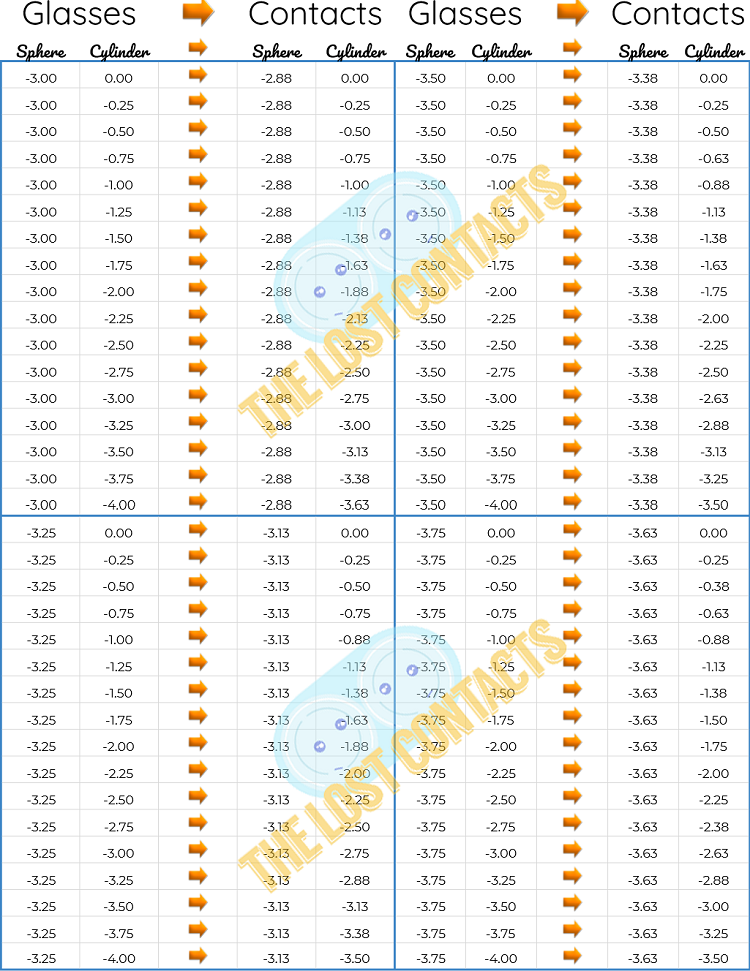
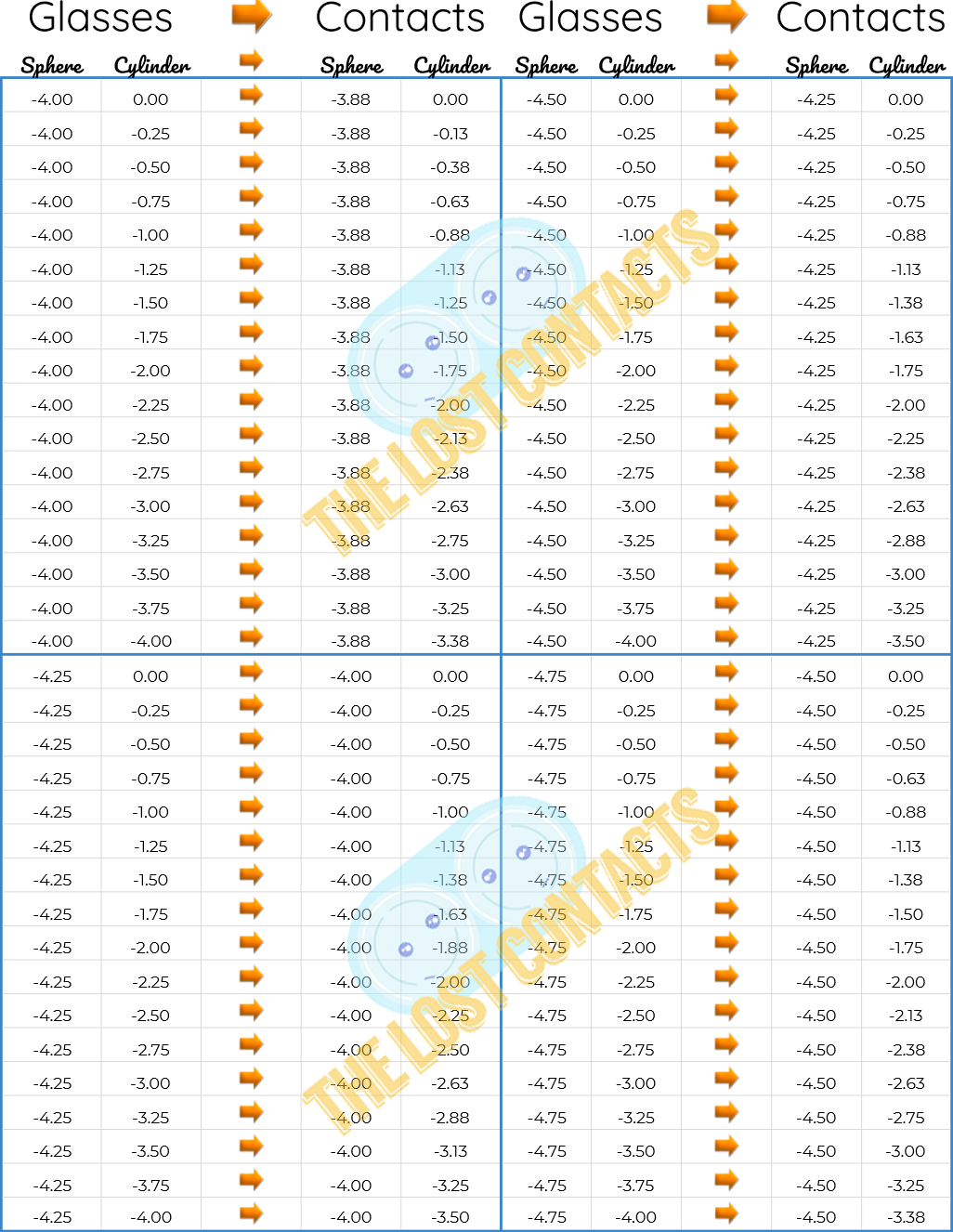
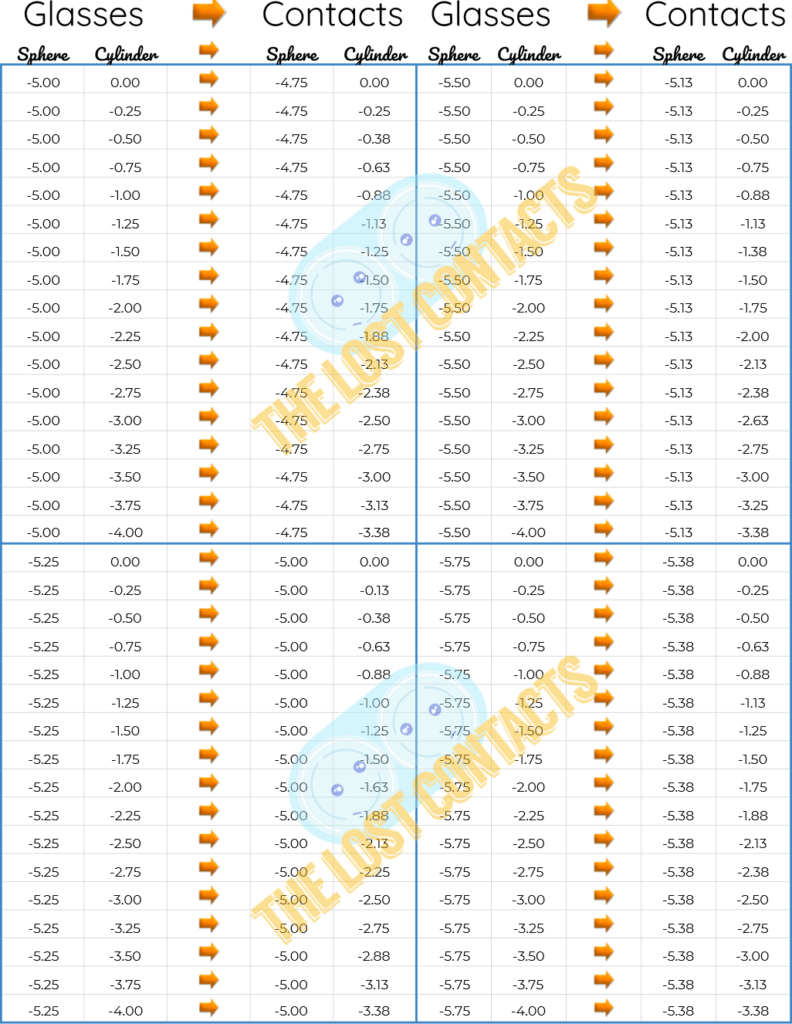
If you are looking you convert a combination of Sphere and Cylinder powers, you will need to reference the following Vertex Distance Conversion Chart for Astigmatism.
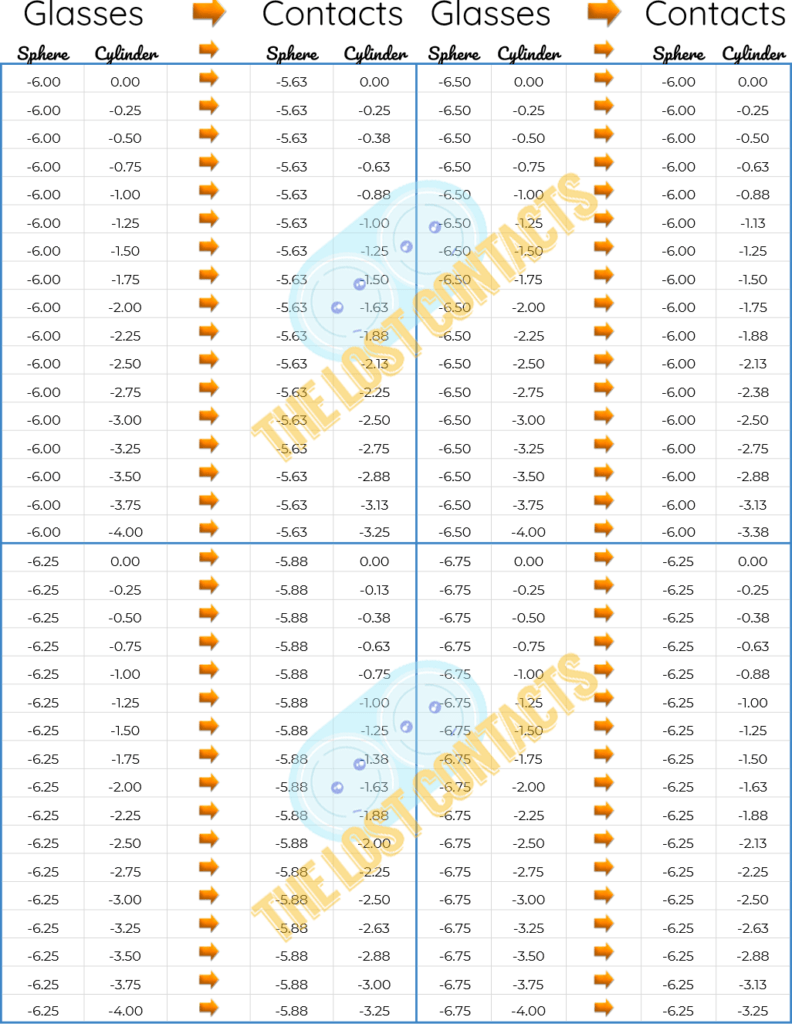
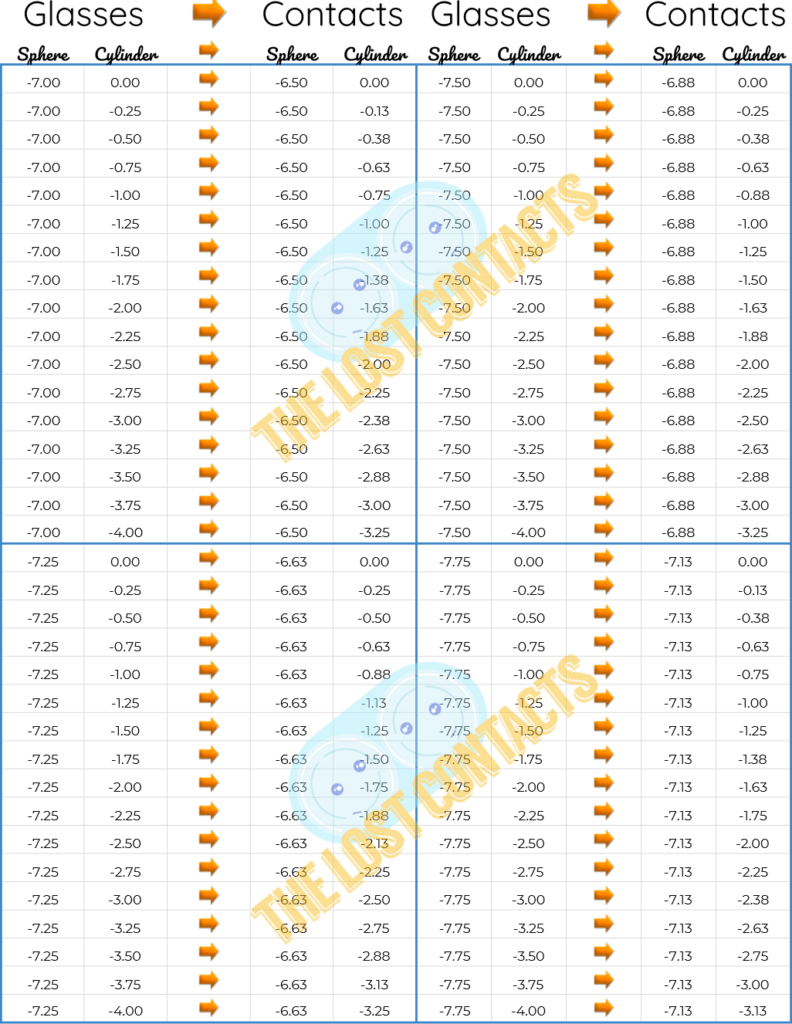
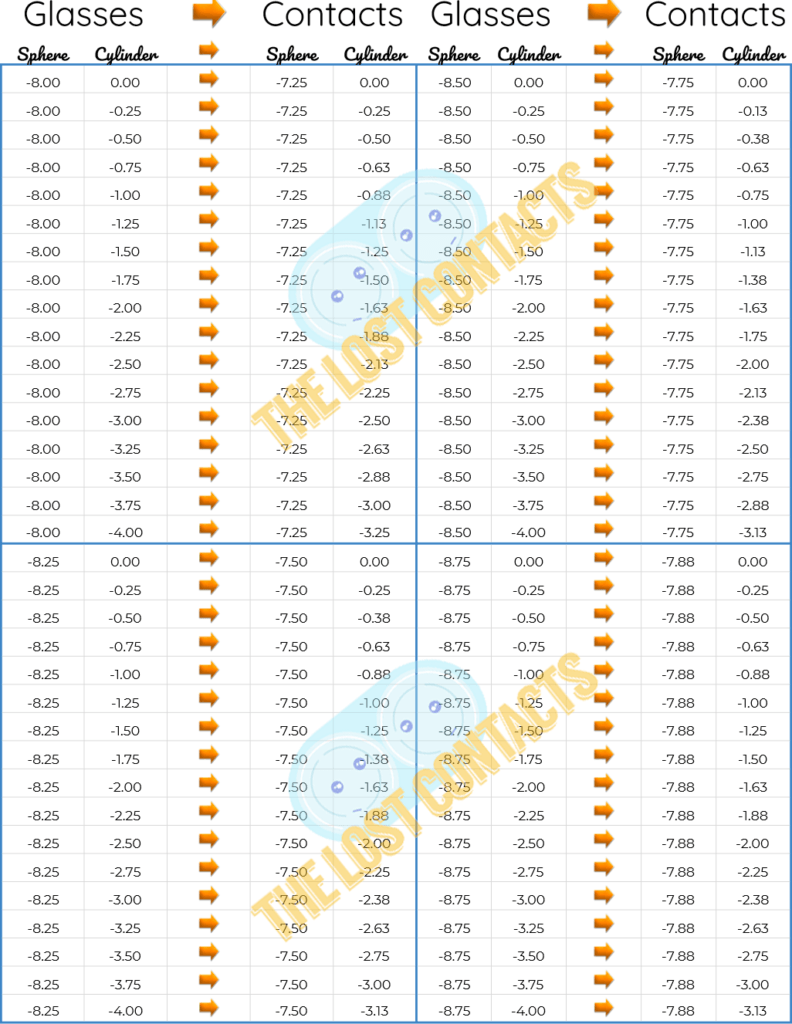
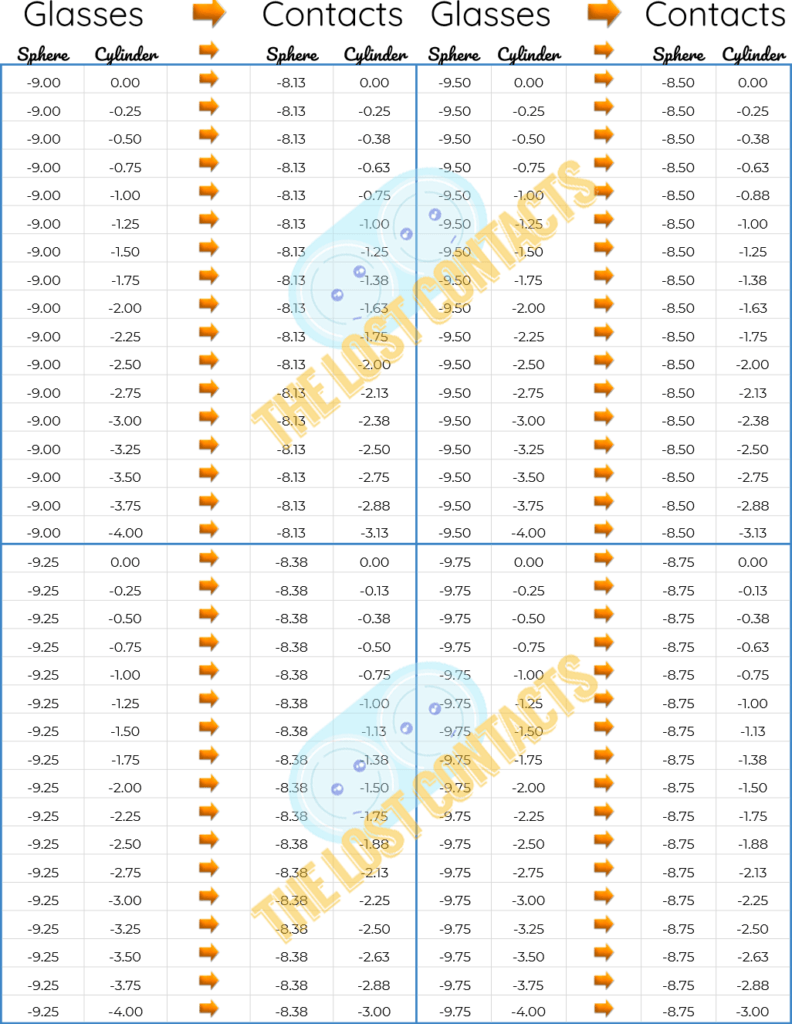
Astigmatism Charts For Minus Sphere Powers
This series of charts will cover all Sphere and Cylinder combinations ranging from Sphere Power 0 to -10.75 and Cylinder Power 0 to -4.00.
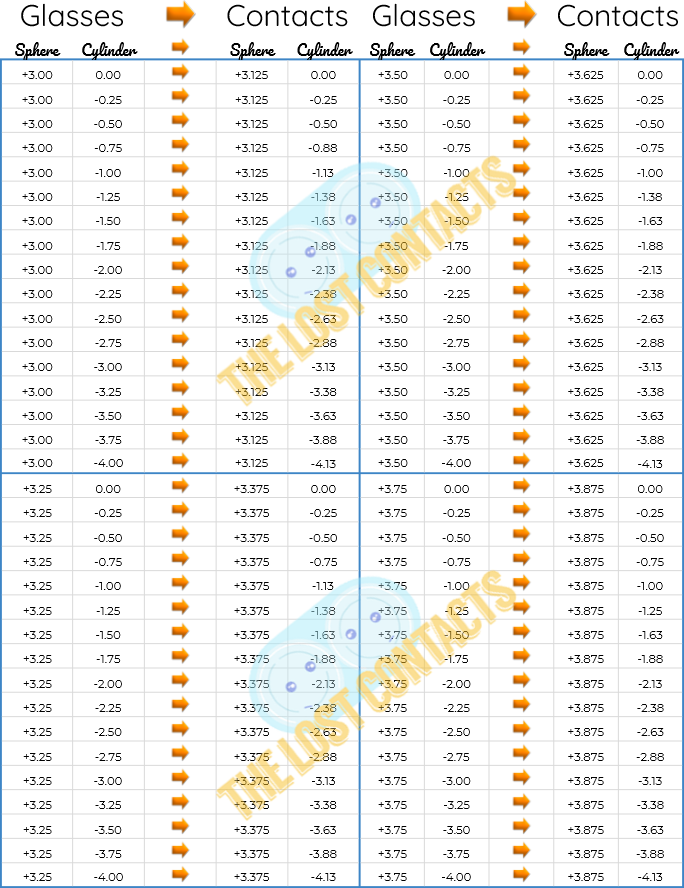
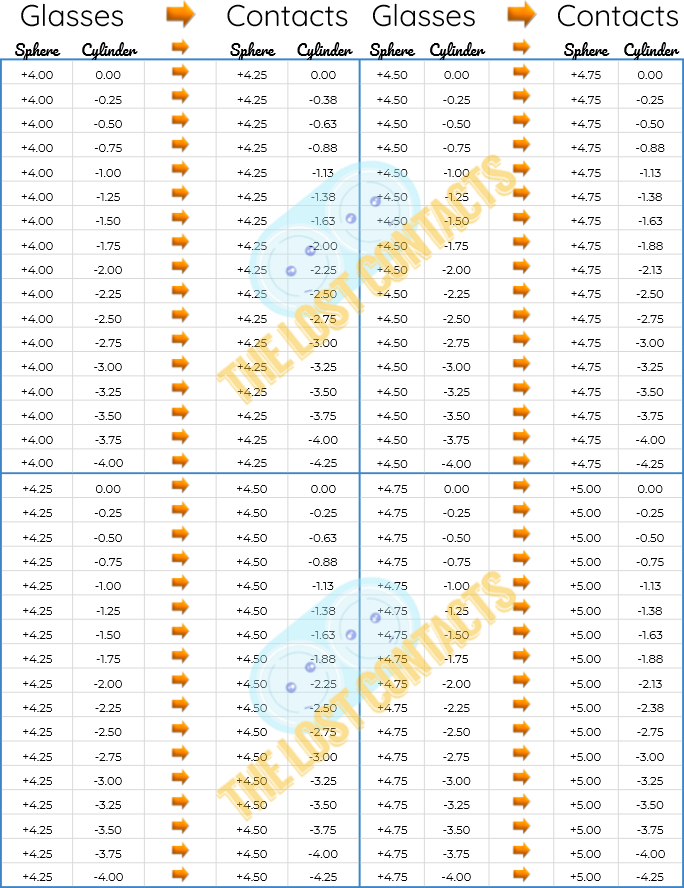
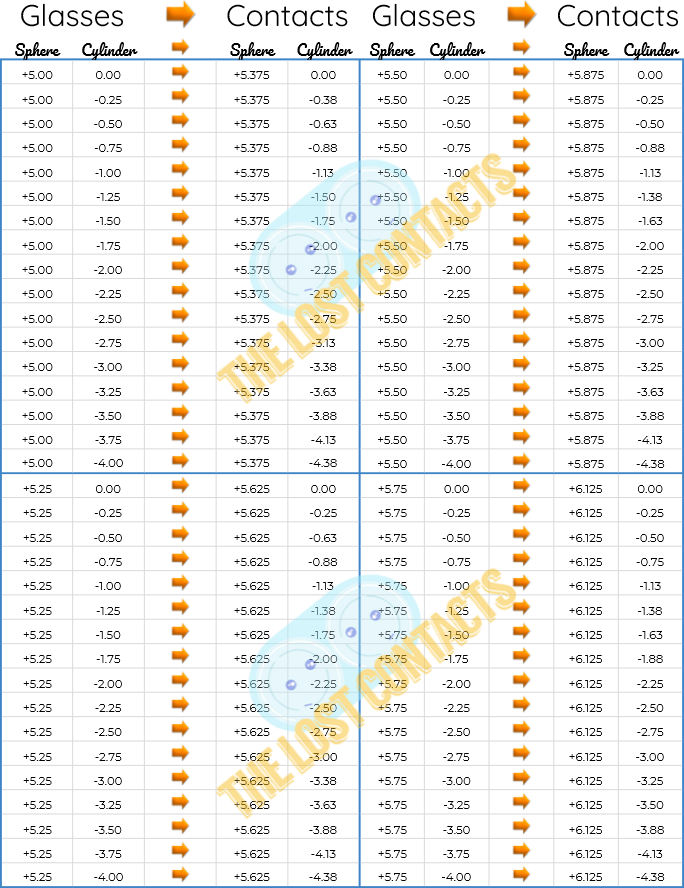
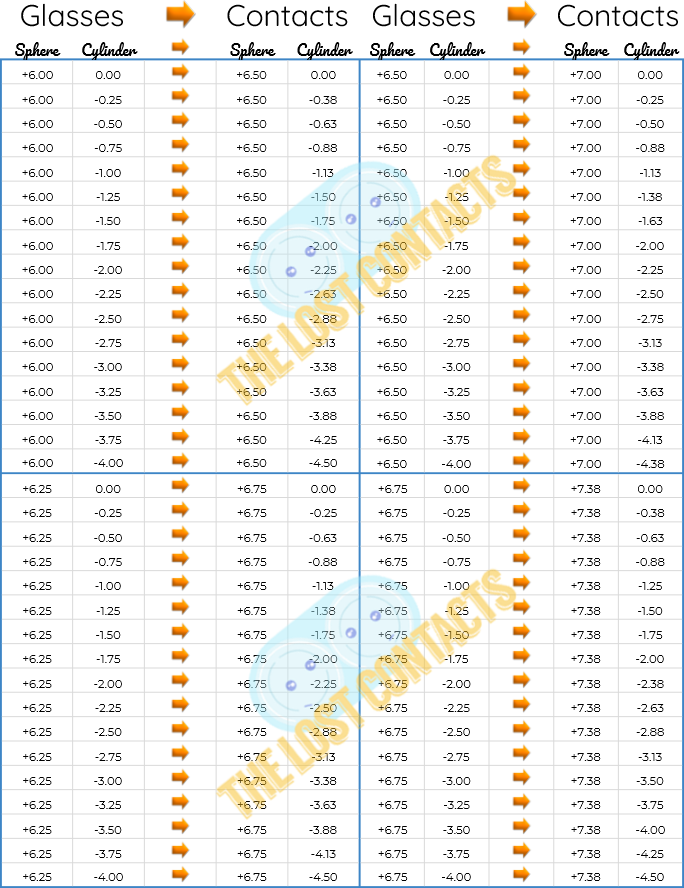
Astigmatism Charts For Plus Sphere Powers
The next series of charts will cover all Sphere and Cylinder combinations ranging from Sphere Power 0 to +10.75 and Cylinder Power 0 to -4.00.
How Were These Charts Calculated?
All the charts were populated using the following equation:
The vertex distance used in every calculation was 12mm.
Summary
I hope these charts provide value for you and save you time in your clinic. If you would like to download and print these charts, you can get the pdfs in The Lost Contacts downloads section.
After studying this lesson, you will understand a concept that eludes the vast majority of people – Astigmatism! But before you proceed, keep in mind that this is Lesson 8 of the course and it is highly advisable that you have read lessons 1-7 before tackling this one.
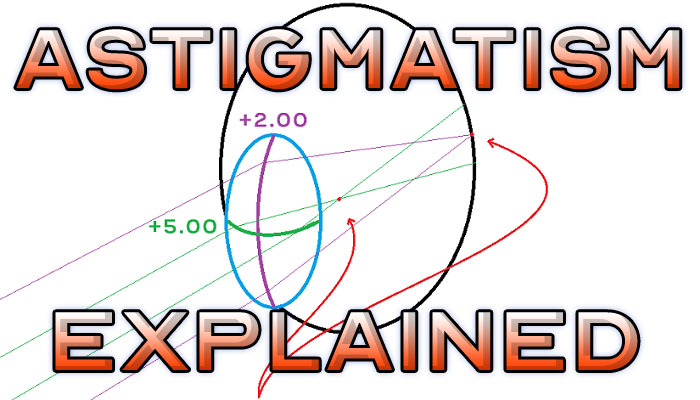
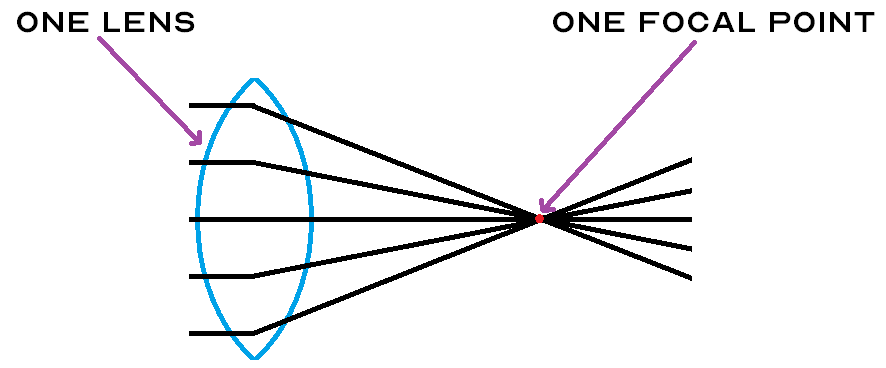
Astigmatism is a refractive condition that results in the creation of 2 separate focal points.
Recall from Lesson 6 & Lesson 7 that the difference between emmetropia, myopia and hyperopia is where the focal point forms inside the eye.
In emmetropia the focal point forms on the retina
In myopia the focal point forms in front of the retina
In hyperopia the focal point forms behind the retina
In all 3 of these conditions the eye produces only a single focal point. But what if there were 2 focal points…? Then that would be astigmatism!
How Can There Be 2 Focal Points?
Brilliant question!
Everything that you have learned in this course so far suggests that it is impossible for a lens to produce two focal points.
Question: So how can one lens produce two different focal points?
Answer: It must have two different curvatures!
Up until now we have always assumed that the lenses and the cornea in our examples have only one curvature, but this is not always true. A lens can have two different curvatures.
Spherical Vs Spherocylindrical Lenses
A lens that has two different curvatures is called a spherocylindrical lens. Before we delve into spherocylindrical lenses, let’s make sure we understand simple spherical lenses.
Spherical Lens
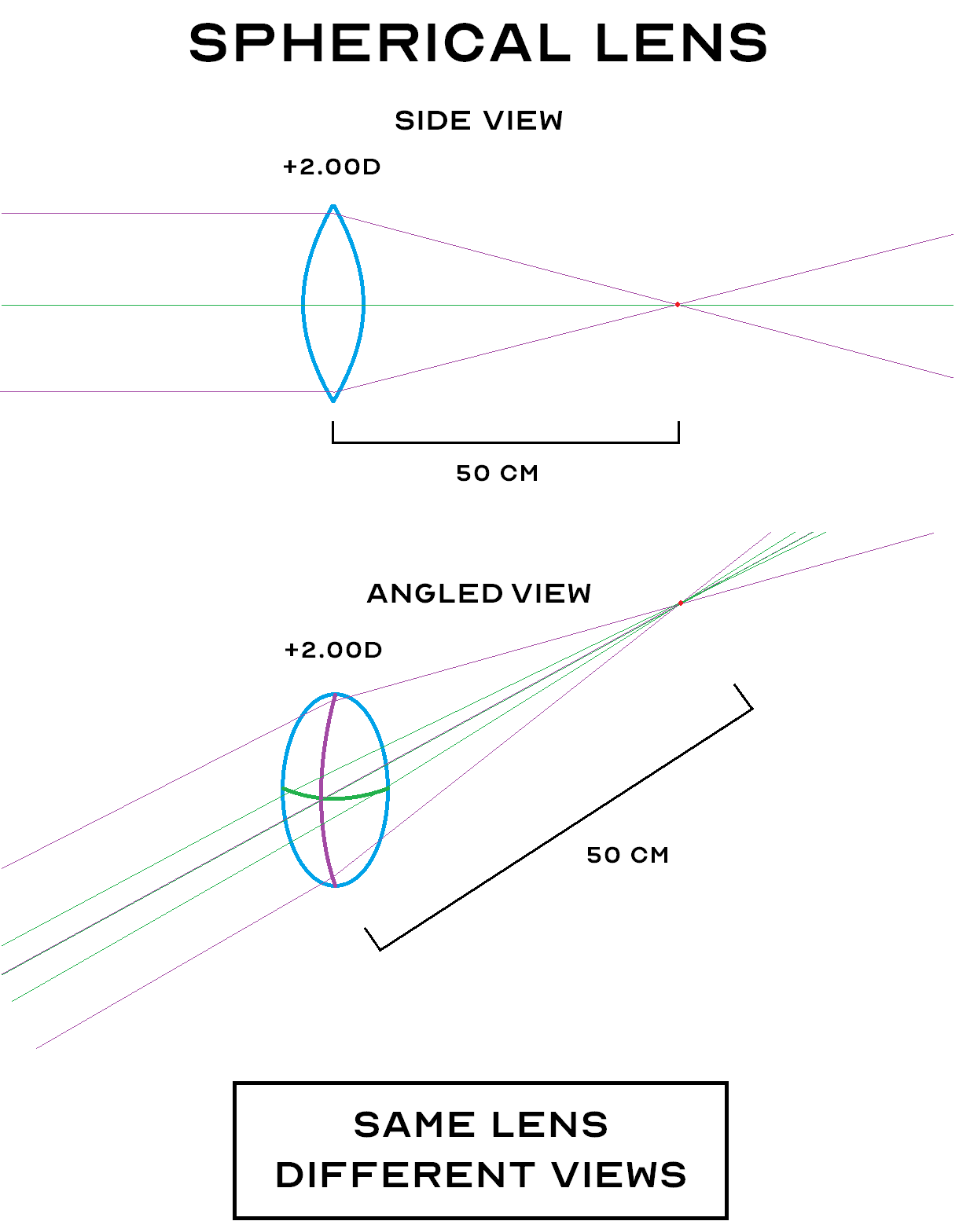
A spherical lens is simply a lens that has the same curvature all around. This is the type of lens we’ve been dealing with in all of our lessons so far.
In the following diagram, you will see a +2.00D spherical lens from two different perspectives. The top is the side view you’re familiar with, but the bottom is an approximately 45° angle view. That’s why it appears oval in nature, but keep in mind that it is the same lens.
There’s a lot going on in this diagram so let’s examine it closely.
Notice that:
Both top and bottom lenses have the same power; +2.00D
Both top and bottom lenses have the same focal distance; 50 cm
In a side view (top) only one curvature can be seen; the vertical curvature
In a 45° angle view, two curvatures can be seen; the vertical curvature (purple) and the horizontal curvature (green)
In this diagram, we see a lens with a vertical and horizontal curvature that are the same. That’s what makes this a spherical lens.
A spherical lens has the same vertical and horizontal curvature
Note: Just because the horizontal view (top) shows a lens that appears to only have a vertical curvature, it does not mean that it has no horizontal curvature. The horizontal curvature is just not visible from that perspective. When drawn this way, the horizontal curvature is simply assumed to be the same as the vertical curvature.
Now let’s see what happens when the vertical and horizontal curvatures are not the same.
Spherocylindrical Lens
A spherocylindrical lens is different from a spherical lens in that:
They have two different curvatures
The different curvatures are always 90° apart
Each curvatures creates a separate focal point
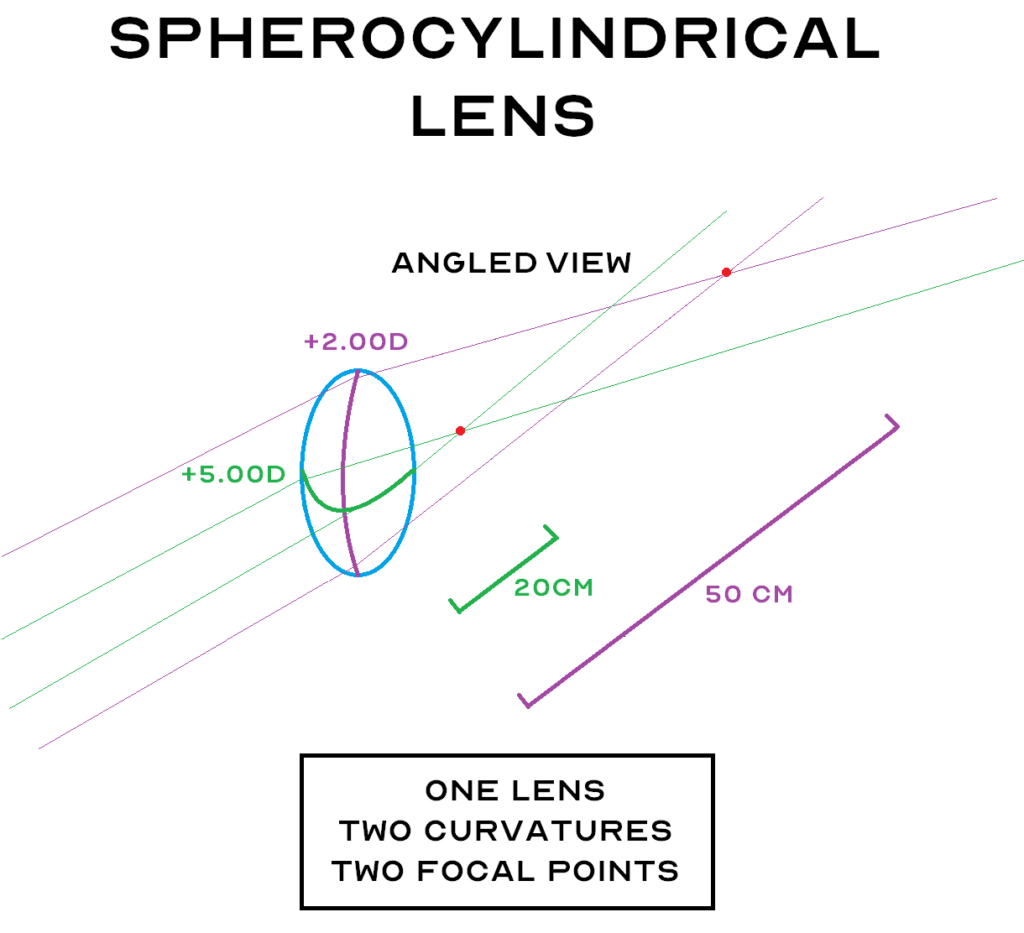
The following diagram illustrates a spherocylindrical lens.
Notice that this lens has two different curvatures instead of just one. The vertical curvature (purple) corresponds to a +2.00D lens power and the horizontal curvature (green) corresponds to a +5.00D lens power.
When light passes through this spherocylindrical lens, each curve will receive exactly half of the light rays.
The rays that pass through the +2.00D curve get focused at 50cm from the lens
The rays that pass through the +5.00D curve get focused at 20cm from the lens
The Cornea As A Lens
Remember that the cornea acts as a lens for the eye – and yes – it can either be spherical or spherocylindrical lens!
If the cornea is spherical – the eye has no astigmatism
If the cornea is spherocylindrical – the eye has astigmatism
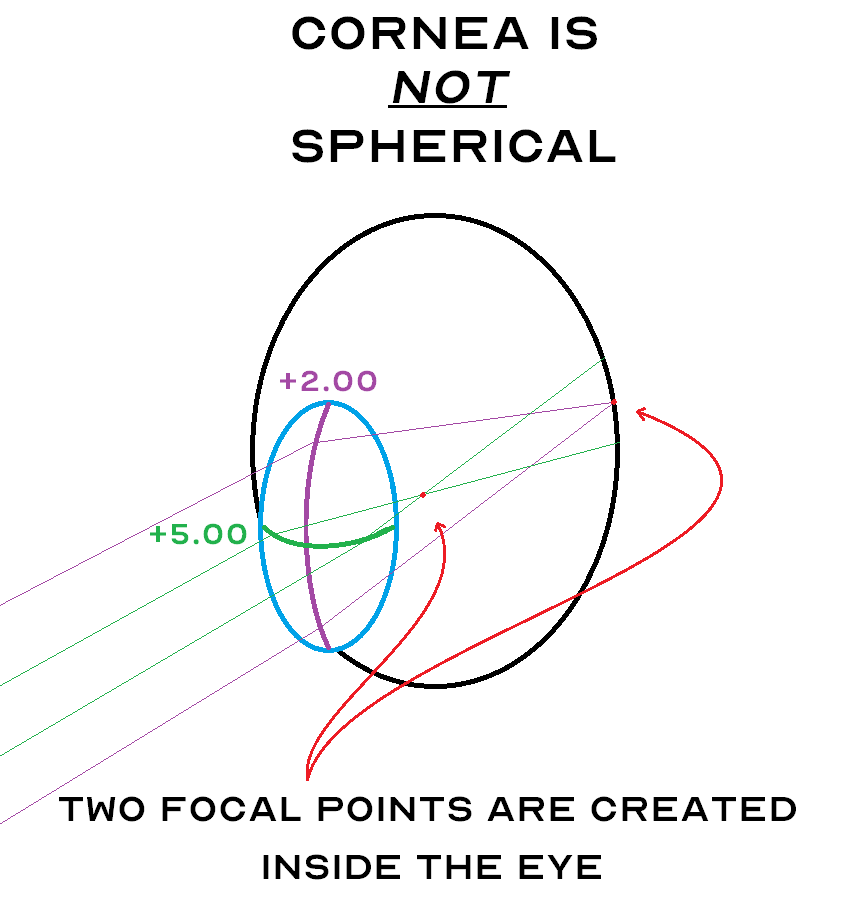
First, let’s look at a spherical cornea. Remember, this means there is no astigmatism.
The cornea is the blue circle. It appears oval because again, we are looking at a 45° angle. If we looked at it straight on it would be a perfect circle.
This cornea has the same curvature in both directions. This makes it a spherical cornea. That’s why it only produces one focal point inside the eye.
Now let’s look at a shperocylindrical cornea.
Because this cornea has two different curvatures, it creates two separate focal points inside the eye. That is astigmatism.
What Does Astigmatism Mean For You?
If you have astigmatism, it means that the glasses or contact lenses that you wear will have to correct (with spherocylindrical lenses) for both curvatures of the cornea so that there is only one focal point inside your eye. Remember from Lesson 5 that for an eye to see clearly, there must only be only one focal point and it has to form on the retina. If there are two focal points inside the eye, the eye will not see clearly.
Glasses for astigmatism are no different than glasses that are not for astigmatism. On the other hand, contact lenses for astigmatism are specialized contact lenses that are more expensive and may be more difficult to wear successfully.
Summary
Astigmatism is not an easy concept to grasp. This is a lesson I highly recommend reading a few times as it is quite complex. If you still have questions I would be happy to answer them for you, just let me know in the comments below!
If you’re comfortable with this lesson, congratulations! You now possess knowledge that very few people possess, so use it wisely! You’ll certainly find that it will come in handy if you work in an eye doctor’s office or an optical store.
In the next lesson we’re going to learn about a new part of the eye and how it affects vision. It’s called the crystalline lens. See you there!
==>THE OPTICS OF VISION – LESSON 9: THE CRYSTALLINE LENS <==
In the previous lesson: “How To Convert A Glasses Prescription to Contact Lenses“, I covered only situations that did not involve any astigmatism correction. In this lesson, I will only be discussing how to convert a glasses prescription to contact lenses when there is astigmatism to deal with.
Before I get into it I just want to say that some of this may appear to be difficult. Sure, it does take a little longer, but it’s literally nothing more than a little bit of addition, subtraction, as well as looking up numbers on our vertex distance conversion chart.
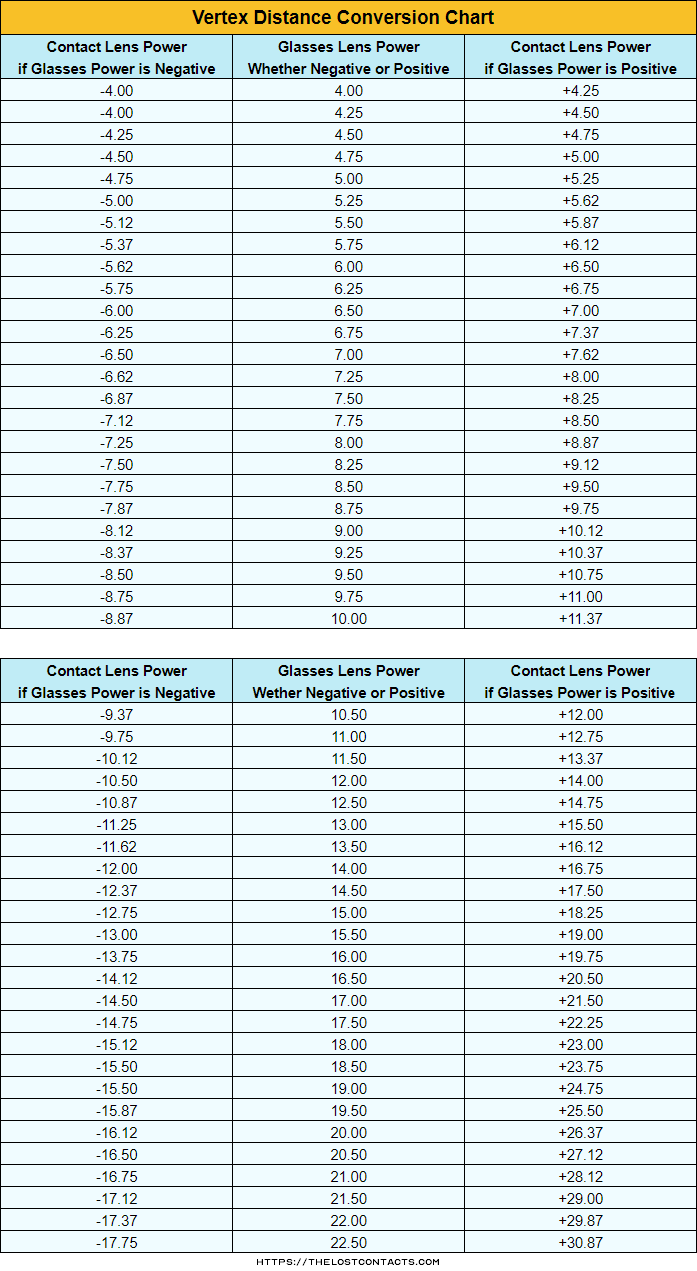
Here it is again for you to reference throughout this lesson.
*Note that this chart is based on a 14mm vertex distance.
Now let’s get right into it. Everything is done one eye at a time so complete steps 1- 5 for the right eye and then again for the left eye.
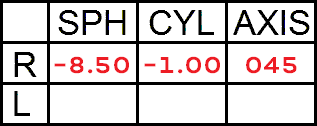
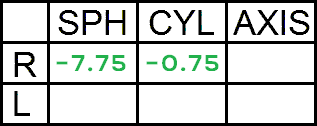
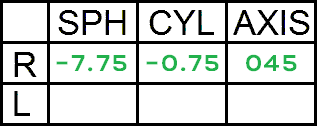
Here is the glasses prescription we will be working with:
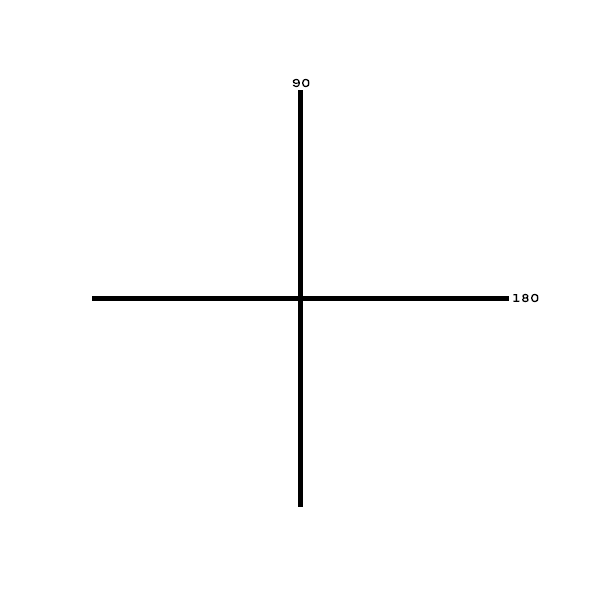
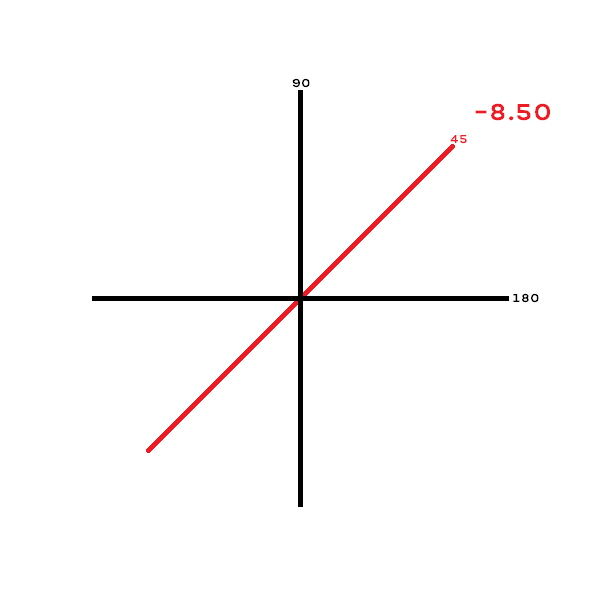
Step 1: Draw 180° and 90° Reference Lines
The power cross is the main tool used in visualizing and organizing the calculations involved in this conversion process.
Here we will draw two reference lines 180° and 90°.
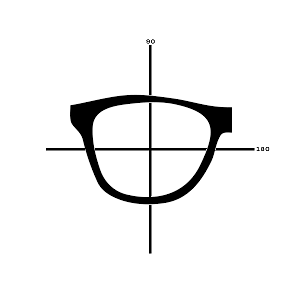
Think of this cross as overlaying the lens of the glasses prescription you’re working with, like this:
Step 2: Add The Sphere Power Line
Look at the glasses prescription that you’re working with and locate the ‘Axis’ number. This number represents a degree value and will be somewhere between 1 and 180. Now draw a line in the direction of the Axis .
In our example prescription, that’s 45. That means that a line at 45° must be drawn on the power cross. This is the Sphere Power Line. It represents the sphere power so write it down next to that line.
Step 3: Add The Sphere+Cylinder Power Line
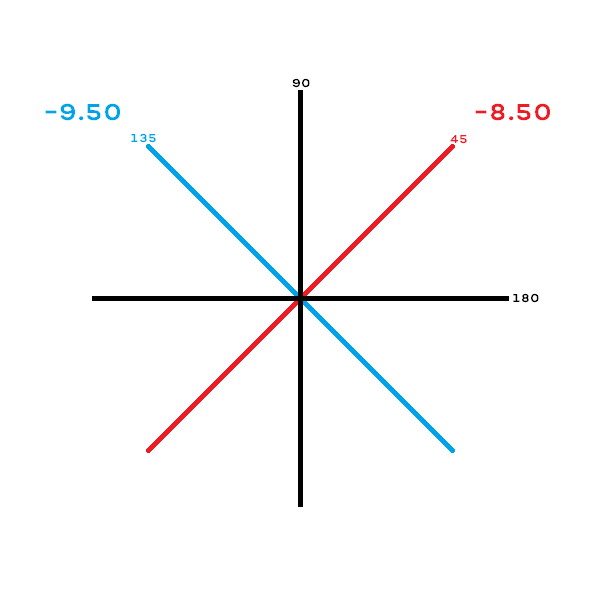
Next add 90 to the axis number and draw another line in that direction. For the example prescription above that would be 90 + 45 = 135.
This new line is the Sphere+Cylinder Line.
Now, as the name implies, to find the power of this line we must add the sphere and cylinder together.
For the example prescription above that would be -8.50 + (-1.00) = -9.50.
This the completed power cross.
Step 4: Covert The Powers
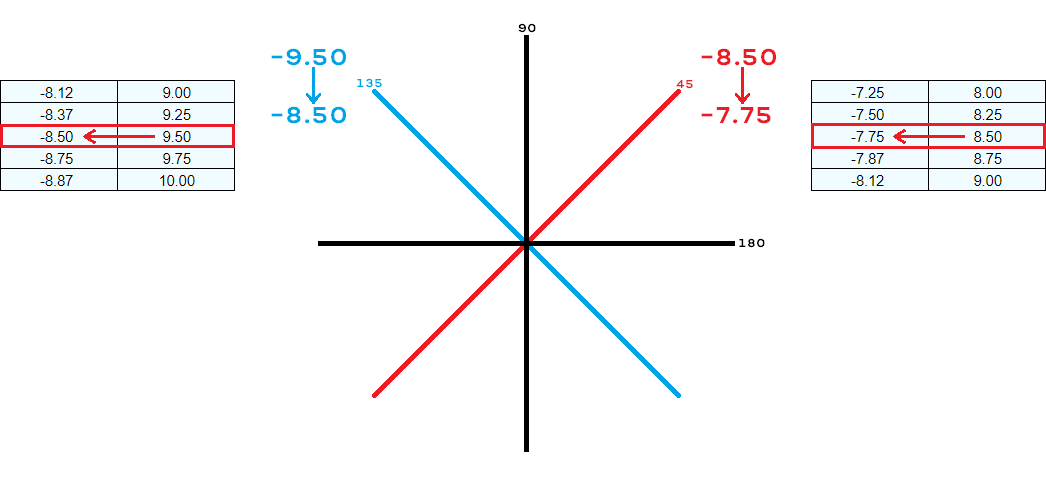
This is the step where we actually convert the glasses prescription to contact lenses. Now that we’ve laid out both the sphere and the sphere+cylinder powers, use the vertex distance conversion chart above to convert them and write those down as well.
Step 5: Returning To Prescription Format
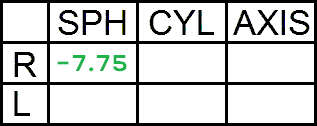
At this point, the glasses prescription is converted to contact lenses, but it’s not in the correct Sphere/Cylinder/Axis format. To return to the correct format, follow these 3 rules:
The converted sphere power becomes the contact lens sphere power.
The converted sphere+cylinder number minus the converted sphere number becomes the contact lens cylinder power.
-8.50 – (-7.75) = -0.75
The original glasses axis becomes the contact lens axis (it doesn’t change)
And that’s it!
You’ve done it! Not bad right?
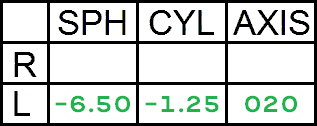
Let’s work through the left eye together.
Step 1: Draw 180° and 90° Reference Lines
Step 2: Add The Sphere Power Line
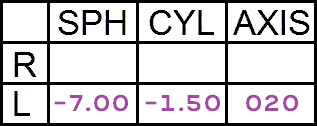
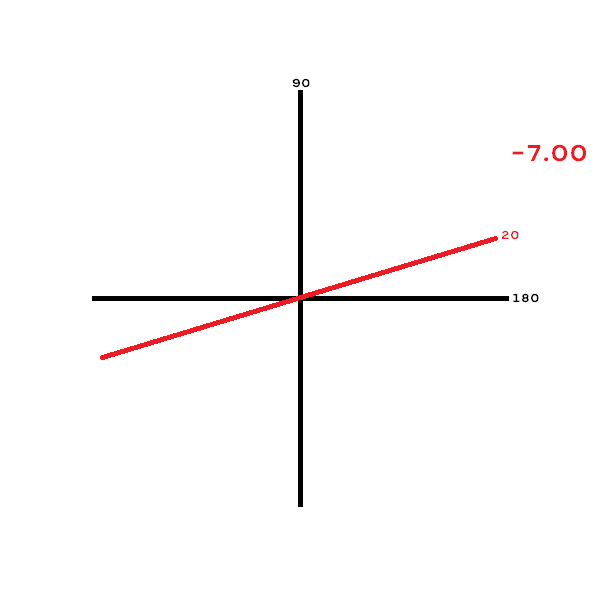
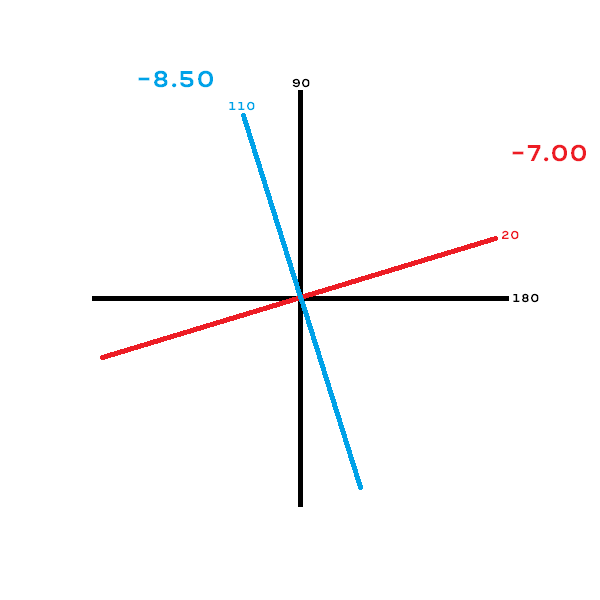
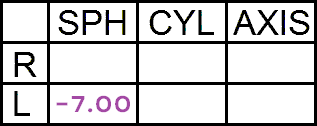
This time the axis is 020 so the sphere power line must be drawn at 20°. The sphere power is -7.00 so that will go next to the sphere power line.
Step 3: Add The Sphere+Cylinder Power Line
Next, add 90 to the axis on the prescription. In this case it’s 90 + 20 = 110, so the sphere+cylinder power line must be drawn at 110°.
The sphere+cylinder power for this prescription is -7.00 + (-1.50) = -8.50, so that will go next to the sphere+cylinder line.
Step 4: Covert The Powers
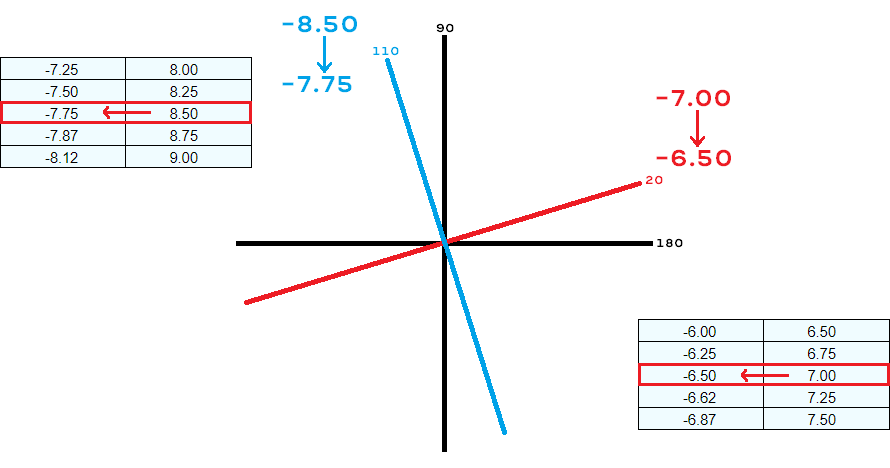
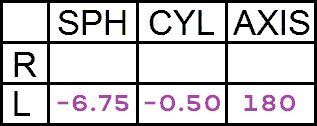
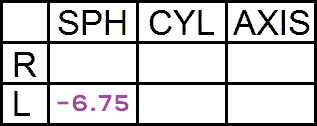
The vertex distance conversion chart is now used to convert both the sphere power and the sphere+cylinder power. The converted powers are written down to help with the next step.
Step 5: Returning To Prescription Format
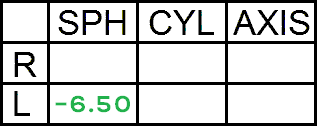
The converted sphere power becomes the contact lens sphere power.
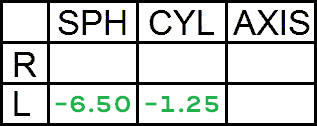
The converted sphere power minus the converted sphere+cylinder power becomes the contact lens cylinder power.
-7.75 – (-6.50) = -1.25
The original glasses axis becomes the contact lens axis (it doesn’t change).
And that’s how to convert a glasses prescription to contact lenses!
Important Shortcuts
Despite the simplicity of converting a glasses prescription with astigmatism to contact lenses using the 5 step process outlined above, it’s not always necessary. There are some shortcuts that can save a lot of time in a real-world practice setting.
When The Glasses Cylinder is -0.25
If the cylinder on the glasses prescription that is being converted to contact lenses is -0.25, there is no need to go through the 5-step power cross procedure. In fact, most of the time there is no need to do anything at all.
With a cylinder of -0.25, after the conversion process the cylinder will either stay -0.25 or become even less. Since there are absolutely no contact lens company that offer a contact lens for astigmatism with a cylinder correction of -0.25, it is a pointless exercise to convert.
Instead, the most common solution is to ignore it altogether. Simply, the cylinder and axis are removed from the contact lens prescription and only the glasses sphere is converted according to these guidelines.
When The Glasses Cylinder is -0.50
This is perhaps the trickiest situation. Contact lenses are not available in cylinder power of -0.50, yet, a cylinder power of -0.50 is significant enough that it can’t just be ignored. So what is the solution?
The -0.50 cylinder & axis are still dropped from the contact lens prescription, however, to compensate for it, and additional -0.25 is added to the glasses sphere. That is, you do not have to use the power cross method. Simply:
Remove the -0.50 cylinder & axis.
Add -0.25 to the glasses sphere.
Convert the new glasses sphere using a vertex distance conversion chart.
Convert the new glasses sphere using a vertex distance conversion chart.
And there you have it. You now have all the tools and knowledge necessary to convert any glasses prescription to contact lenses. But are you now ready to start prescribing contact lenses? Not quite yet! Actually, at this point we’re still in the very early stages of the contact lens fitting.
Next Steps
You know how to convert a glasses prescription to contact lenses, even if it has astigmatism, but what if contact lenses aren’t available in the numbers that you calculated?
Have you noticed that many of the conversions on the vertex distance conversion chart end in weird numbers like 0.12, 0.37, 0.62, & 0.87? Have you noticed that only certain cylinder powers and axis are available for contact lenses?
If the conversion you calculated doesn’t match what is available in contact lenses, there will be additional adjustments needed in order for trials to be ordered for the patient/client. And that’s what we’re going to learn about next!
If you have any questions about the process laid out in this article, please let me know in the comments and I’ll help you through it.
Can everyone wear contact lenses? No. There are definitely some people who can’t wear contact lenses, but in this article, I will discuss the kinds of people who can wear contact lenses. Not only that, but there are some people for whom contact lenses are the best option for their vision, and I will go over those scenarios as well.
Who Can Wear Contact Lenses
This is by far and away, the biggest category. These days, contact lenses are available in a wide range of different parameters and have become quite remarkably comfortable. This means that most people should be able to find a contact lens that works at least reasonably well.
People Who Can Wear Contact Lenses And Can Expect Perfect Vision
People with any amount of nearsightedness or farsightedness and no astigmatism can expect to be able to wear contact lenses and see perfectly well.
Rough range: Sphere: +6.00D to -10.00D, Cylinder: 0, Axis: None
People Who Can Wear Contact Lenses And Can Expect Near Perfect Vision
People who are nearsighted or farsighted in combination with low to moderate amounts of astigmatism, or people who have low to moderate amounts of astigmatism on its own, will still do very well in contact lenses.
Rough range: Sphere: +6.00D to -10.00D, Cylinder: 0 to -1.25, Axis: 001 to 180
People Who Can Wear Contact Lenses And Should Expect Somewhat Reduced Vision
When the levels of astigmatism start to get moderately high to high, the vision can still be quite good but there will be a noticeable departure from a perfect vision.
Rough range: Sphere: +6.00D to -10.00D, Cylinder: -1.25 to -2.75, Axis: 001 to 180
There are several reasons why the vision could be reduced in this prescription range:
Unstable contact lenses. With a high cylinder power, it becomes very important for the contact lens to sit perfectly aligned on the eye and never move throughout the day. Due to all of the different ways in which our eyes move throughout the day in combination with all the different head positions and eyelid-contact-lens interactions, it is nearly impossible for contact lenses for astigmatism to remain still. When they move far enough out of their ideal position, the vision will become and remain blurry until the lenses return to their ideal fit. This could take anywhere from seconds to minutes.
Falling between available parameters. Most contact lenses for astigmatism will offer an axis between 10 and 180 and in 10-degree steps. I.e., 10, 20, 30, 40, 50, and so on. However, a person’s vision may require an axis of any number between 1 and 180. I.e., 003, 017, 134, 166, 175, etc. This forces the eye doctor to have to choose the closest axis possible to the prescription, but this may not necessarily be exactly what is needed in order to see perfectly.
Who Should Wear Contact Lenses
For most prescriptions, wearing glasses is the go-to solution. For most prescriptions, contact lenses can offer an alternative to glasses but are not necessarily better. However, there are certain people for whom contact lenses would actually correct the vision much better than glasses. I will discuss these situations now.
Anisometropia & Antimetropia
Anisometropia Definition
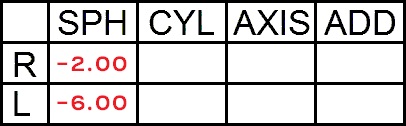
Anisometropia means that the prescriptions for the right and the left eye are considerably different. How different is considerable? It’s usually when the overall difference reaches around 1.50D or more.
For example: Right: -2.00D, Left: -6.00.
Glasses are not ideal when dealing with high levels of anisometropia. I will discuss why in just a second.
Antimetropia Definition
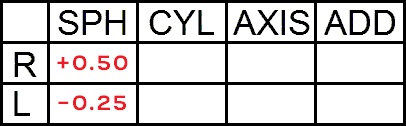
Antimetropia is the condition where one eye is nearsighted and the other eye is farsighted. This is sometimes called ‘mixed anisometropia’.
Antimetropia, if very low doesn’t cause too many problems.
For example: Right: +0.50D, Left -0.25D.
However, if antimetropia and anisometropia are present together, that’s when glasses can start causing problems.
Why Aren’t Glasses Ideal For Anisometropia & Antimetropia?
In a nutshell, glasses induce visual distortions. The magnitude of these distortions depends on the strength of the glasses. When both eyes experience roughly the same levels of distortions, the brain is still able to combine the information it receives from both eyes into one coherent image of the world. However, when the distortions are vastly different, the brain cannot combine the information it is receiving from each eye; they are just too different.
The result of wearing glasses for anisometropia can range from uncomfortable vision, to double vision, eyestrain, headaches, loss of depth perception, and more.
If you have a very savvy optician or optometrist, he/she can attempt to mitigate the symptoms of anisometropia by altering various properties of the glasses such as lens index, vertex distance, base curve, bevel position, etc.
Click here for more information on this type of solution.
However, a simpler solution would be to simply wear contact lenses!
Why Are Contact Lenses Ideal For Anisometropia & Anitmetropia?
Contact lenses do not produce any of the distortions in vision that glasses produce, no matter how different the prescription is between the two eyes. Why is that? Because not only do visual distortions depend on the strength of the lenses, but also the distance between the lens and the eye.
You can think of it this way:
Visual Distortions = [Strength of Lens] X [Distance Between Lens & Eye]
When using glasses for anisometropia, the strength of the lens will be different for each eye and the distance between the lens and the eye is usually about 12-14mm. This will lead to considerably different visual distortions for each and result in visual discomfort.
When using contact lenses for anisometropia, the strength of the lens doesn’t matter because the distance between the lens and the eye is always zero. That results in zero visual distortions for each eye every time.
Very High Sphere Power
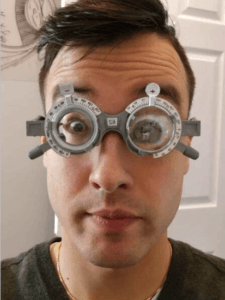
Me wearing a -20D lens on the right and +20D lens on the left. Note the way that each change the apparent size of my eyes.
When you have a very high prescription, glasses start to affect the apparent size of your eyes. Sometimes this can be distracting or unappealing.
If you have a very strong hyperopic prescription, it will make your eyes look unnaturally big.
If you have a very strong myopic prescription, it will make your eyes look unnaturally small.
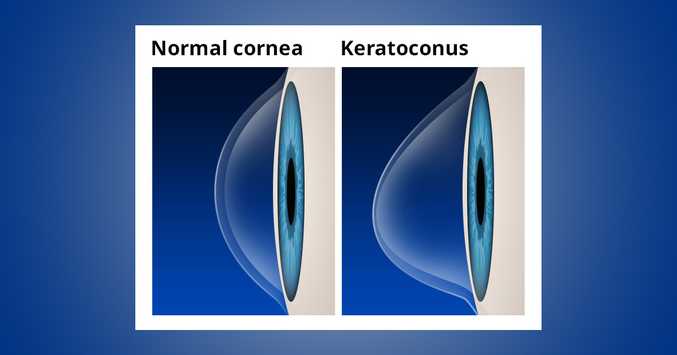
Keratoconus
Keratoconus is a condition that causes the cornea to develop something known as irregular astigmatism. Glasses and regular soft contact lenses are not able to correct irregular astigmatism. In this case what is needed are hard contact lenses called RGPs (rigid gas permeable).
There are some people that can’t wear contact lenses but as you can see now, most people can and there are even many people for whom contact lenses are the best option.
Can you think of any scenarios that I’ve missed? If so, please share them in the comments below!
Once a suitable contact lens candidate has been found, it’s time to start analyzing what power of contact lenses they will need.
A contact lens fitting is a multi-step process that involves many important considerations, but perhaps the most important step is the one that precedes it all; determining if your patient can or can’t wear contact lenses.
In this article, I will walk you through the process of determining who can’t wear contact lenses & who shouldn’t wear contact lenses. In Part 2, I will discuss who can wear contact lenses and who should wear contact lenses.
*Note: This article will only deal with soft contact lenses. It’s possible that some of the things I say don’t apply to rigid gas permeable (RGP) contact lenses, hybrid contact lenses or scleral contact lenses.
Who Can’t Wear Contact Lenses
These are the people who you just have to turn down if they ask you to fit them with contact lenses.
Corneal Disease
If your patient or customer has a corneal disease which would be aggravated by the use of contact lenses, DO NOT put contact lenses in their eyes.
Active Corneal or Conjunctival Infections
Most of us have had some sort of eye infection at some point in our lives. While having experienced such as thing does not disqualify someone from wearing contact lenses, if someone is currently dealing with an eye infection – whether it be conjunctival or corneal – they DO NOT put contact lenses in their eyes.
This goes for any kind of eye infection. It doesn’t matter if it’s viral, bacterial, fungal, etc.
Very High Prescriptions
Contact lenses have limits as to what strength of prescriptions they can correct. This is mostly true for astigmatism correction. If the strength of a person’s astigmatism is -5.00 or higher, or if the strength of their near/farsightedness is higher than +/-10.00D in addition to any amount of astigmatism, there are no contact lenses that can correct these types of prescriptions.
Limited Dexterity/Fine Motor Skills
Wearing contact lenses requires people to perform several specialized tasks with their hands. If a person is afflicted with a condition that makes them unable to open a contact lens blister pack, pick up a fallen contact lens, manipulate a contact lens into position on their finger, hold their eyelids while approaching their finger to their eye, or pinch a contact lens off of the eye, then they will not be able to wear contact lenses.
Of course, I’m talking about people who are living independently here. If there is a caretaker who can do this for your patient or customer, then it is possible.
And then there’s Jessica Cox so… I stand corrected.
Unrealistic Expectations
Sometimes you just have to know when you’re outmatched by a patient or customer’s expectations. If you’re faced with someone who has moderate myopic astigmatism and advanced presbyopia, and they expect to be able to see perfectly well in contact lenses at all distances without any fluctuations in their vision, you just have to explain to them why it will not be possible.
Who Shouldn’t Wear Contact Lenses
These are the people who ideally shouldn’t be wearing contact lenses, but in certain situations, it could be permissible.
Chronic Dry Eyes
Having chronic dry eyes was once a death sentence for wearing contact lenses. For some, it will still be. The good news is that contact lens manufacturers have figured out how to make contact lenses feel really comfortable. For some, this will mean that despite their dry eyes, they may still be able to wear contact lenses from time to time.
Naturally, you may be curious about what the most comfortable contact lenses are. In my opinion, it is the DAILIES TOTAL1 brand by Alcon. No, Alcon did not pay me to write that. Some close seconds are ULTRA by Bausch + Lomb and Acuvue Oasys With HydraLuxe (not HydraClear Plus) by Johnson & Johnson.
Smokers
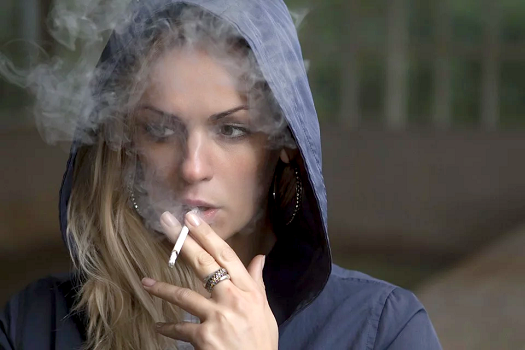
Smoking does not mean that you cannot wear contact lenses. However, many published studies (such as this one) show that smokers who wear contact lenses are at greater risk of getting corneal ulcers compared to non-smokers who wear contact lenses.
Allergies
If someone’s allergies affect their eyes and they do not have them under control, they are not going to do well with contact lenses. If you have an allergy suffering patient or customer asking for contact lenses, make sure you help them with their allergy symptoms before you even try contact lesnes.
Sometimes it is just best to stop wearing contact lenses during one’s specific allergy season.
People Who Are Immunocompromised
One of the considerations we always have to keep in mind for people wearing contact lenses is the risk of infection. Putting contact lenses in your eyes increases the risk of eye infections, end of the story. For the majority of people, the immune system can quickly quash any would-be bodily intruders. However, if the immune system is suppressed by medication or illness, the body’s defense is not as strong.
There are many ways one can become immunocompromised. I recommended this article to learn more about them.
Irresponsible People
This is a bit of a broad and vague category, but it’s a good one to be aware of. Success in wearing contact lenses depends heavily on knowing how to care for contact lenses. If you’re explaining the process of caring for contact lenses to your patient or customer and they seem wholly uninterested, that should be a red flag.
Scientific studies have shown that males encounter contact lens complications at higher rates than women, probably due to their propensity to disregard proper techniques on how to care for contact lenses.
People Asking For ‘Sleeping Contact Lenses’
If your patient or customer is asking you for contact lenses that they can sleep in (extended wear contact lenses), proceed with caution. Extended wear contact lenses exist and some people can sleep with them without problems but for most people, this type of contact lens wear is not suitable.
The contact lens brand Air Optix Aqua Night & Day was developed by Ciba Vision (now Alcon) as an extended wear contact lens brand when the idea of sleeping with contact lenses become somewhat of a craze. In that same era there were also a handful of other brands approved for overnight wear, but by and large, it didn’t work out and the industry has now given up on the idea (and so should you – probably).
Who Can and Should Wear Contact Lenses
Now that you know who cannot wear contact lenses, let’s explore the type of people who can.




 This is by far and away, the biggest category. These days, contact lenses are available in a wide range of different parameters and have become quite remarkably comfortable. This means that most people should be able to find a contact lens that works at least reasonably well.
 Unstable contact lenses. With a high cylinder power, it becomes very important for the contact lens to sit perfectly aligned on the eye and never move throughout the day. Due to all of the different ways in which our eyes move throughout the day in combination with all the different head positions and eyelid-contact-lens interactions, it is nearly impossible for contact lenses for astigmatism to remain still. When they move far enough out of their ideal position, the vision will become and remain blurry until the lenses return to their ideal fit. This could take anywhere from seconds to minutes.
 For most prescriptions, wearing glasses is the go-to solution. For most prescriptions, contact lenses can offer an alternative to glasses but are not necessarily better. However, there are certain people for whom contact lenses would actually correct the vision much better than glasses. I will discuss these situations now.