What Is On The Optometry Admission Test Featured

What Is On The Optometry Admission Test?

Knowing what is on the Optometry Admission Test (OAT) is the first step to preparing for it. This article will be an overview of the Optometry Admission Test intended to help you prepare and know what to expect.

Optometry Admission Test Format

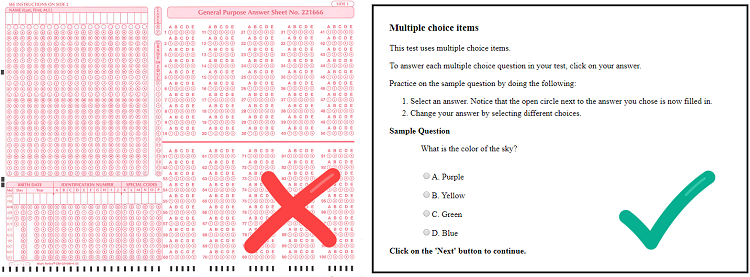
The OAT entirely consists of multiple-choice questions. Questions have between 4 and 5 different answers to choose from.

You do not have to answer all questions right away. Each section is timed so if you’re stuck on a question, it can be marked and returned to later.

There are no written long answer questions, no essays, and no in-person questioning or interview.

You may be used to taking multiple-choice exams by filling in circles on a Scantron sheet (or the like) while flipping through a stack of paper containing the exam questions. This will not be the case for the OAT. The OAT is done at a computer terminal at specified Prometric testing locations.
Optometry Admission Test Format

What Is On The Optometry Admission Test

Here is the OAT breakdown:

  • Survey of the Natural Sciences – 100 Questions

    • Biology -40 QuestionsOptometry Admission Test Biology

      • Cell and Molecular Biology
      • Diversity of Life
      • Structure and Function on Systems
      • Developmental Biology
      • Genetics
      • Evolution, Ecology and Behavior
    • General Chemistry -30 QuestionsOptometry Admission Test General Chemistry

      • Stoichiometry and General Concepts
      • Gases
      • Liquids and Solids
      • Solutions
      • Acids and Bases
      • Chemical Equilibria
      • Thermodynamics and Thermochemistry
      • Chemical Kinetics
      • Oxidation-Reduction Reactions
      • Atomic and Molecular Structure
      • Periodic Properties
      • Nuclear Reactions
      • Laboratory
    • Organic Chemistry – 30 QuestionsOptometry Admission Test Organic Chemistry

      • Mechanisms
      • Chemical and Physical Properties of Molecules
      • Stereochemistry (structure evaluation)
      • Nomenclature
      • Individual Reactions of the Major Functional Groups and Combinations of Reactions to Synthesize Compounds
      • Acid-Base Chemistry
      • Aromatics and Bonding
  • Reading Comprehension – 50 Questions

This section consists of reading 3 different passages related to various scientific subjects. For each passage, you must answer questions about its content. The passages are approximately 1000 words each, and they are randomized for every examinee (not everyone taking the test will get the same passages).

You do not have to memorize the details of the passages. You can scroll through the text as you answer the questions.

Tip: Do not assume this section will easy and not worthy of preparing for. This section is generally believed to be the hardest by many of those who have taken the OAT.

  • Physics – 40 QuestionsOptometry Admission Test Physics

    • Units and vectors
    • Linear kinematics
    • Statics
    • Dynamics
    • Rotational motion
    • Energy and momentum
    • Simple harmonic motion
    • Waves
    • Fluid statics
    • Thermal energy and thermodynamics
    • Electrostatics
    • D.C. circuits
    • Optics
  • Quantitative Reasoning (Math) – 40 Questions

    • Mathematical ProblemsOptometry Admission Test Quantitative Reasoning

      • Algebra (equations and expressions, inequalities, exponential notation, absolute
        value, ratios and proportions, and graphical analysis)
      • Data Analysis
      • Interpretation
      • Sufficiency
      • Quantitative Comparison
      • Probability and Statistics
    • Applied Mathematics (Word) Problem

Note: You allowed an on-screen basic calculator during this section.

How Long Is The Optometry Admission Test?

The total length of the OAT is 5 hours and 5 minutes. However, realistically, you will want to get there early and get your results at the end. You should plan to be at the testing center for approximately 6 hours altogether to be safe.
Time Left For Optometry Admission Test

Here is a breakdown in the time schedule:

  • Opening Tutorial – 15 minutes

  • Survey of the Natural Sciences – 90 minutes

  • Reading Comprehension – 60 minutes

  • Break – 30 minutes

  • Physics – 50 minutes

  • Quantitative Reasoning (Math) – 45 minutes

  • Post Test Survey – 15 minutes

Optometry Admission Test Results

Your test results will automatically be generated and presented to you when the test is done. Your score will be a number between 200 and 400. A score of 300 is the average score. If you score below 300, that is not good. In order for your optometry school application to be competitive, you will want a score that is considerably higher than 300.

Optometry Admission Test Location

The OAT is administered by the company Prometric. Prometric has testing locations all over Canada and the United States. To find the location that is most convenient, you can use their online testing center locator.

Optometry Admission Test Prep

In addition to your years of schooling, it can be quite helpful to pick up a study guide tailored specifically to the Optometry Admission Test. There are many OAT test prep materials out there for you to acquire ranging from study material, OAT sample questions, entire OAT sample tests, time management strategies, etc.

My Optometry Admission Test Experience

Jason Woo Optometrist
Jason Woo, Optometrist

What I did

I was 22 and in my last year of undergraduate studies when I took the Optometry Admission Test. Due to some poor planning on my part, I ended up taking the OAT in the middle of my final exams, so leading up to it I was juggling studying for tons of different things. Do not do this to yourself.

What I learned

I learned that you should schedule your Optometry Admission Test during a time where you can focus solely on preparing for it.

What I did

The test itself was not unlike many of the practice tests I had done. Going through OAT practice exams is extremely helpful in that regard. However, while doing practice tests I had never timed myself. That was a big mistake because the fear of running out of time was always top of mind making it very difficult to concentrate on the questions themselves.

What I learned

I learned that you should time yourself while doing a practice OAT test to get used to the feeling of being under time pressure.

What I did

I was so focused on learning the science material that I hardly practiced the reading comprehension component. That turned out to be the most difficult part for me and it was also the section I received the lowest mark on. Talking to my classmates in optometry school confirmed that I was not the only one. Nearly everybody scored the worst on that section.

What I learned

I learned that you should practice that section or at the very least devise a strategy for it. I.e., Read through all the questions first so that you know when to pay particular attention while reading through the passage.

What About You?

Are you planning to take the Optometry Admission Test? Have you taken it already? If so please share your experience with the test in the comments section.

 

how-to-make-the-most-of-your-studies-person-studying

How to Make the Most of Your Studies

In this post, I’m going to share with you some tips to help you make the most of your studies. Note that I chose Opticianry as an example, but these tips can be applied to any field of study. Ready? Let’s dive in!

1. Know What to Expect

Knowing what to expect from your chosen program, is mentally preparing yourself for what lies ahead, so that you are less likely to feel stressed out, confused, and frustrated down the road. This is especially important if you have been away from school for a while or are going to enter a new school system in a new country. If you are considering studying Opticianry, I recommend reading my previous posts on;

In general, you want to gather as much information as you possibly can, and there are many ways to do that. 

The Website

The first and most obvious one is; read the school’s website inside and out! Usually, all schools have a website that highlights key information for new applicants and current students. You can learn about the school’s reputation, and faculty, the specific program’s curriculum, and possible career paths. You can also directly contact the program coordinator, or join a student forum if you have specific questions.

The Regulatory Body & Association

Next, look up the profession’s regulatory body website. This should be your primary reference for field-specific information, such as; regulations, and standards of practice. Professional association websites have a variety of resources available, as well. You can access educational material, updates and news on the industry, and much more. For Ontario Opticians, the College of Opticians of Ontario (COO) is the regulatory body, and the Ontario Optician Association (OOA) is the professional association. Provincial associations are usually part of national associations, like the Optician Association of Canada (OAC) for OOA.

Orientation & Open House

Make sure to attend the school’s open house and orientation days. If you happen to miss the open house, make sure you do attend the orientation day! Because it would be your first official day at the school! You will have the opportunity to;

  • Get a feel for the school’s atmosphere,
  • See the facilities, such as your classrooms and labs,
  • Meet your program coordinator, future classmates, and some of your teachers in person,
  • Ask any unanswered questions that came up during your research,
  • And if the weather condition allows, you can party under the sky and eat hot dogs and veggie burgers! Yay!

Other Resources

Last but not least, take your research a step further by looking up other field-specific forums, websites, online magazines, and blogs. An example would be…ahem…The Lost Contacts 🙂 You can find useful information that might help you before, during, and after your studies! I will share with you a list of these resources in the near future.

Remember to collect any and all information you find during your research in a file; it can be a folder in your browser’s Bookmarks section, a folder on your computer, or a physical copy. Keep this collection, and use it as your reference throughout your studies.

2. Develop a Plan of Action

Now that you know what to expect, it’s time to develop a plan of action. To do so, there are a few things you need to gather;

  • Your list of strengths & weaknesses (We covered this here)
  • Your research collection (explained above)
  • Pen & paper (or your journal)

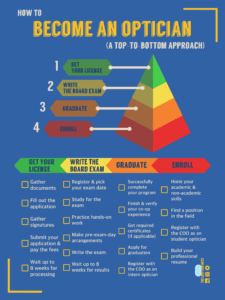
To create your plan of action the best way is the top-down approach. I divided the study period into four general categories;

  • Getting Licensed,
  • Writing the Board Exam,
  • Graduate,
  • and Enroll.

You can assign a time-line to each category, plus definitive sub-categories that are necessary to complete, to climb the pyramid. Here’s when your research collection comes handy!
To paint a clearer picture for you, I used Opticianry as an example in the diagram below. Let’s have a look;

As you see, at the top of the pyramid is “registered/licensed Optician” which is where you want to land after finishing your studies. (Now, of course, getting your license is not the end of the journey, rather it’s the beginning. However, for the sake of this article, our focus is on studies, only.) From the top, we work our way backward, creating a list of requirements step by step. As you progress through school, you can update your plan to reflect your current situation and help you stay on track.

3. Prepare Your Environment

Now that you know what to expect and have your plan of action, it’s time to prepare your environment for execution! And by that I mean, submerging yourself into your field of study. Since we have limited resources, like time and energy, the best way to make the most out of them is to focus our attention. It’s not easy to do so, not at all! But there are things we can do to minimize distraction as much as possible. Let’s get down to it!

First, look at your strengths & weaknesses list.

In Choosing your field of study we talked about how to identify your strengths and weaknesses. Your time at school is the best opportunity to work on improvement areas. It is also an opportunity for you to start building your resume, by relying on your strengths to get involved in extracurricular activities.

Second, start looking for a position in the field.

If you are not currently working in your field of study, I suggest starting your job search ASAP. The position you come across during your job search, probably will not be your dream job. However, I recommend taking it even if it’s slightly/remotely related to your field. This helps to keep your mental energy more focused, and you could explore the career possibilities out there with your specific education. For instance, if you are starting to study Optometry or Opticianry, but don’t have any experience in the optical field look for jobs as a sales associate, or a frame stylist at an optical store, or a receptionist position at an Optometrist’s or Ophthalmologist’s office. 

Third, connect with your teachers, classmates and other students.

Not only you will be creating an academic support system for yourself, but also you might end up making valuable connections that can help you in the future.

And finally, register with the regulatory body and professional association as a student.

As I mentioned in part 1, you will have access to valuable resources, and you get discounts and offers to attend professional events.


Summary

Today we learned the key to making the most of your studies lies in three things, and those are;

  • Do your research, so you know what to expect,
  • Categorize the information you collected to develop a plan of action,
  • Start executing your plan, by preparing your environment to work your way up.

I hope you find this post helpful!
Feel free to share your tips for making the most out of your studies, I would love to hear your thoughts!
Talk to you in the next post!

Opticianry Schools II- NAIT

Opticianry Schools Part II

Welcome to part II of Opticianry Schools! In Part I, we reviewed opticianry schools in Ontario offering the program in traditional-classroom-style delivery. We also did a comparison of the two schools and briefly went over what to expect from your studies.

Here we are going to learn about a third option to become a licensed optician in Ontario, and that is through NAIT – the Northern Alberta Institute of Technology.

I know, sounds a little weird. Alberta and Ontario are some 2000 km apart, and they each have their own rules and regulations for opticians, so how is that you can become a licensed optician in Ontario by studying a program in Alberta?

Well, that’s exactly what I’m going to do in this post; telling you how!

How is NAIT different from Seneca and Georgian college?

In comparison to Seneca and Georgian College, NAIT has a different delivery mode, program structure, and licensing. NAIT offers multiple disciplines under the Optical Sciences field, including accredited and non-accredited programs. We are going to focus on accredited education today.

As discussed in Part I, in Ontario your studies encompass both eyeglasses and contact lenses. You can choose to specialize in one category when you are applying for your license, but you must complete the school’s curriculum nonetheless. At NAIT, however, the accredited education designed for opticians is primarily focused on eyeglasses dispensing. After receiving your diploma, if you wish to expand your scope of practice, you can study a 1-year post-diploma certificate program focused on contact lenses.

Now, let’s take a closer look at things.

NAIT Optical Sciences-Eyeglasses

Delivery Mode & Program Structure

If you are currently working in the eye care field and wish to pursue it professionally, then this program could be a great fit for you. Why? Because, NAIT’s Optical Sciences-Eyeglasses program is an online optician training program, and entry to the program is conditional upon having secured employment with a licensed supervisor, such as a licensed optician, optometrist or ophthalmologist. This is especially important, as your dispensing hours and the practical portion of your studies must be verified by a licensed practitioner for you to be able to graduate.

That means you can get your license without disrupting your work schedule, and build upon your skills in the field you love. It’s a luxury to be able to study and work in the same field; I mean doing one while doing the other!

As an applicant outside of Alberta, you can apply through the Opticians Association of Canada. Once you send your inquiry you will receive an application package, which guides you through the registration process.

NAIT’s online optician training program is 2 years long and made up of 4 terms, each with its own practicum portion.

In year one you will start by learning about frames, basic mathematics and optics, instruments and measurement techniques. Then in 2nd term, you delve deeper by studying communication, prescription interpretation, and design of single vision lenses.

In the 2nd year, you will continue building upon your knowledge by studying eye health (which covers basic principles in anatomy, physiology, and pathology of the eye). You also further your knowledge of dispensing by learning about multi-focal prescription interpretation and lens design. Finally, in term 4, you will learn about patient /practice management, work ethics, and standards of practice. In each term, you are required to complete a Clinical portion, before levelling up.

Licensing

After successfully finishing your online optician training program you will receive your diploma from NAIT. However, you are not entitled to practice independently as an optician yet! First, you have to write the national examination for opticians called NACOR (National Association of Canadian Optician Regulators). Once you passed your NACOR exam, then you can apply to register with the College of Opticians of Ontario. Throughout this process, you have to continue to work under the supervision of a licensed eyecare professional. When you receive your registration number and license from COO, you can officially call yourself an optician!

This was just a brief overview of the optician training programs in Canada, specifically Ontario. If you’re not sure which one is the best fit for you or you have any questions about the different schools, let me know in the comments below!

Choosing Your Field of Study

Choosing Your Field of Study

Choosing your field of study, or more specifically, choosing what to take on as your career, can be one of the hardest decisions anyone has to make in life. No matter what stage of life you are in, it is worth taking some time to get to know yourself better. This is called self-awareness, and if you commit to it before making any life-changing decisions, in a few years when you look back, you will see how much physical, mental, and emotional energy you have saved, not to mention money!

Now, some of you might say that’s not the case for you! And you decided on a career at a young age! If that’s you, well…kudos to you! However, I bet there are some of you who don’t know what to pursue. At least not as of yet! In that case, don’t worry…you are not alone! 

Today, I’m sharing with you a few tips that helped me in making a decision.

Make a list of your strengths & weaknesses

When choosing a field of study it’s a good idea to take inventory of your strengths and weaknesses before committing to anything. All of us have some sort of idea of what we do well and what we don’t. However, having a tangible representation, such as a list, can help in reinforcing the good qualities and developing a plan of action for areas of improvement. I suggest taking your time when preparing this list, maybe over a few days. Try to find a time and place where you cannot be distracted and can gather your thoughts. To start identifying your areas of strength and weakness think of the things you have done and your experiences until this point in time, and look at them objectively.

For instance, think of any subject you have studied at school, hobbies or activities that you do, compliments or criticism you’ve received from someone regarding your character or skills, something you have done or accomplished that made you feel proud or disappointed. If you are still in high school, looking at the rubrics from your assignments and the mark you received can be very helpful to gain more insight into things. Remember to give yourself a break after spending some time thinking and writing. 

You can also, talk to your trusted acquaintances – friends, family, colleagues, etc. – to learn more about yourself. Usually, people see us differently than we see ourselves. It can be interesting to hear their point of view, as well. When you are done, keep your list as a reference to go back to every once in a while to see where you stand with your improvements, and to remind yourself of the good things about you.

Consider Volunteering

How to choose your field of study

Volunteering is a great opportunity to meet new people and learn new things. The experience you gain through volunteer work can impact what you choose to study in the future. 

Try to find a position in a field you are interested in or are curious about. If you are a student try to take on different roles in different industries to expand your views. You might end up hating a field or falling in love with one. Whatever the outcome, you will have a better understanding of your likes and dislikes. If you are interested in giving it a try, check out the links below to get started;

  1. Volunteer Canada
  2. Volunteer Match
  3. Ontario Nature
  4. Canadian Red Cross
  5. Volunteer Ontario
  6. Toronto Charities
  7. City of Toronto
  8. Volunteer Toronto
  9. The CNIB Foundation

Take Personality Tests

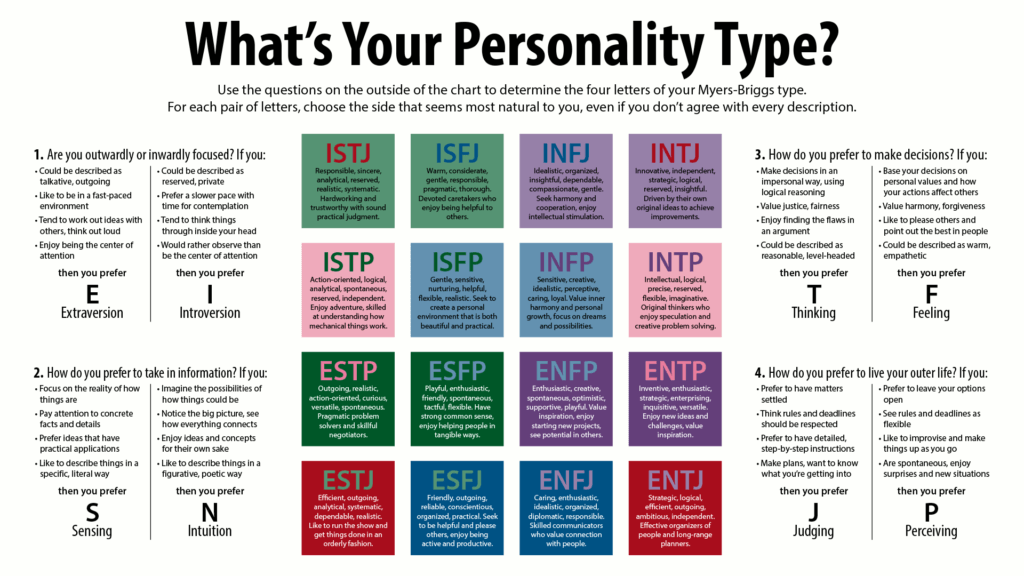
Chart of Myers Briggs Types

Another way to learn more about yourself is by taking standardized personality tests. Standardized Personality tests are tools developed by scientists and scholars, especially in the field of psychology. The purpose of these tests is to identify and categorize different aspects of human behaviour. The insight that these tests give us, can have many practical applications, one of which is finding a suitable field of study or career.

 One of the most popular personality tests out there is the Myer-Briggs Type Indicator or MBTI. Some of you might already be familiar with this test. For those of you who might not be, here’s a little background;

MBTI or Myer-Briggs Type Indicator is named after its developers, Isabel Briggs Myers and Katharine Cook Briggs, a mother-daughter duo, who developed this tool over 30 years of careful study, research, and analysis of similarities and differences between humans. The test identifies 16 personality types each made of 4 major indicators of human behavioural tendencies. Each of these 4 indicators has 2 contrasting qualities. Based on MBTI our personalities are made up of how we view the world, how we perceive information, how we process that information to make decisions, and how we structure our values. Take a look at the chart below, for a summary of these 16 personality types, and their characteristics.

If you can’t wait to find out what your personality type is, and you love to learn and have fun, then you’re going to love these;

Truity

Take Personality Tests

Truity is a website dedicated to psychometric tests, and it offers both free and paid tests. An account is not needed to take the tests and view your results. However, you might want to consider one if you want to save your results & review them later on. What I like about Truity is that the test results include potential career options. And if you find yourself interested in a field you can go ahead and read on job-specific requirements, or take their career aptitude test to narrow down your options. You can take the MBTI test here, for free!

16 Personalities

Take Personality Test

As you might have guessed, 16 Personalities offers only the MBTI test. What makes it interesting is that you can join their community and find like-minded people to connect with, or read on interesting blog posts to learn more about your type and maybe those of your friends!

Frank James

And my personal favourite, Frank James, a Youtuber who specializes in MBTI comedy sketches! So, if you are tired after all the test-taking, check out his channel and refresh with a good laugh. You might also learn a thing or two about other personalities in your life! 😉

Visit Job Bank Canada

Last but not least is a useful resource, great for gaining insight not only into your qualities but also into different fields of study and work. Job Bank Canada provides local, and current data and trends on occupations and fields of study. You can use the career planning tool to;

  • learn about a field of study,
  • take career quizzes or in other words, personality and aptitude tests,
  • discover job profiles,
  • and use the skills and knowledge checklist to take inventory of your abilities.  

I hope this post helps you to have a better understanding of what your desires are. Also, I hope you find these ideas helpful in choosing your field of study. If you are interested to know about my field of study, check out this post. I  also recommend reading this post on optometry, to learn more about careers in the eye care industry.  As always feel free to ask any questions, or leave a comment. I would love to hear about what helped you choose a career!

Opticianry Schools I - Featured Image

Opticianry Schools Part I

In the previous post, we covered what opticianry is and what opticians do. Today, we are going to learn about education and training options available for those of you interested in entering the field. I decided to write this post in two parts to keep things easy to navigate through. Now, let’s get started with the part I of Opticianry Schools!

Opticianry Schools in Ontario

Like most college programs, opticianry is a combination of theoretical and practical work and is usually offered as a two-year full-time program. In Ontario, there are two schools offering Ontario College Diploma in opticianry; Seneca College, located in Toronto, and Georgian College, located in Barrie. Both schools have facilities to teach practical courses, which gives students the opportunity to learn the procedures and work with the common tools & instruments. Although what both schools have to offer are fundamentally similar, you might prefer the curriculum design of one over the other. Ultimately, your decision comes down to your life situations. I prepared a comparison chart for you, with external links, to give you a glimpse of what you could expect from each school. Let’s take a look;

Seneca Vs. Georgian

 Seneca CollegeGeorgian College
Program NameOpticianryOpticianry
Program CodeOPTCOPTI
LocationNewnhamBarrie
Duration4 Semester (2 years)4 Semester (2 years)
Co-op OptionAvailable & MandatoryAvailable & Mandatory
Credentials AwardedOntario College DiplomaOntario College Diploma
SchoolSchool of Health SciencesSchool of Health, Wellness and Sciences
DeliveryFull-time & Part-timeFull-time
Start DateSeptemberSeptember & January
Admissions RequirementsOntario Secondary School Diploma (OSSD), or equivalentEnglish: Grade 12 C or U, or equivalent courseMathematics: Grade 12 C or U, or equivalent courseScience: Grade 12 C or U chemistry or physics, or Grade 11 C or U biology, or an equivalent courseMature ApplicantsOthersOntario Secondary School Diploma (OSSD), or equivalentEnglish: Grade 12 C or UMathematics: Grade 12 C or UGrade 11 or 12 Biology (C or U) OR Grade 11 (U) or Grade 12 (C or U) ChemistryOR Grade 11 or 12 (U), or Grade 12 (C) PhysicsMature Applicants & Others
Courses  Downloadable PDFDownloadable PDF
Tuition$7,247$3,057.26
Books & Supplies$1,485$1,023.07
Seneca VS. Georgian

Subjects Covered

I mentioned in this post, that opticianry is a mix of hard and soft sciences. So if you are thinking about studying opticianry, it would be really helpful to have some background knowledge in; biology, mathematics, physics (specifically optics), business and communications, and chemistry. However, don’t worry if that’s not the case for you! There are many resources available at both schools to help you succeed in your studies. In general, these are the subjects you can expect to study throughout your program (with each school having its variations of the titles);

Anatomy and Physiology of the Eye:

You will study the structures of the human eye and how they work in relation to each other and the nervous system to produce vision. Check out lesson 4 for a head start.

Geometric Optics:

In this course, you will learn the fundamental principals of optics, which is the study of what light is, how it helps us see and how it behaves. Check out lesson 1, to start learning.

Ophthalmic Optics:

This course builds on your Geometric Optics foundation, and focuses mainly on corrective eyeglass lenses and their properties. See lesson 2 & lesson 3 to learn the basic principals.

Eyeglass Dispensing Theory:

This course teaches you about the most common refractive errors, how to identify them by looking at a prescription for eyeglasses, how to correct them, how to take necessary measurements, what type of lens to use, and what type of frame to choose to meet your patient’s specific needs.

Eyeglass Dispensing Labs:

This course puts your theoretical knowledge to practice. You get to work in pairs or groups to practice dispensing procedures with or on your classmates. Get ready to get intimate! You will also, work individually and will learn how to fix or adjust a pair of glasses, and how to neutralize one.

Eyeglass Fabrication Labs:

In this lab you will learn how to shape a pair of lenses to fit into an eyeglass frame. You are going to apply your knowledge in dispensing to troubleshoot your work, and you will learn some new techniques.

Contact Lens Dispensing Theory:

This course will give you the fundamental knowledge on contact lenses including, but not limited to; types, applications, and dispensing procedures.

Contact Lens Dispensing Labs:

If you thought eyeglass dispensing lab was intimate, wait until you attend a contact lens dispensing lab! Here you will usually work in pairs, and get to practice contact lens dispensing procedures on your poor classmates. You will also work with a variety of instruments involved in contact lens fitting, and you will learn fitting procedures, assessment, and troubleshooting techniques.

Business courses:

You will study some introductory business courses to learn about economics, procedures involved in establishing your own business, and more.

Communications courses:

You will study introductory communications courses, which covers the following topics; communication in different settings, across cultures, within groups and organization, and more.

Pathology of the Eye:

Pathology is the study of disease, conditions, and abnormalities of a system, in this case, the human eye. You will learn to identify signs of various eye diseases and conditions.

Professional Education:

This subject covers the ethics and scope of practice regulated by the College of Opticians of Ontario. You will learn standards of practice in Ontario. Depending on the program’s demands, you might learn other useful information that will help you in practice such as product knowledge, customer service, and marketing basics.

Refraction:

In this course, you will learn the necessary procedures for determining a patient’s prescription. As of now, opticians in Ontario are not allowed to refract. However, knowledge of refraction will help you to communicate with other professionals (i.e optometrists) effectively and dispense eyewear with more confidence, plus you’d be able to provide better customer care.


Summary

Today, we learned about opticianry schools in Ontario. We briefly compared the two schools offering opticianry diploma and went over the subjects taught in those schools. In part II  I will introduce an alternative option to study opticianry. Meanwhile, go ahead and check out our courses and articles to start learning some basics, and join our newsletter to receive updates. Don’t forget to download the course lists available for you in the chart, it will give you a clearer picture of how the two curricula compare. And finally, feel free to ask your questions in the comments section below, and I’ll try my best to answer them. Cheers!