Introduction to Lenses The Index - Featured

Introduction To Lenses – The Index

Hello and welcome to the first lesson of The Lost Contacts’ Introduction To Optical Dispensing course! Before tackling this course, please keep in mind that it is meant to build on the knowledge laid out in The Lost Contacts’ The Optics of Vision course. Please make sure you are familiar with the topics in that course before taking this one.

Today’s topic will be something known as a lens index. But let’s make sure we’re familiar with a few things first.

What is a Lens?

Basically, a lens is a clear (transparent) & curved material used for the purpose of refracting light.

Please review The Optics of Vision – Lesson 2: Introduction to Lenses for more information about what lenses are.

What is Refraction?

Refraction is what happens to light when it passes from one medium to another.

A medium in this context is anything that light can travel through. For example, the first medium for light produced by the sun is the vacuum of outer space.  Eventually it reaches Earth and then switches medium from space to Earth’s atmosphere (air). Then it switches medium again when it enters your eyes.
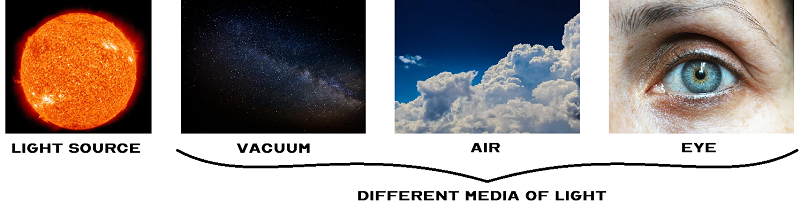
Different media of light

Other common examples of media that light can travel through are: water, glass & clear plastics.

Whenever light passes from one medium to another, the trajectory of the light changes. This change in trajectory is referred to as refraction. Lenses (usually plastic or glass) are a different medium than the air around them. So as light passes through lenses, it is refracted.

Generally speaking, the denser the medium is, the more it will change the trajectory of the light. Every medium has a different index of refraction, which is a number describes how much it changes the path of light.

The Index of Refraction

In this lesson, we will learn about one of the most important properties of a lens; the index of refraction.

Nowadays, lenses for glasses are made from plastic – not glass. But there isn’t just one plastic that’s used for all lenses. We have a lot of different plastics at our disposable when making a pair of glasses.

The reason for having so many types of plastics to make lenses is to take advantage of their different indices of refraction.

Let me explain.

As mentioned before, different media with different indices of refraction will alter the trajectory of light passing through them by varying amounts.

  • Plastic lenses that have a lower index of refraction will not bend light as much and therefore the focal point will be further away.
  • Plastic lenses that have a higher index of refraction will bend light more and therefore the focal point will be closer.

You may recall from The Optics of Vision – Lesson 3: Lens Power, that the curvature of lenses also affects where the focal point will be.

  • Plastic lenses that have a lower curvature will result in the focal point being further away.
  • Plastic lenses that have a higher curvature will result in the focal point being close.

This means that we now have 2 tools with which to adjust the position of the focal point; the curvature of lens and the index of refraction of the lens.

In the every day operations of an optical store, the index of refraction is simply referred to as ‘the index’.

Why Is The Index Important?

As you may already intuitively know, the more curved a lens is, the thicker it will be. That means that people with prescriptions for strong lenses will have thick lenses. But when it comes to lenses that we wear on our heads all day long, we don’t want those lenses to be too thick.

The solution is to increase the index. Doing this allows us to reduce the curvature (which reduces the thickness) without affecting the focal point of the lens.

Here are two lenses of the same power side by side. Notice that one of them is significantly thicker than the other. This is because they are made from two different lens indices.
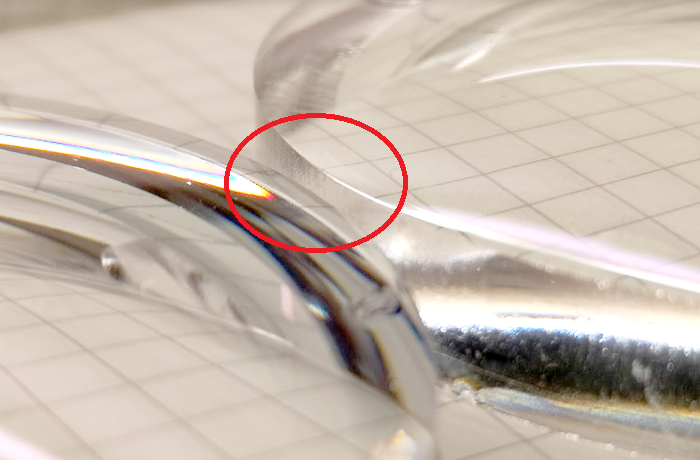
-4.00 normal versus high index lens
Notice the difference in edge thickness in the red circle.

Different Lens Indices


1.50 Index

  • Also known as CR-39.
  • 1.50 CR-39 is the ideal lens index for low prescriptions. It is the least expensive lens material, but also the thickest.
  • Recommended for prescriptions between +2.00 and -3.00
  • 1.50 CR-39 lenses block some but not all UV light.

Keep in mind that 1.5 is not very impact resistant and should not be sold to people who are prone to breaking their glasses/lenses.

Be careful when mounting 1.50 CR-39 lenses into certain frames as they are prone to chipping.


1.53 Index

  • Also known as Trivex.
  • 1.53 Trivex is a light-weight and highly impact resistant lens material. It is more expensive than 1.5 CR-39, but also a little thinner.
  • 1.53 Trivex blocks 100% of UV light.

1.59 Index

  • Also known as polycarbonate.
  • 1.59 polycarbonate is also light-weight and highly impact resistant. It is slightly thinner than 1.53 Trivex but also slightly heavier.
  • 1.59 polycarbonate blocks 100% of UV light.

1.53 Trivex and 1.59 polycarbonate have very similar uses. They are generally used for children’s glasses & safety glasses.


1.61 Index

  • 1.61 index lenses and above are considered to be ‘high index’ lenses. 1.61  index offers considerably thinner lenses than 1.50.
  • Recommended for prescriptions +2.50 to +4.50 and -3.00 to -5.00.
  • 1.61 index lenses block 100% of UV light.

1.67 Index

  • 1.67 index is similar to 1.61 index but used for even strong prescriptions.
  • Recommended for prescriptions +4.50 or higher and -5.50 or higher.
  • 1.67 index lenses block 100% of UV light.

1.74 Index

  • 1.74 is the thinnest and also most expensive lens material offered by most optical stores. The benefits of 1.74 are marginal as it does not make lenses considerably thinner than 1.67, but it does make them considerably more expensive.
  • It can be used instead of 1.67 if customers insist on the thinnest lenses possible.
  • 1.74 index lenses block 100% of UV light.

Here is a diagram showing the relative thicknesses of different lens indices.
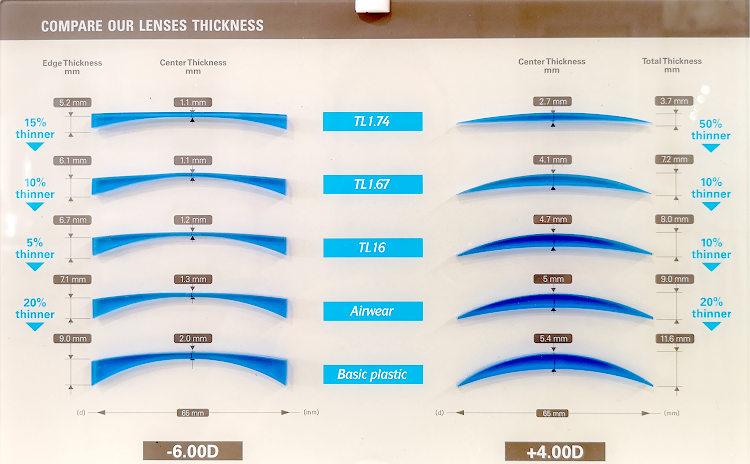
Lens Index Comparisons
From bottom to top the lens indices shown above are 1.53, 1.59, 1.6, 1.67, 1.74

Clear Lenses Can Block 100% of UV light?

Yes, all lens indices except for 1.50 CR-39 block 100% of UV light and yet they are not tinted. This is something that most people aren’t aware of as we usually think of lenses that block UV light to be sunglasses (tinted lenses).

Despite the fact that clear lenses can block 100% of UV light, that does not mean that sunglasses aren’t necessary. Sunglasses are generally larger and hence offer more protection then regular glasses as well as increased visual comfort from reducing the overall brightness.

Remember to Look at the Cylinder

Recommended power rangers for different lens indices typically just show the ‘sphere’ power. But what if your customer has ‘sphere’ and ‘cylinder’ in his/her prescription?

FOR EXAMPLE

If this is your customer’s prescription:
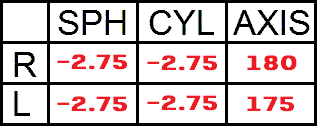
example prescription of compound myopic astigmatism

You see a bunch of -2.75 everywhere so you might think that 1.50 index would work fine for this prescription. But this would be incorrect.

What a prescription with cylinder is really saying is that half of the lens contains the ‘sphere’ power only, and the other half has the ‘sphere’ + ‘cylinder’ power.

This means that the strongest portion of the lenses in this example prescription above would be -5.50 (-2.75 + -2.75).

Making these lenses with 1.50 index would result in half the lenses being very thick. Therefore, 1.67 index would be a more appropriate.

Remember to Look at the Add

The ‘add’ power is similar to the ‘cylinder’ power in that it get’s added to the ‘sphere’ power when making reading glasses.

FOR EXAMPLE

If this is your customer’s prescription:
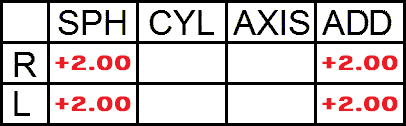
example prescription of hyperopia and presbyopia

If you only look at the sphere or the add you might think that 1.50 index would be appropriate for this prescription. But that would be incorrect.

An ‘add’ is always added to the ‘sphere’ when making reading glasses.

This means that the strength of the reading glasses in this example would be +4.00 (+2.00 + +2.00).

Making these reading glasses with 1.50 index would result in glasses that are thick and heavy. Therefore, 1.61 index would be more appropriate.

The Index of Refraction of Other Materials

If you’re interested in learning what the index of refraction of other materials like air, water, glass, ice, diamonds, & more, click here.

Summary

When making glasses, we select the most appropriate lens index for the every prescription in order to maximize the satisfaction of the customer. Knowing the different lens indices and when to use them will make you a much better eye-wear consultant and optical associate.  Please take the time to memorize the different indices and be sure to keep a reference chart for each index’s prescription range somewhere in your store.

Next in this lesson series we will learn about something called the base curve.

==> CLICK HERE TO READ ‘INTRODUCTION TO LENSES – THE BASE CURVE’ <==

Opticianry Schools I - Featured Image

Opticianry Schools Part I

In the previous post, we covered what opticianry is and what opticians do. Today, we are going to learn about education and training options available for those of you interested in entering the field. I decided to write this post in two parts to keep things easy to navigate through. Now, let’s get started with the part I of Opticianry Schools!

Opticianry Schools in Ontario

Like most college programs, opticianry is a combination of theoretical and practical work and is usually offered as a two-year full-time program. In Ontario, there are two schools offering Ontario College Diploma in opticianry; Seneca College, located in Toronto, and Georgian College, located in Barrie. Both schools have facilities to teach practical courses, which gives students the opportunity to learn the procedures and work with the common tools & instruments. Although what both schools have to offer are fundamentally similar, you might prefer the curriculum design of one over the other. Ultimately, your decision comes down to your life situations. I prepared a comparison chart for you, with external links, to give you a glimpse of what you could expect from each school. Let’s take a look;

Seneca Vs. Georgian

 Seneca CollegeGeorgian College
Program NameOpticianryOpticianry
Program CodeOPTCOPTI
LocationNewnhamBarrie
Duration4 Semester (2 years)4 Semester (2 years)
Co-op OptionAvailable & MandatoryAvailable & Mandatory
Credentials AwardedOntario College DiplomaOntario College Diploma
SchoolSchool of Health SciencesSchool of Health, Wellness and Sciences
DeliveryFull-time & Part-timeFull-time
Start DateSeptemberSeptember & January
Admissions RequirementsOntario Secondary School Diploma (OSSD), or equivalentEnglish: Grade 12 C or U, or equivalent courseMathematics: Grade 12 C or U, or equivalent courseScience: Grade 12 C or U chemistry or physics, or Grade 11 C or U biology, or an equivalent courseMature ApplicantsOthersOntario Secondary School Diploma (OSSD), or equivalentEnglish: Grade 12 C or UMathematics: Grade 12 C or UGrade 11 or 12 Biology (C or U) OR Grade 11 (U) or Grade 12 (C or U) ChemistryOR Grade 11 or 12 (U), or Grade 12 (C) PhysicsMature Applicants & Others
Courses  Downloadable PDFDownloadable PDF
Tuition$7,247$3,057.26
Books & Supplies$1,485$1,023.07
Seneca VS. Georgian

Subjects Covered

I mentioned in this post, that opticianry is a mix of hard and soft sciences. So if you are thinking about studying opticianry, it would be really helpful to have some background knowledge in; biology, mathematics, physics (specifically optics), business and communications, and chemistry. However, don’t worry if that’s not the case for you! There are many resources available at both schools to help you succeed in your studies. In general, these are the subjects you can expect to study throughout your program (with each school having its variations of the titles);

Anatomy and Physiology of the Eye:

You will study the structures of the human eye and how they work in relation to each other and the nervous system to produce vision. Check out lesson 4 for a head start.

Geometric Optics:

In this course, you will learn the fundamental principals of optics, which is the study of what light is, how it helps us see and how it behaves. Check out lesson 1, to start learning.

Ophthalmic Optics:

This course builds on your Geometric Optics foundation, and focuses mainly on corrective eyeglass lenses and their properties. See lesson 2 & lesson 3 to learn the basic principals.

Eyeglass Dispensing Theory:

This course teaches you about the most common refractive errors, how to identify them by looking at a prescription for eyeglasses, how to correct them, how to take necessary measurements, what type of lens to use, and what type of frame to choose to meet your patient’s specific needs.

Eyeglass Dispensing Labs:

This course puts your theoretical knowledge to practice. You get to work in pairs or groups to practice dispensing procedures with or on your classmates. Get ready to get intimate! You will also, work individually and will learn how to fix or adjust a pair of glasses, and how to neutralize one.

Eyeglass Fabrication Labs:

In this lab you will learn how to shape a pair of lenses to fit into an eyeglass frame. You are going to apply your knowledge in dispensing to troubleshoot your work, and you will learn some new techniques.

Contact Lens Dispensing Theory:

This course will give you the fundamental knowledge on contact lenses including, but not limited to; types, applications, and dispensing procedures.

Contact Lens Dispensing Labs:

If you thought eyeglass dispensing lab was intimate, wait until you attend a contact lens dispensing lab! Here you will usually work in pairs, and get to practice contact lens dispensing procedures on your poor classmates. You will also work with a variety of instruments involved in contact lens fitting, and you will learn fitting procedures, assessment, and troubleshooting techniques.

Business courses:

You will study some introductory business courses to learn about economics, procedures involved in establishing your own business, and more.

Communications courses:

You will study introductory communications courses, which covers the following topics; communication in different settings, across cultures, within groups and organization, and more.

Pathology of the Eye:

Pathology is the study of disease, conditions, and abnormalities of a system, in this case, the human eye. You will learn to identify signs of various eye diseases and conditions.

Professional Education:

This subject covers the ethics and scope of practice regulated by the College of Opticians of Ontario. You will learn standards of practice in Ontario. Depending on the program’s demands, you might learn other useful information that will help you in practice such as product knowledge, customer service, and marketing basics.

Refraction:

In this course, you will learn the necessary procedures for determining a patient’s prescription. As of now, opticians in Ontario are not allowed to refract. However, knowledge of refraction will help you to communicate with other professionals (i.e optometrists) effectively and dispense eyewear with more confidence, plus you’d be able to provide better customer care.


Summary

Today, we learned about opticianry schools in Ontario. We briefly compared the two schools offering opticianry diploma and went over the subjects taught in those schools. In part II  I will introduce an alternative option to study opticianry. Meanwhile, go ahead and check out our courses and articles to start learning some basics, and join our newsletter to receive updates. Don’t forget to download the course lists available for you in the chart, it will give you a clearer picture of how the two curricula compare. And finally, feel free to ask your questions in the comments section below, and I’ll try my best to answer them. Cheers!

What is Opticianry - Featured Image

What is Opticianry?

Opticianry is an exciting field of study, as it touches on a variety of topics, from hard and soft sciences to design and art. However, if we define the word “Opticianry” in itself, it is the practical study of light and its properties (i.e. optics), as applied to correct problems associated with the human visual system.

  • What does that mean?

Well, it basically means opticianry is the practice of making or dispensing eyeglasses, contact lenses, and other visual aid devices.

Now that you have a rough idea of what opticianry is, let’s get technical and take a look at who opticians are and what they do, exactly!

Let’s get started!

Who Are Opticians?

Opticians are, in some sense, interpreters. They interpret prescriptions written by Ophthalmologists & Optometrists and dispense eyeglasses, contact lenses, and other visual aid devices, accordingly.

Like Ophthalmologists & Optometrists, Opticians are regulated healthcare professionals, too. According to WES;

“The government regulates occupations that affect a large number of people directly, such as those in healthcare, engineering, law, finance, and education. In a regulated profession, you need a license or certificate from the regulatory body that governs that occupation to be employed in that field.”

In Ontario, the College of Opticians of Ontario (COO) regulates Opticians. COO protects public safety by ensuring Opticians follow standards of practice of the profession.

What-is-opticianry-coo-logo

Besides the COO there are 9 other provincial regulatory bodies for opticians in Canada, including;

College of Opticians of British Columbia

Alberta College & Association of Opticians

Saskatchewan College of Opticians

The Opticians of Manitoba

Opticians Association of New Brunswick

Nova Scotia College of Dispensing Opticians

P.E.I. Board of Dispensing Opticians                  

The Dispensing Opticians Board of Newfoundland and Labrador

Each provincial regulatory body has its own set of regulations that could be slightly different from other provinces. But who regulates them?

Well, that would be NACOR’s job!


NACOR’s logo

NACOR is the National Association of Canadian Optician Regulators. In the future, I will tell you more about what NACOR does…stay tuned!

What Do Opticians Do?

Sometimes people confuse Opticians with Optometrists and vice versa. While there are some similarities between the two professions, they are, in fact, two different fields of study. To help distinguish between the two, imagine a lab setting. The optometrists would be the scientists, and the opticians would be the lab technicians. To learn about what optometrists do check out this page. For now, let’s have a look at what opticians do.

Refraction: In eye care settings, refraction is the procedure through which an eye care professional checks a patient’s visual acuity and determines his/her prescription for glasses. As of now only a small number of opticians in Ontario perform refraction.

Opticianry-Optician's tools-Consultation

Consultation: Opticians consult their client in choosing eyewear that is both compatible with the prescription and the client’s needs. They can also consult patients on eye care and eyewear care, and refer them to other health professionals when necessary.

Opticianry-Optican's-tools-Measurement-pd-meter

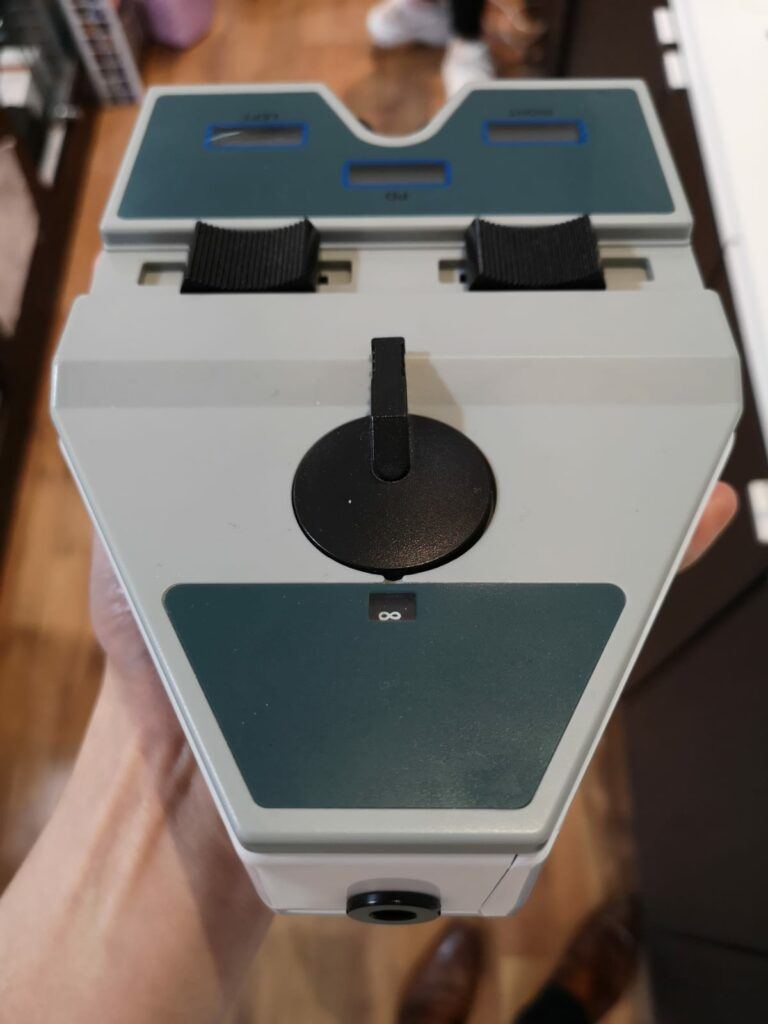
Measurements: This is a crucial part of opticians’ job. Whether fitting a pair of glasses, contact lenses or other visual aid devices accurate measurements are key to patients’ comfort and satisfaction.

Opticianry-Optician's tools-Adjustment

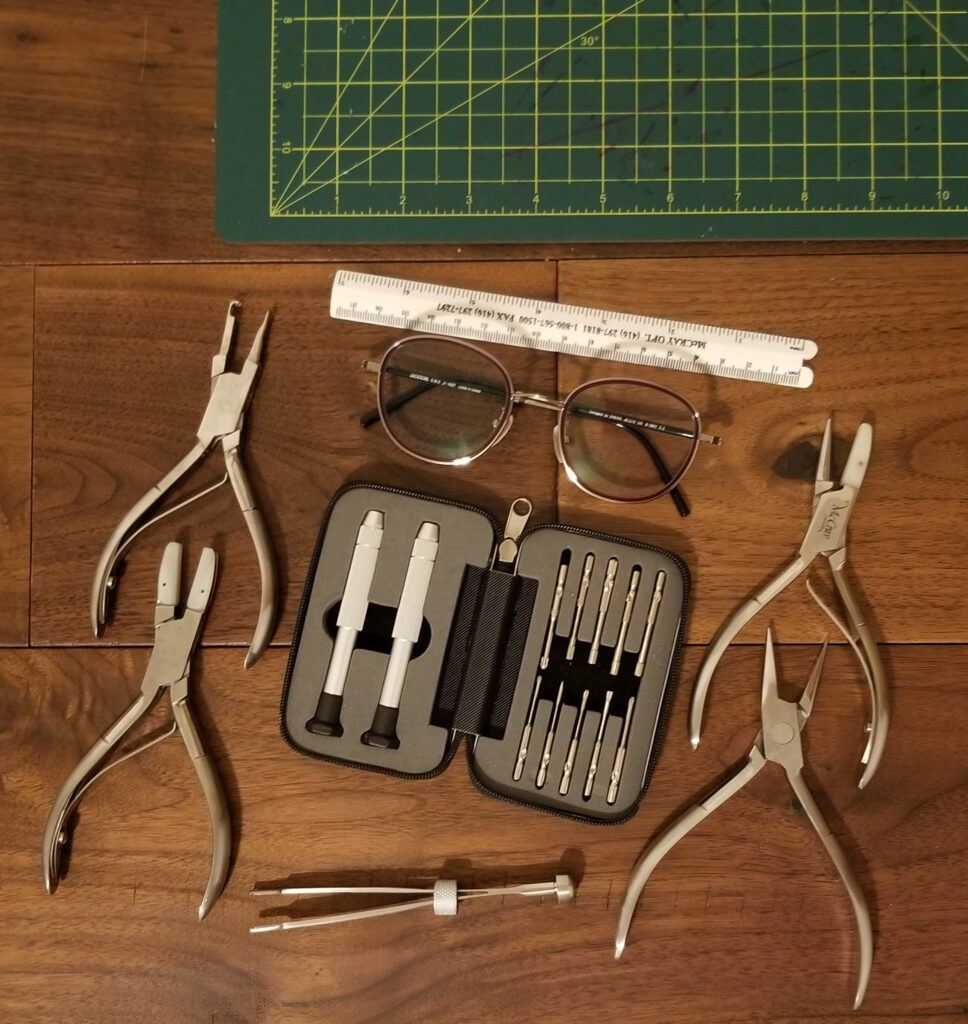
Adjustments: Adjustment is another crucial step! In fact, adjustments can make or break the accuracy of measurements. Adjustment and measurement usually happen simultaneously, based on the optician’s judgement.

Opticianry-Fabrication-auto-lens-groover

Fabrication: Fabrication is the process of making a pair of glasses based on an order form. Fabrication includes interpreting the data collected during consultation and measurement and edging (i.e. cutting) a pair of lenses to fit into an eyeglasses’ frame.

Opticianry-Neutralization-auto-lensometer

Neutralization: Is the process of verifying the prescription of a pair of glasses against an existing order, for accuracy.

Opticianry-Dispensing-woman-trying-on-eyeglasses

Dispensing: Is the final step in which the optician gives the ready-made eyewear to the client to physically try on. This is when both the optician and the client get a chance to see whether the eyewear is functioning the way it should be. So, it is an opportunity for both to address any issues.

Do you find Opticianry interesting? Do you like to know more about it? Then go ahead and check out my post on How to become an Optician.

There are many other aspects of an optician’s job that I will share with you in future posts. Meanwhile, feel free to ask your questions or leave a comment in the comments section below. Don’t forget to like, share, and subscribe to our newsletter, if you find this post helpful. 

Talk to you soon!