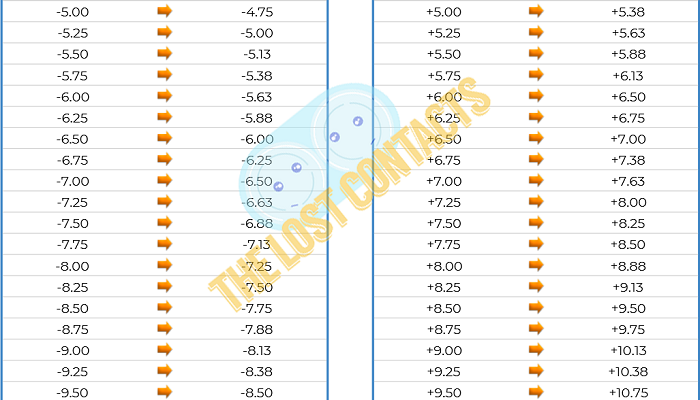
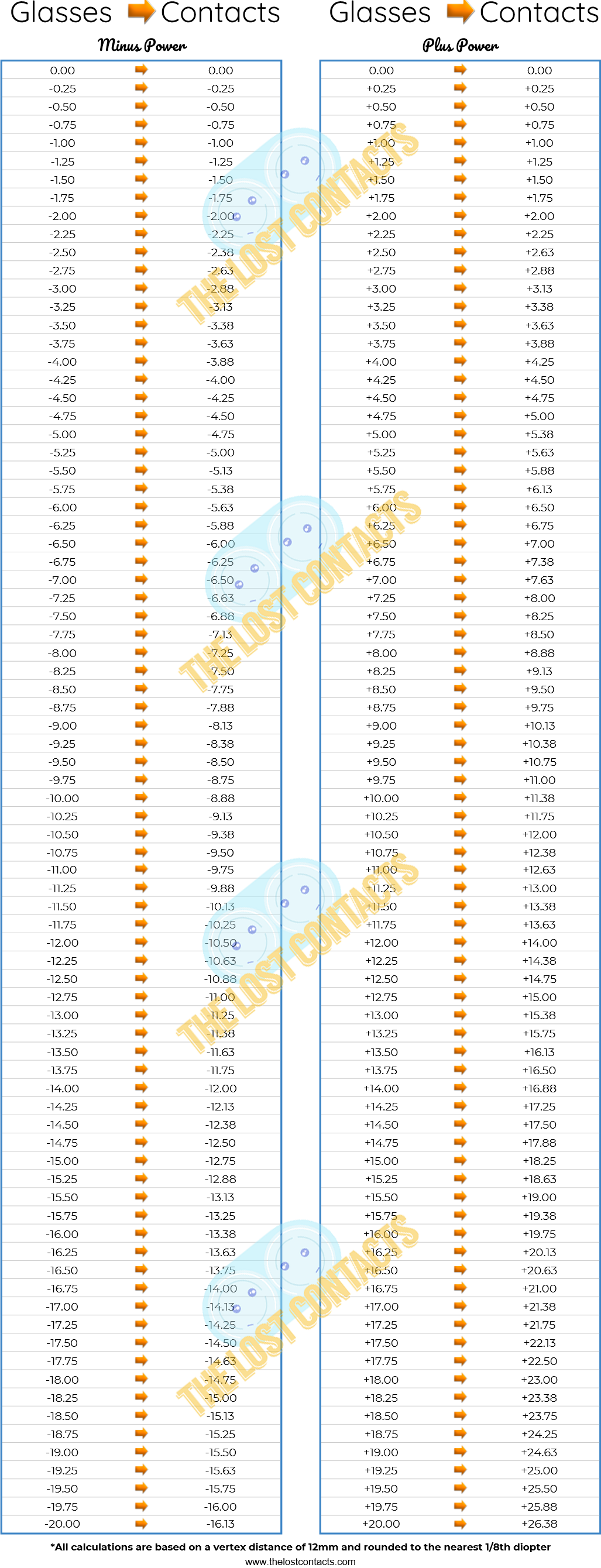
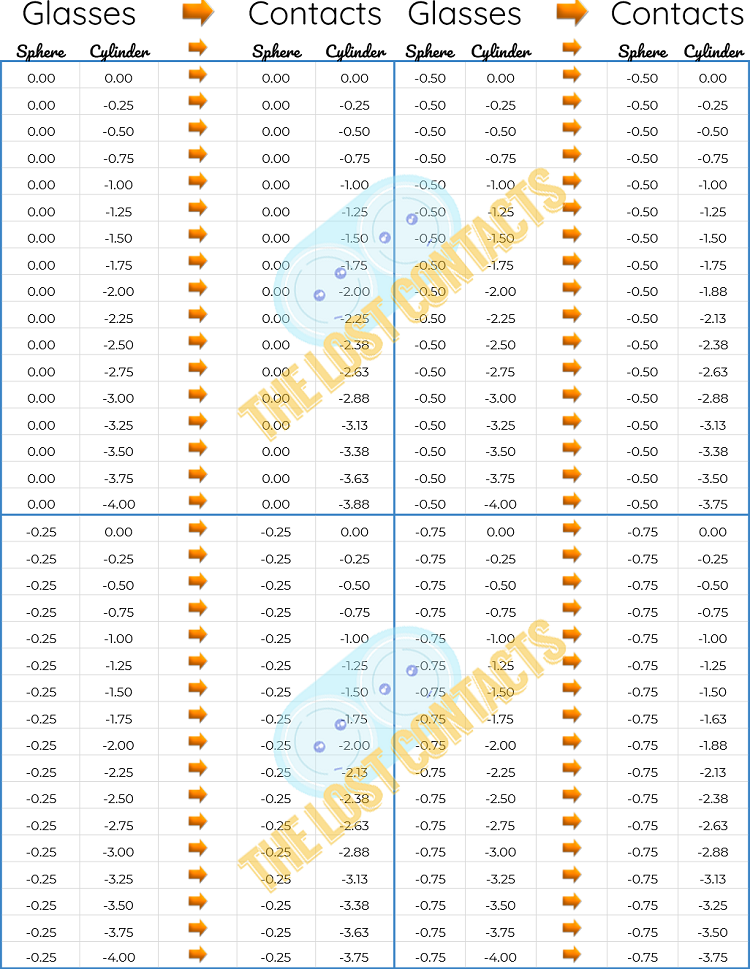
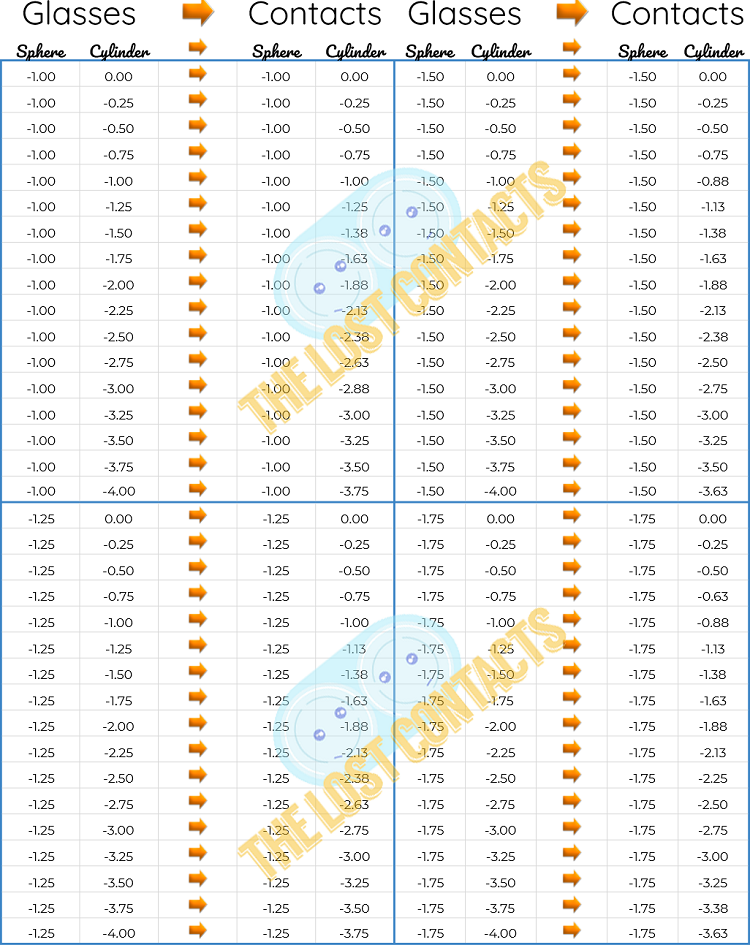
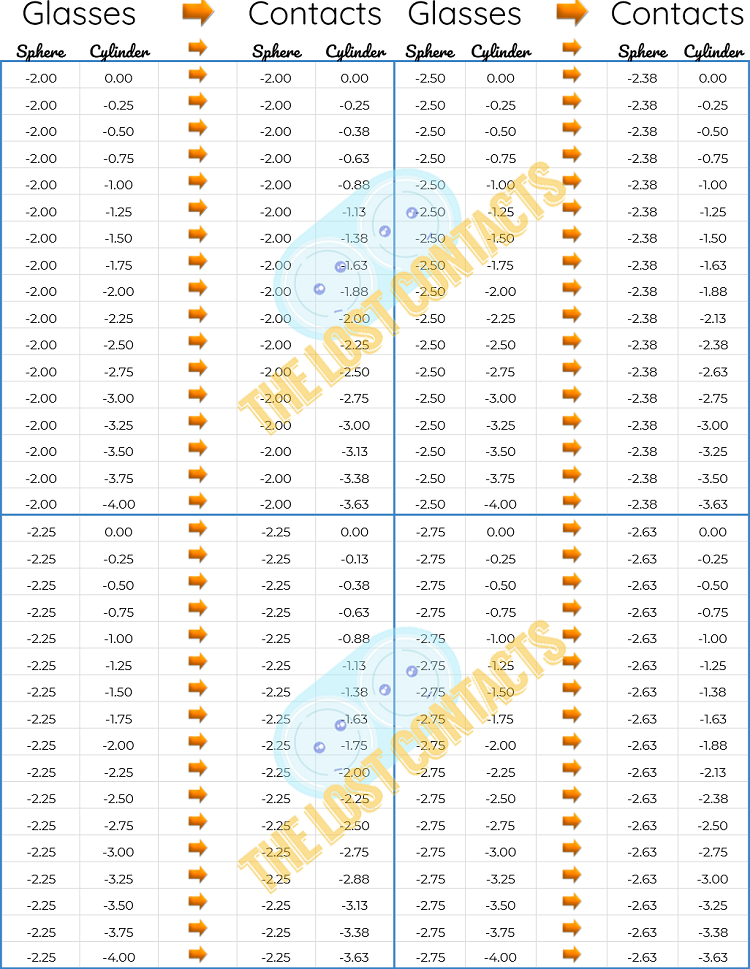
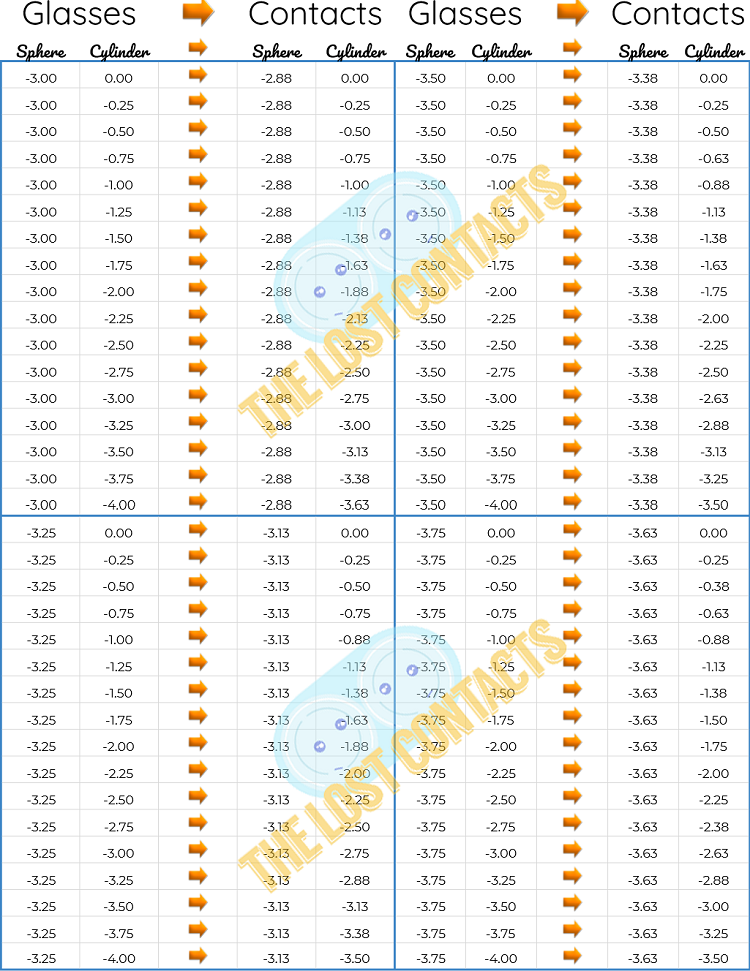
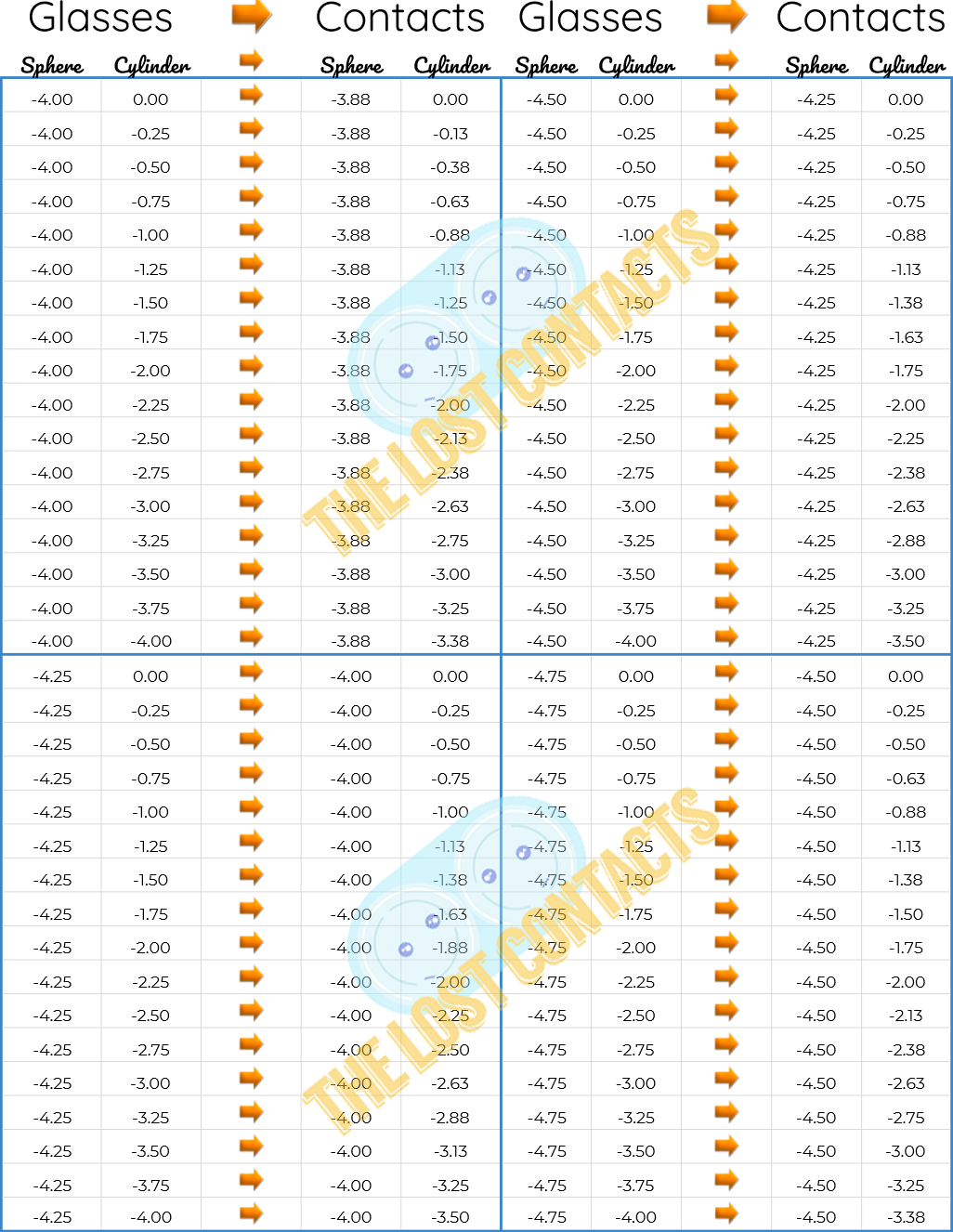
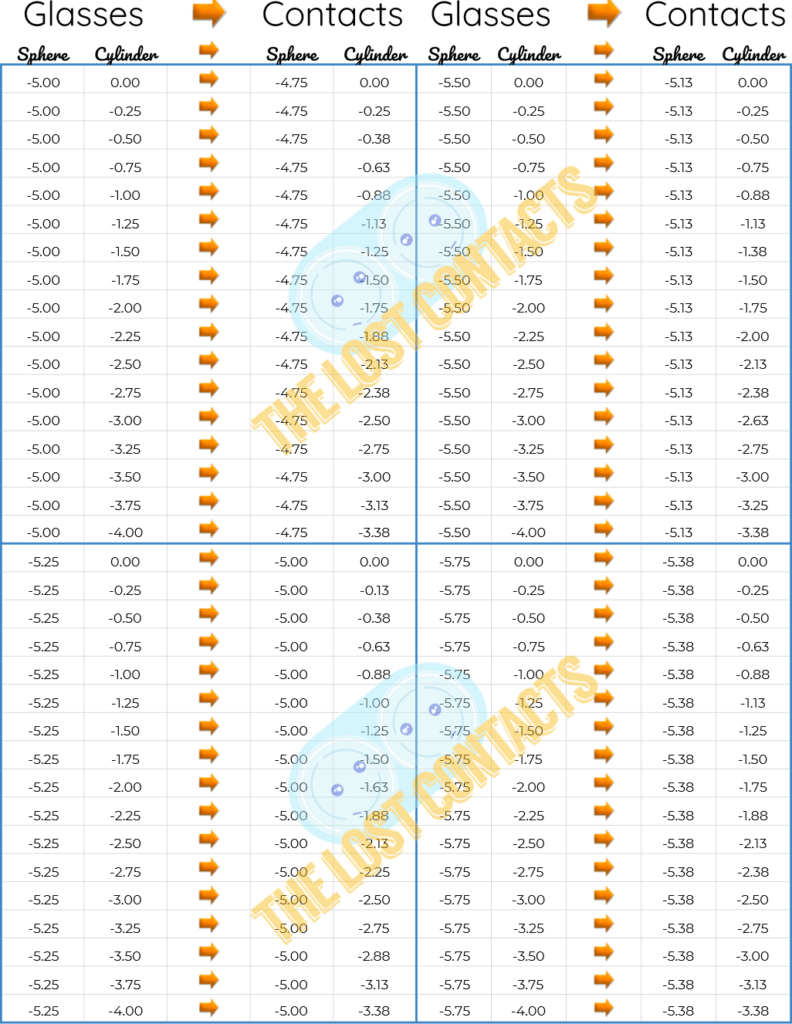
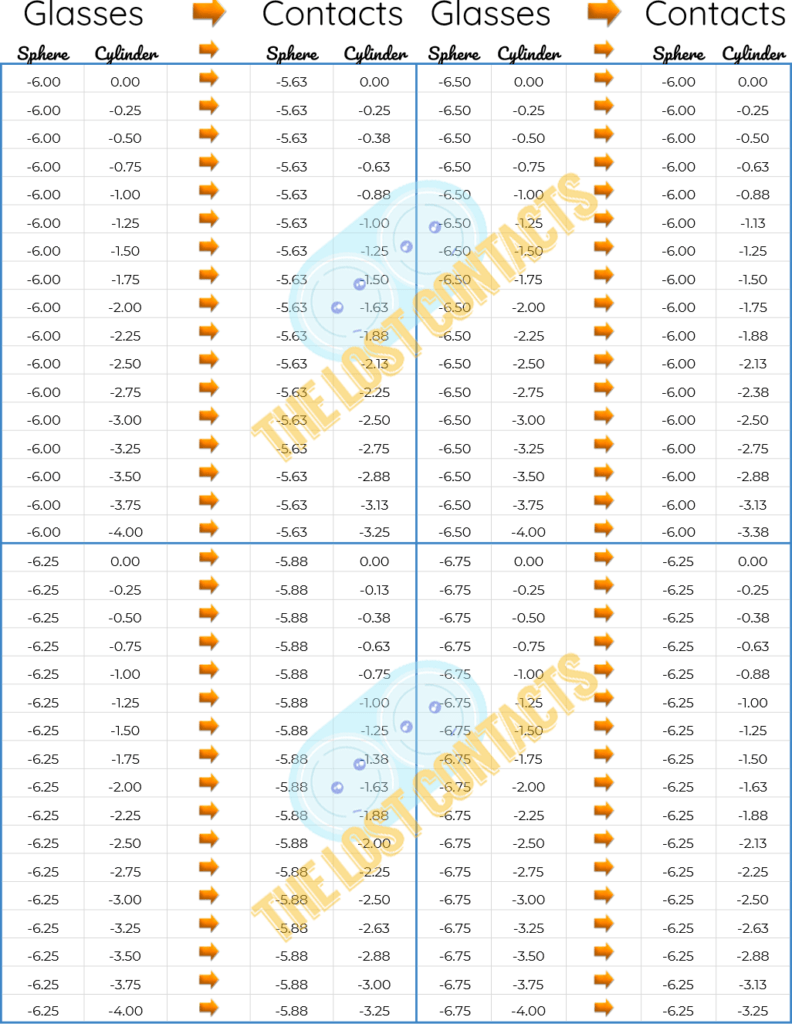
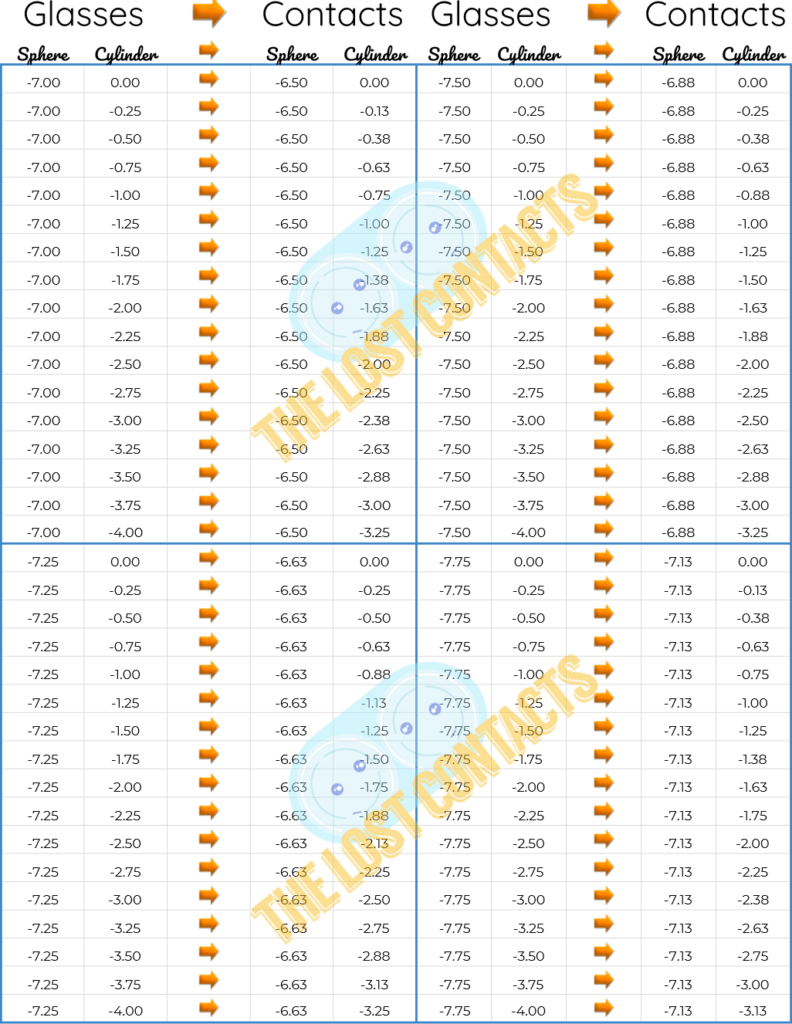
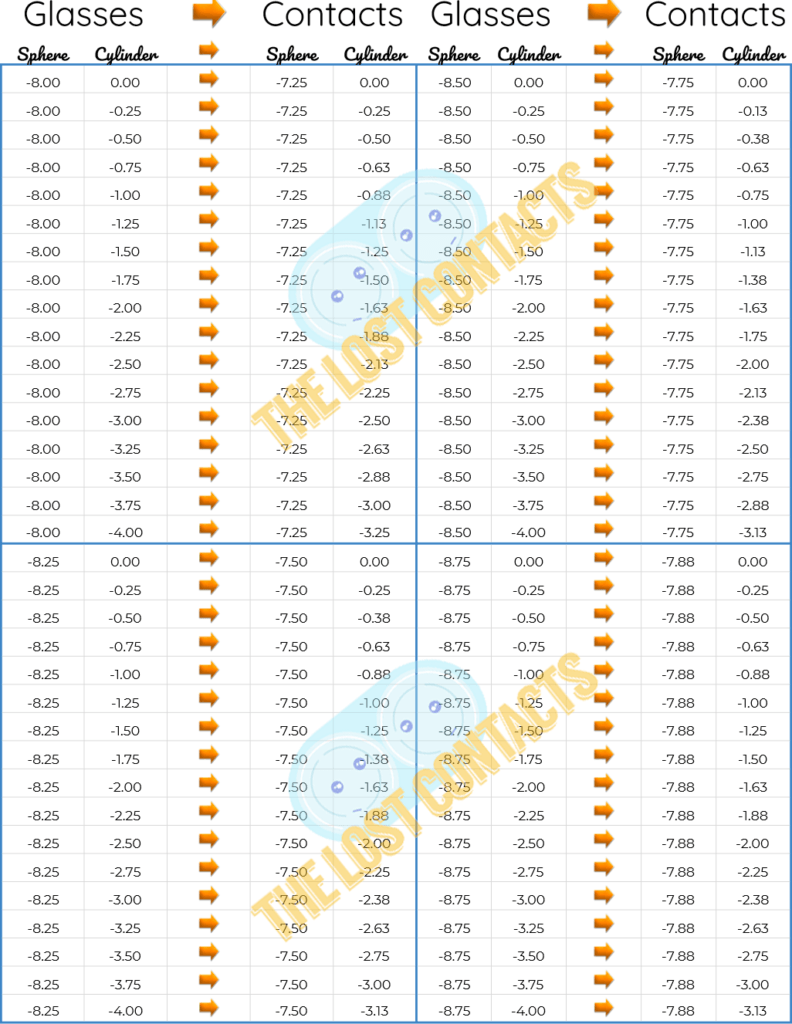
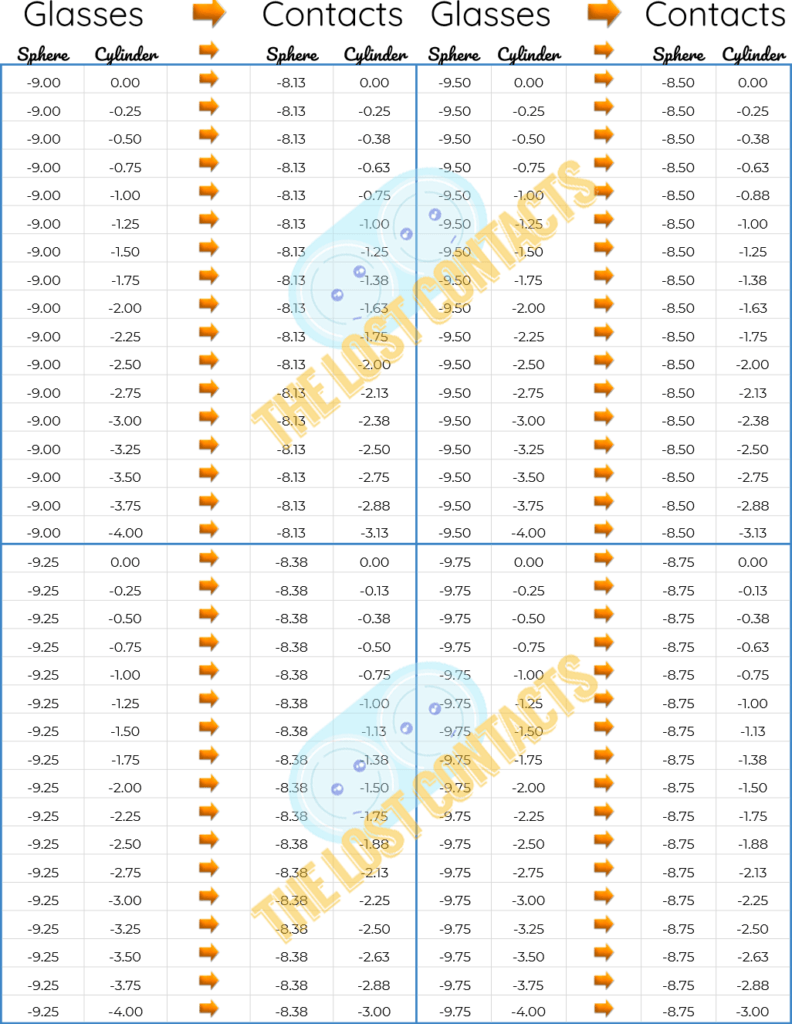
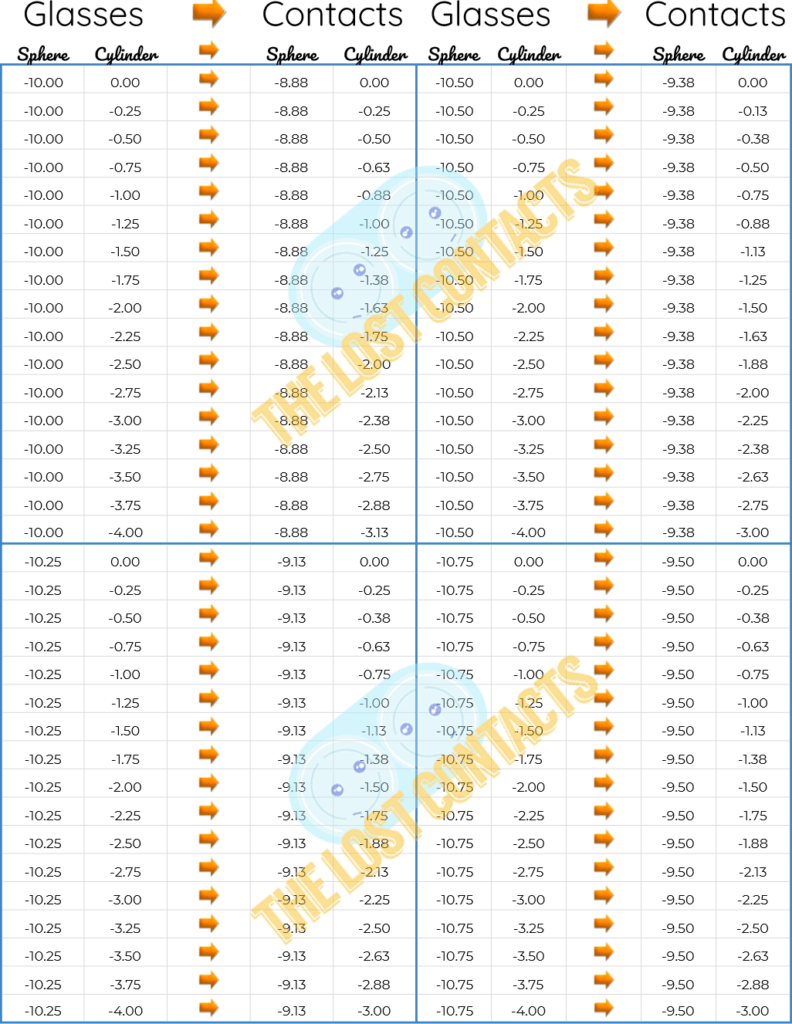
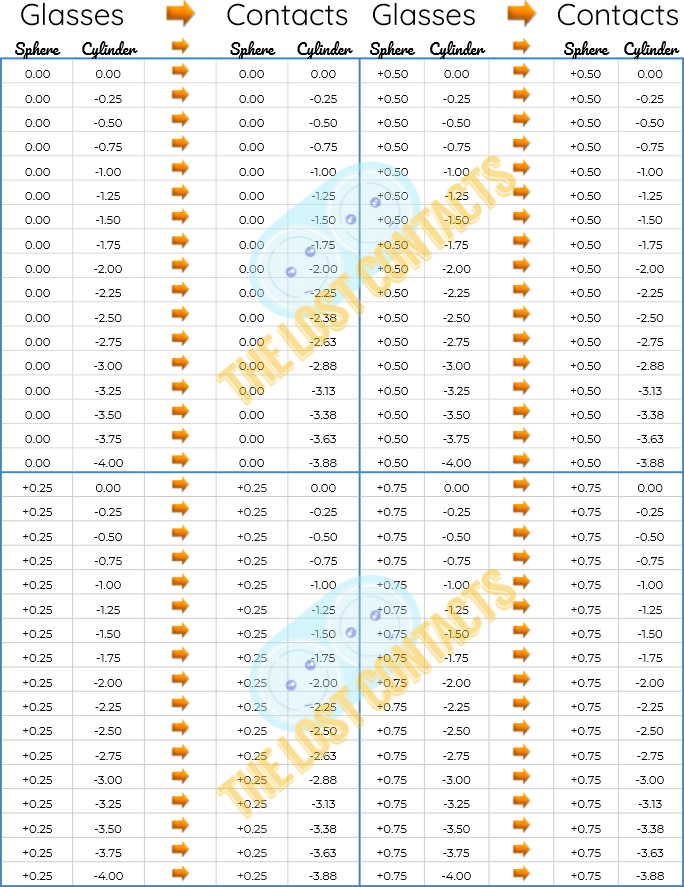
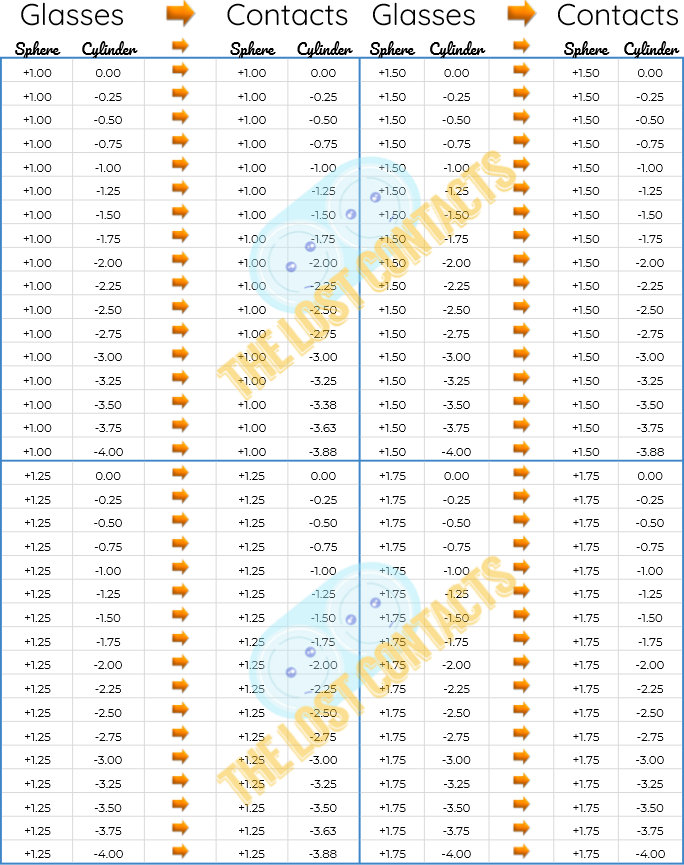
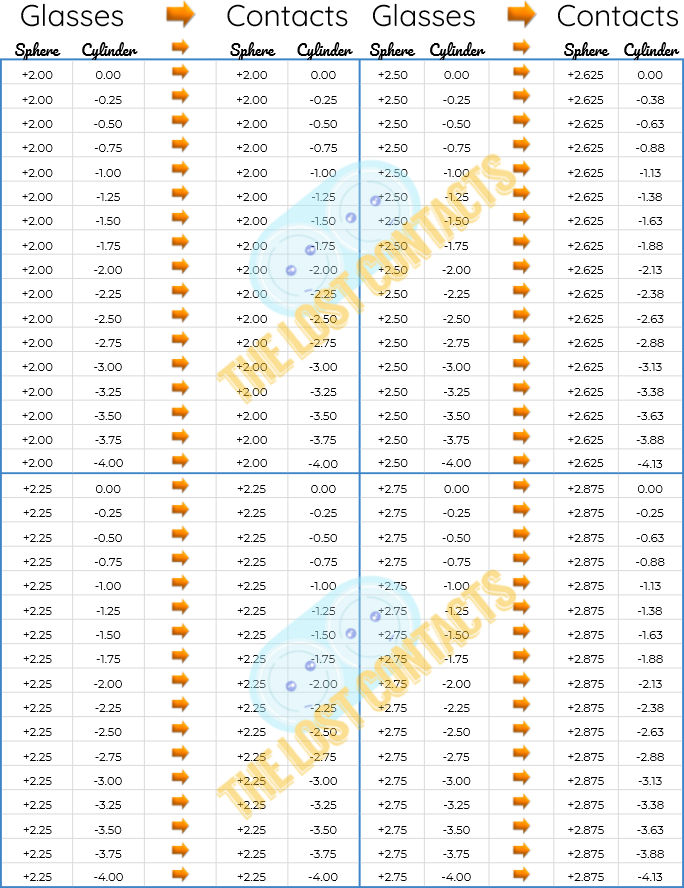
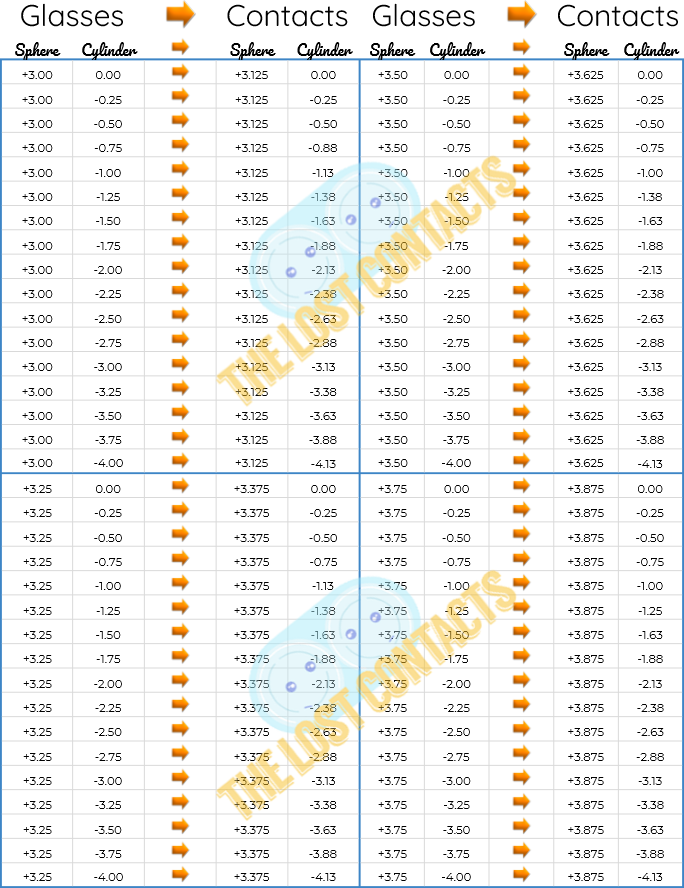
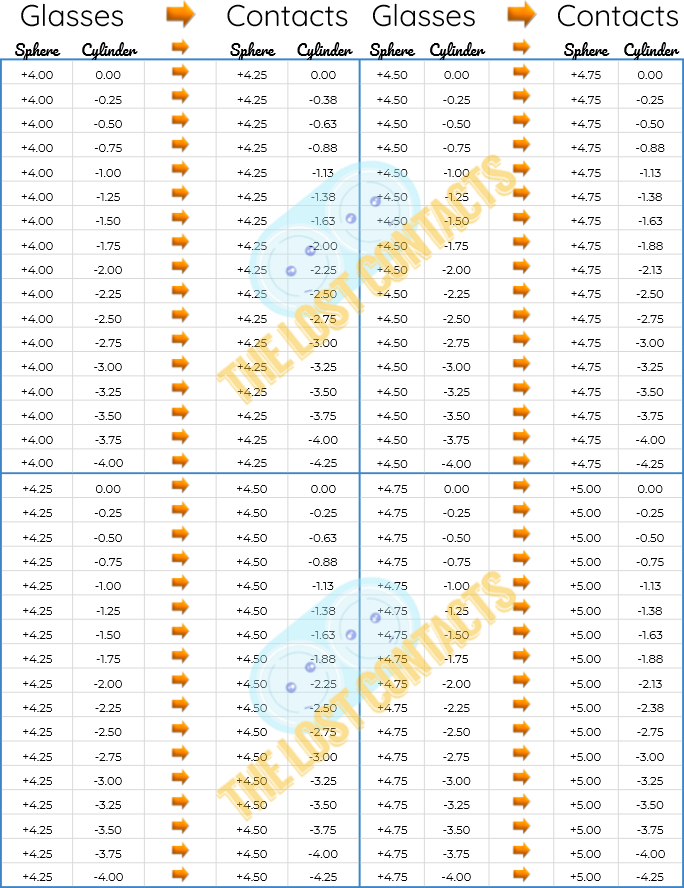
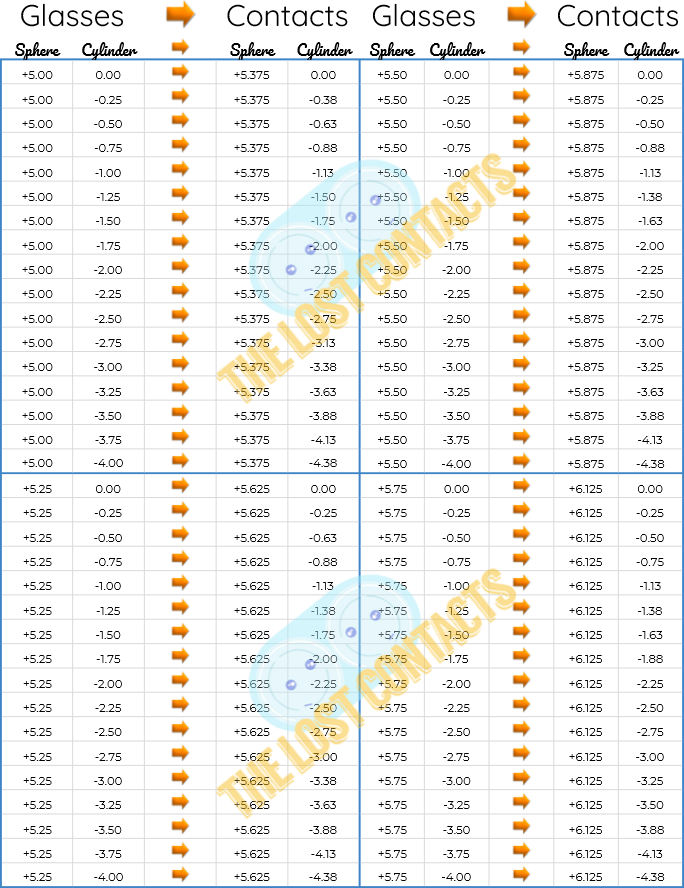
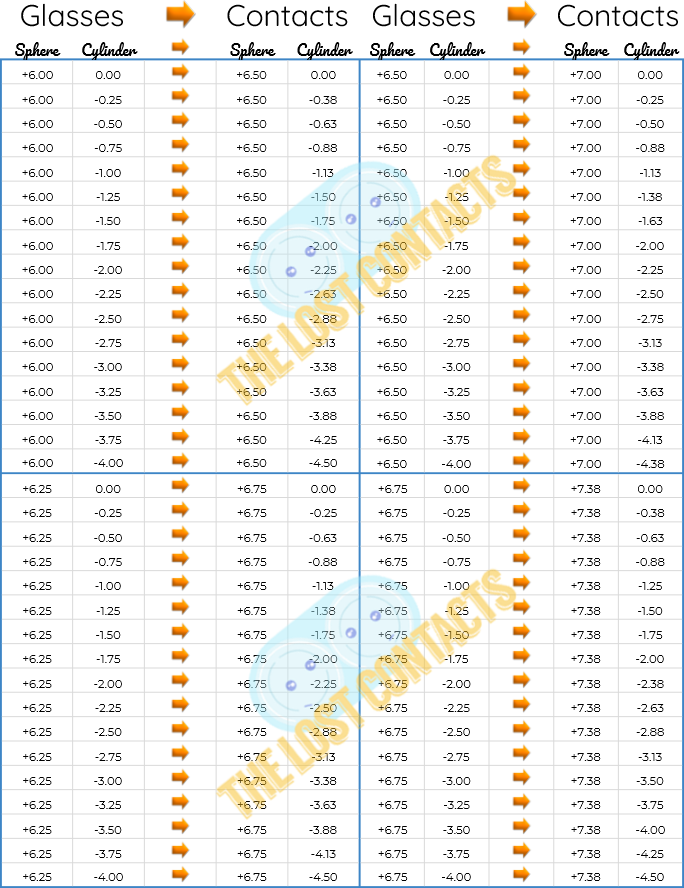
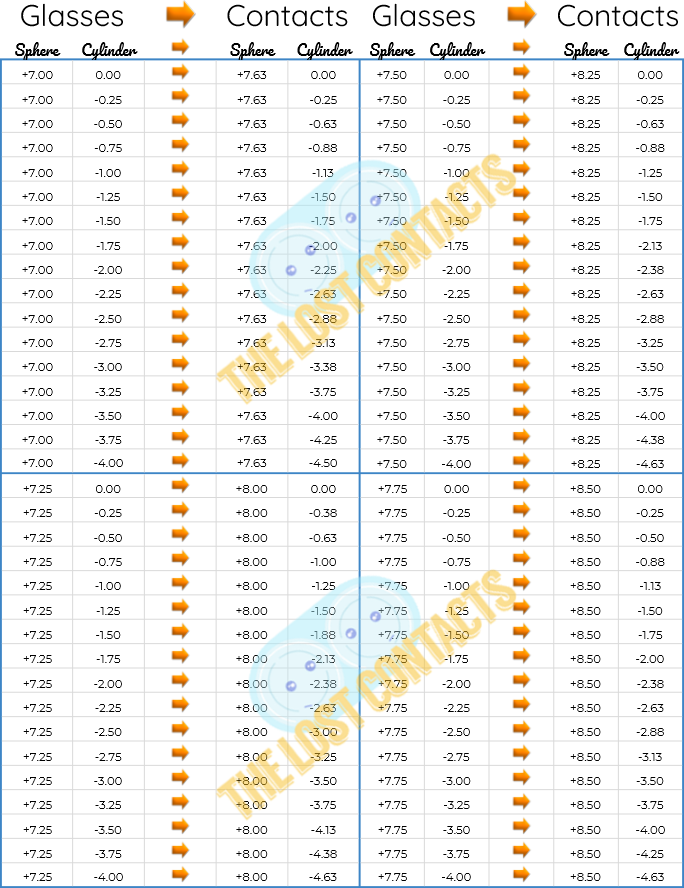
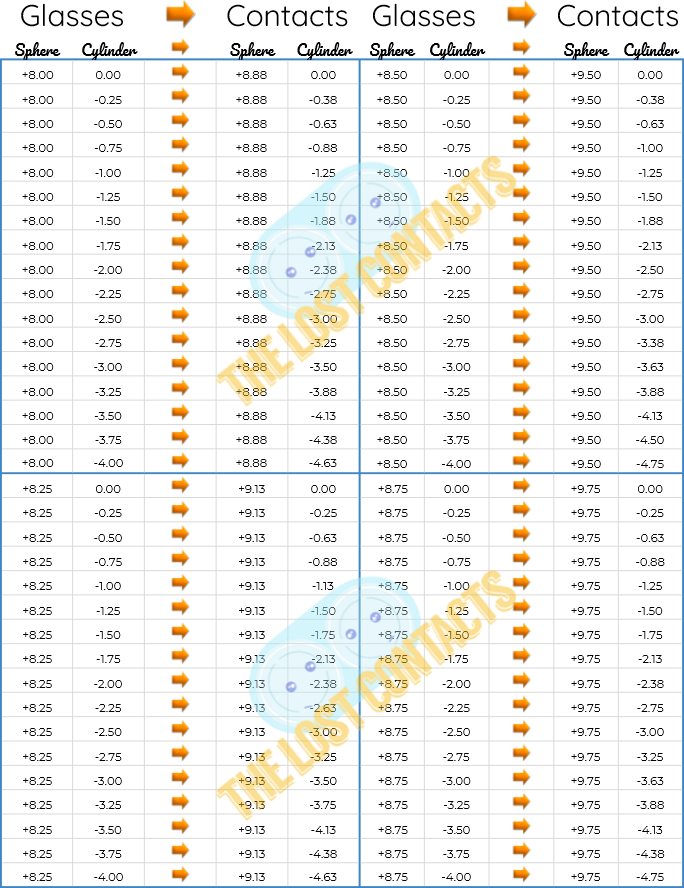
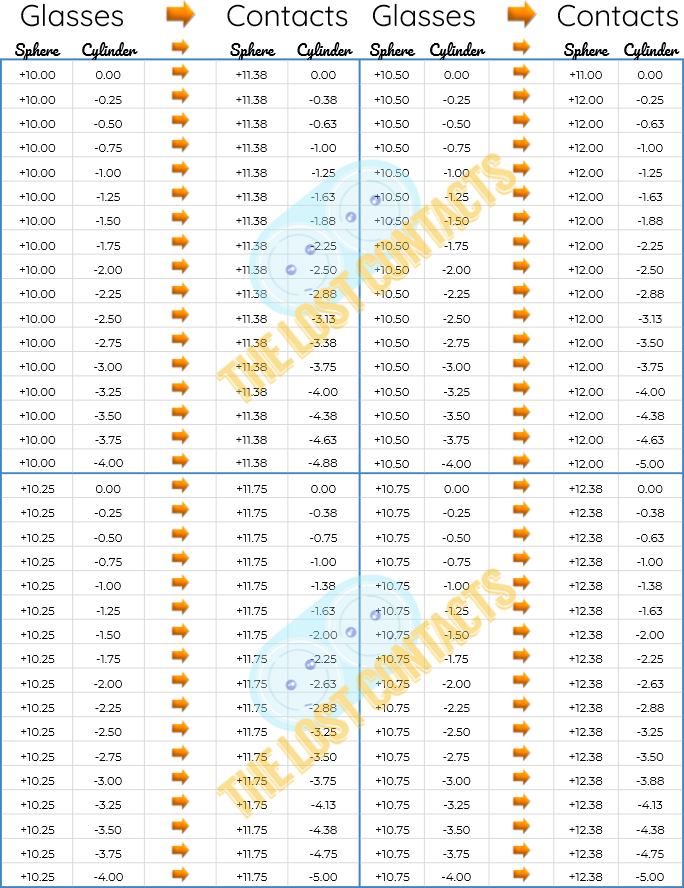
If you’re looking for a vertex distance conversion charts, you’ve found the motherload. Here you will find vertex distance conversion charts for single powers (i.e Sphere power only), as well as for astigmatism (Sphere + Cylinder combinations).
Lets start your typical Sphere Power Only Vertex Distance Conversion Chart.
If you are looking you convert a combination of Sphere and Cylinder powers, you will need to reference the following Vertex Distance Conversion Chart for Astigmatism.
Astigmatism Charts For Minus Sphere Powers
This series of charts will cover all Sphere and Cylinder combinations ranging from Sphere Power 0 to -10.75 and Cylinder Power 0 to -4.00.
Astigmatism Charts For Plus Sphere Powers
The next series of charts will cover all Sphere and Cylinder combinations ranging from Sphere Power 0 to +10.75 and Cylinder Power 0 to -4.00.
How Were These Charts Calculated?
All the charts were populated using the following equation:
The vertex distance used in every calculation was 12mm.
Summary
I hope these charts provide value for you and save you time in your clinic. If you would like to download and print these charts, you can get the pdfs in The Lost Contacts downloads section.
The next step is to get your patient a free trial contact lenses so that you can assess their fit and performance.
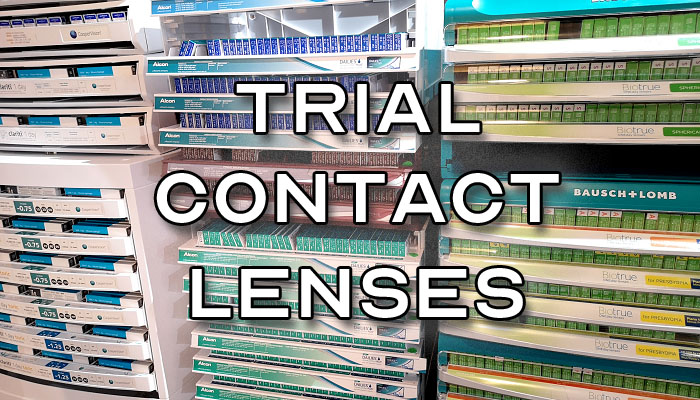
This lesson is going to be centered around ordering your patient/client’s first pair of free contact lens trials. I wrote it assuming your don’t have trial fitting sets in your office and have to order your trial lenses from the companies. If you do have the fitting sets, you can just get your trials from there (assuming they are well maintained).
Working With What’s Available
At this point, you’ve successfully converted your patient/client’s glasses prescription to contact lenses and you know what contact lens trial pair you want to order. However, the exact numbers that you calculated in your conversion is not always available for you to order. To avoid problems and unnecessary delays, it’s important to order contact lens trials that are actually available.
Limitations in Sphere Power
+6.00 to -6.00
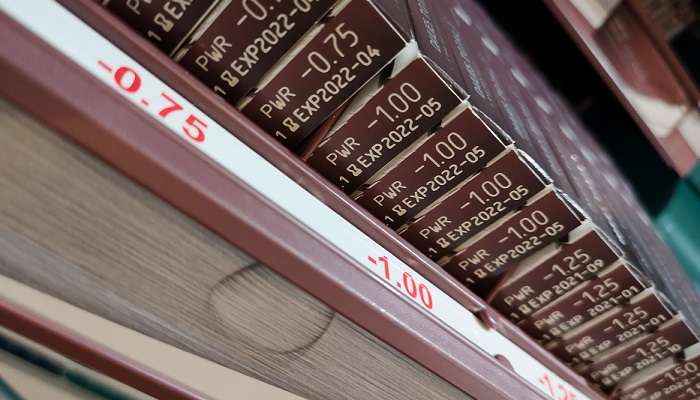
If the sphere number you want for your patient’s contact lens trails is between +6.00 and -6.00, you shouldn’t have any problems finding what you are looking for. Contact lenses generally come in 0.25 steps in that range.
A Dailies TOTAL1 fitting set showing sphere power increasing in 0.25D increments.
The problem you may come across in this range is when your glasses to contact lens conversion gives you a sphere power that ends in an eighth diopter step, i.e., .12, .37, .62 & .87. You will have no choice but to choose from one of the two nearest quarter diopter step, i.e., .00, .25, .50 & .75.
If this happens, you can use your professional judgement to choose the one you think would work best for you patient. However, if there’s some uncertainty you can always order and try them both.
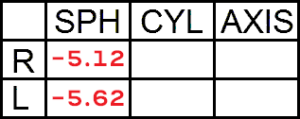
For example, if your glasses to contact lens conversion is:
Since neither of those sphere powers are available in contact lenses, a safe bet would be to order -5.00 and -5.25 for the right eye, and -5.50 and -5.75 for the left eye.
Over +/-6.00
If you need a contact lens trail with a power that is higher than +6.00 or -6.00, you will be more limited. Outside of the +/-6.00 range, most contact lens brands become available only in steps of 0.50, i.e., -6.00, -6.50, -7.00, -7.50, -8.00 etc.
So if you’re looking for trail contact lenses with a sphere power ending in .25 or .75, what do you do? Well, at this point you should be expecting to have to try 2 or 3 different combinations of powers before you find the one the works best for your patient. The best thing to do would be to order the contact lens trials in both powers that bracket what you calculated in your conversion.
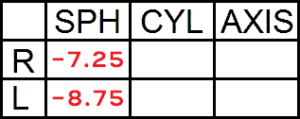
For example, if your glasses to contact lenses conversion is:
Since neither of the those sphere powers are available in typical (non-extended range) contact lens brands, a safe bet would be to order -7.00 and -7.50 for the right eye, and -8.50 and -9.00 for the left eye.
Start by having the patient try on the lower power and see if holding a -0.50 trial lens over the eye makes a significant difference in the vision. If it does, you’ll be happy that you ordered the stronger power.
It’s A Trial & Error Process
Keep in mind that it may still be possible that despite this, your patient will be need something that’s even lower or higher that what you have ordered. There are many factors that influence this such as specific contact lens designs, patient age, patient visual demands, etc.
Additionally, it is important to keep in mind that whatever sphere power ends up working best for any given brand does not necessarily translate to other brands. Every time you try a different brand, it is advisable to re-test the vision and perform a contact lens over-refraction to find the best sphere power for each brand you try.
Limitations in Cylinder Power
What’s Available
Cylinder power is perhaps the most limited parameter in contact lenses. There are 3 cylinder powers that every contact lens for astigmatism have. They are:
-0.75
-1.25
-1.75
Many brands also have:
-2.25
A few brands have:
-2.75
As you can see, the cylinder powers in contact lenses are quite limited and only appear in 0.50 diopter steps. This is due to manufacturing limitations as well as the fact that when the cylinder is only slightly off, it doesn’t affect the vision all that much.
A clariti-1day toric fitting set showing -0.75, -1.25 and -1.75 cylinder options.
To Round Up Or Down?
If you need a cylinder power that isn’t available, should you pick the closest lower one or the closest higher one? In this situation it’s typical to round down to the nearest available cylinder power. People who wear contact lenses for astigmatism do best when they have the lowest possible cylinder power that still allows them to see 20/20.
For example, if your glasses to contact lenses conversion is:
The right eye’s contact lens cylinder power should be -1.50 but due to restricted availability we have to pick between -1.25 and -1.75. It is quite possible that the patient would be able to see perfectly and equally well with either one. If that is the case, it would be best to opt for the lower cylinder of -1.25.
It’s also possible that when you convert a glasses prescription to contact lenses, the cylinder ends in a eighth diopter step. When this happens, simply choose the nearest available cylinder (a cylinder ending in an eighth diopter step never falls squarely between two available cylinders.
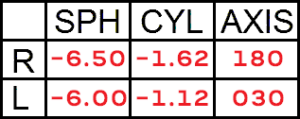
For example, if your glasses to contact lens conversion is:
For the right eye: -1.62 falls between -1.25 and -1.75 but it much close to -1.75.
For the left eye: -1.37 falls between -1.25 and -1.75 but it much close to -1.25.
Limitations in Axis
Excluding extended range and specialty contact lens brands, contact lenses for astigmatism are available in axes of steps of 10.
A Bausch + Lomb ULTRA for Astigmatism fitting set showing axis increments of 10 degrees.
When you convert a glasses prescription to contact lenses, the axis does not change. This means that you could end up with an axis that’s any number between from 1 – 180.
When picking the contact lens free trial for your patient, what you have to do is choose the axis that is the closest to the glasses axis.
Of course, you’re going to encounter many prescriptions where the axis ends in a 5. When this is the case, I tend to order both axes that straddle the glasses axis so that I don’t have to wait on another delivery if that one I ordered wasn’t the right one.
Assessing The Vision/Examining The Fit
Once you’ve ordered all the contact lens trials you think you’ll need for your patient, the next step is to have the patient try them on assess their performance. This is where you’ll make the decision as to whether what you’ve ordered is adequate, or if you have to make adjustments.
This is what I discuss in the next installment of my Fitting Contact Lenses Course.
In the previous lesson: “How To Convert A Glasses Prescription to Contact Lenses“, I covered only situations that did not involve any astigmatism correction. In this lesson, I will only be discussing how to convert a glasses prescription to contact lenses when there is astigmatism to deal with.
Before I get into it I just want to say that some of this may appear to be difficult. Sure, it does take a little longer, but it’s literally nothing more than a little bit of addition, subtraction, as well as looking up numbers on our vertex distance conversion chart.
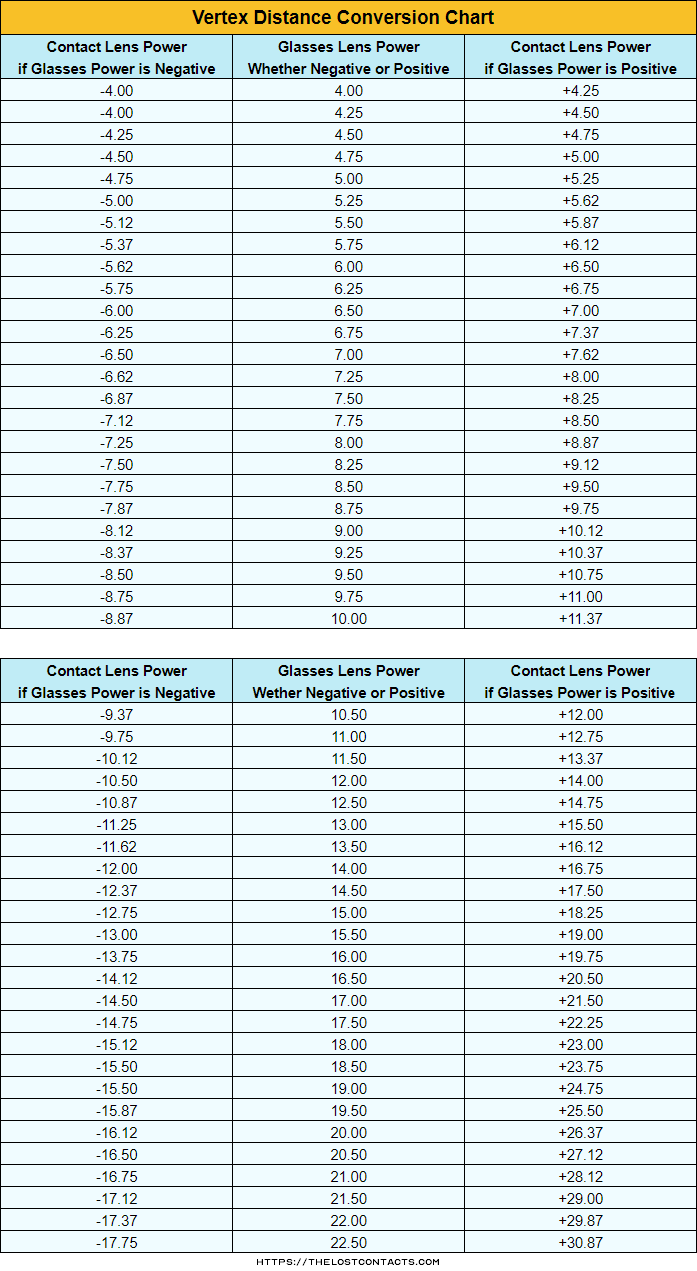
Here it is again for you to reference throughout this lesson.
*Note that this chart is based on a 14mm vertex distance.
Now let’s get right into it. Everything is done one eye at a time so complete steps 1- 5 for the right eye and then again for the left eye.
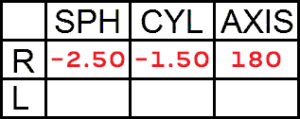
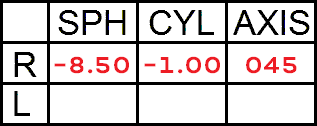
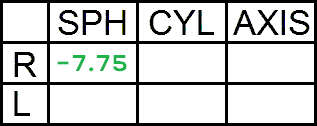
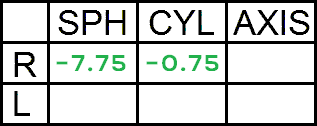
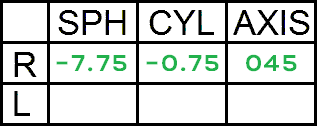
Here is the glasses prescription we will be working with:
Step 1: Draw 180° and 90° Reference Lines
The power cross is the main tool used in visualizing and organizing the calculations involved in this conversion process.
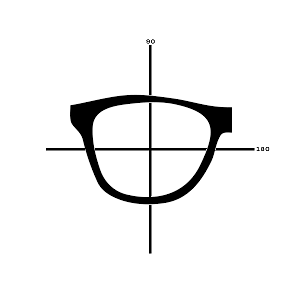
Here we will draw two reference lines 180° and 90°.
Think of this cross as overlaying the lens of the glasses prescription you’re working with, like this:
Step 2: Add The Sphere Power Line
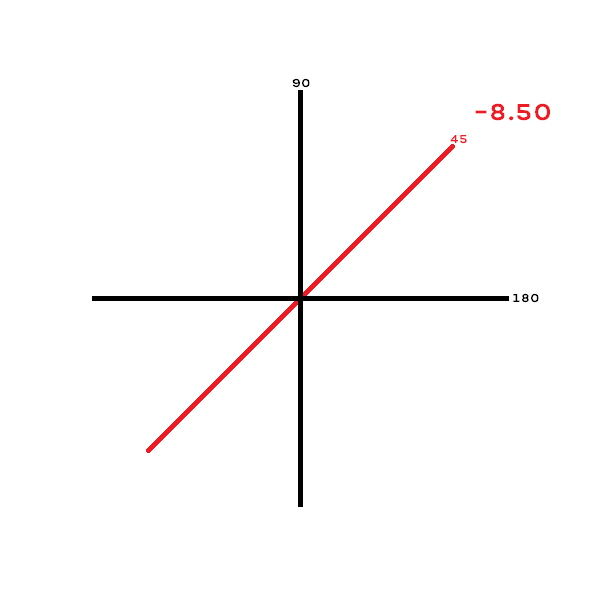
Look at the glasses prescription that you’re working with and locate the ‘Axis’ number. This number represents a degree value and will be somewhere between 1 and 180. Now draw a line in the direction of the Axis .
In our example prescription, that’s 45. That means that a line at 45° must be drawn on the power cross. This is the Sphere Power Line. It represents the sphere power so write it down next to that line.
Step 3: Add The Sphere+Cylinder Power Line
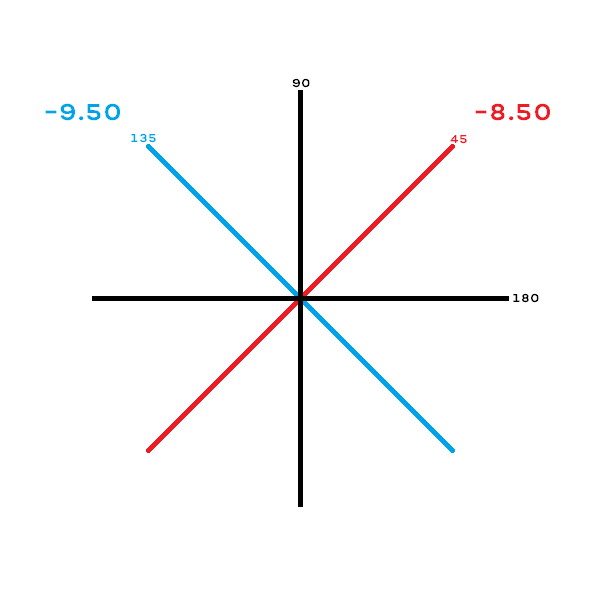
Next add 90 to the axis number and draw another line in that direction. For the example prescription above that would be 90 + 45 = 135.
This new line is the Sphere+Cylinder Line.
Now, as the name implies, to find the power of this line we must add the sphere and cylinder together.
For the example prescription above that would be -8.50 + (-1.00) = -9.50.
This the completed power cross.
Step 4: Covert The Powers
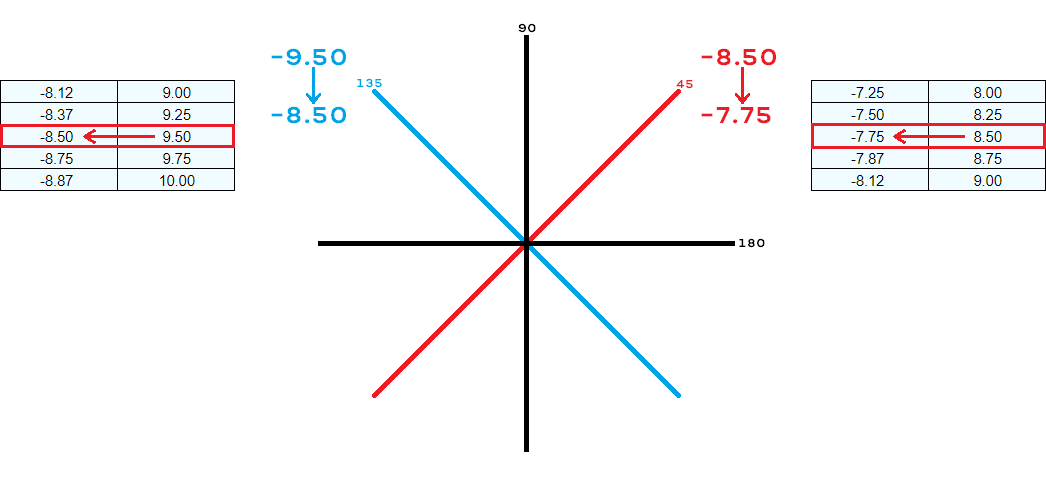
This is the step where we actually convert the glasses prescription to contact lenses. Now that we’ve laid out both the sphere and the sphere+cylinder powers, use the vertex distance conversion chart above to convert them and write those down as well.
Step 5: Returning To Prescription Format
At this point, the glasses prescription is converted to contact lenses, but it’s not in the correct Sphere/Cylinder/Axis format. To return to the correct format, follow these 3 rules:
The converted sphere power becomes the contact lens sphere power.
The converted sphere+cylinder number minus the converted sphere number becomes the contact lens cylinder power.
-8.50 – (-7.75) = -0.75
The original glasses axis becomes the contact lens axis (it doesn’t change)
And that’s it!
You’ve done it! Not bad right?
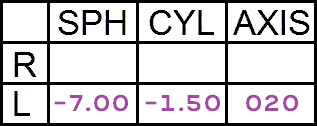
Let’s work through the left eye together.
Step 1: Draw 180° and 90° Reference Lines
Step 2: Add The Sphere Power Line
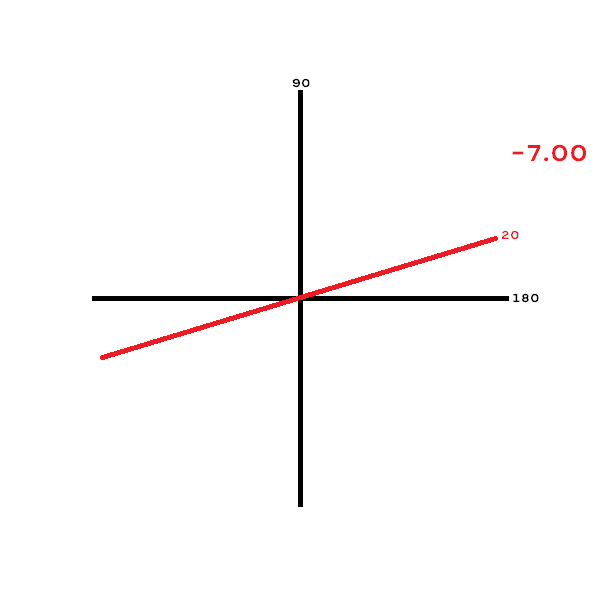
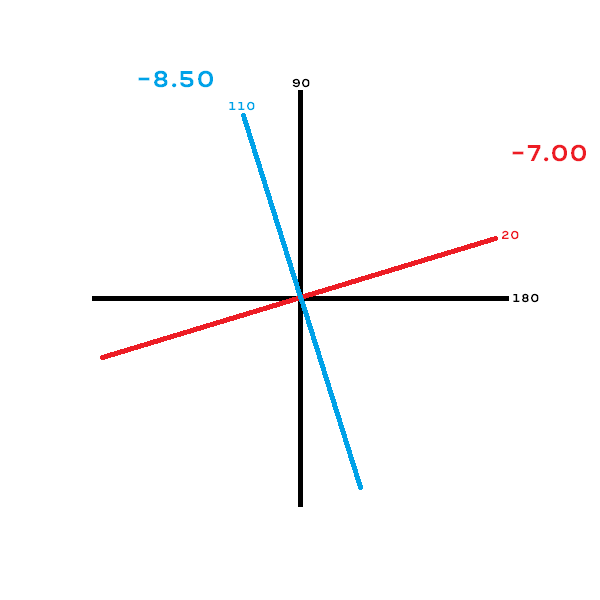
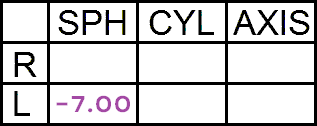
This time the axis is 020 so the sphere power line must be drawn at 20°. The sphere power is -7.00 so that will go next to the sphere power line.
Step 3: Add The Sphere+Cylinder Power Line
Next, add 90 to the axis on the prescription. In this case it’s 90 + 20 = 110, so the sphere+cylinder power line must be drawn at 110°.
The sphere+cylinder power for this prescription is -7.00 + (-1.50) = -8.50, so that will go next to the sphere+cylinder line.
Step 4: Covert The Powers
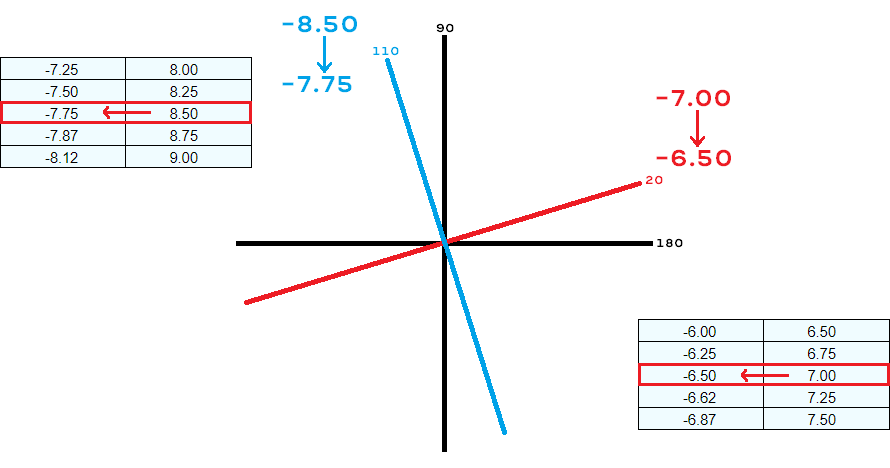
The vertex distance conversion chart is now used to convert both the sphere power and the sphere+cylinder power. The converted powers are written down to help with the next step.
Step 5: Returning To Prescription Format
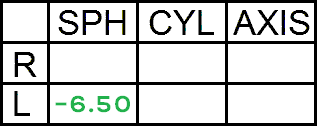
The converted sphere power becomes the contact lens sphere power.
The converted sphere power minus the converted sphere+cylinder power becomes the contact lens cylinder power.
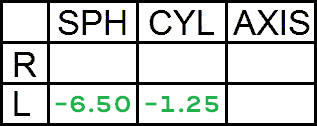
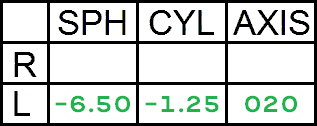
-7.75 – (-6.50) = -1.25
The original glasses axis becomes the contact lens axis (it doesn’t change).
And that’s how to convert a glasses prescription to contact lenses!
Important Shortcuts
Despite the simplicity of converting a glasses prescription with astigmatism to contact lenses using the 5 step process outlined above, it’s not always necessary. There are some shortcuts that can save a lot of time in a real-world practice setting.
When The Glasses Cylinder is -0.25
If the cylinder on the glasses prescription that is being converted to contact lenses is -0.25, there is no need to go through the 5-step power cross procedure. In fact, most of the time there is no need to do anything at all.
With a cylinder of -0.25, after the conversion process the cylinder will either stay -0.25 or become even less. Since there are absolutely no contact lens company that offer a contact lens for astigmatism with a cylinder correction of -0.25, it is a pointless exercise to convert.
Instead, the most common solution is to ignore it altogether. Simply, the cylinder and axis are removed from the contact lens prescription and only the glasses sphere is converted according to these guidelines.
When The Glasses Cylinder is -0.50
This is perhaps the trickiest situation. Contact lenses are not available in cylinder power of -0.50, yet, a cylinder power of -0.50 is significant enough that it can’t just be ignored. So what is the solution?
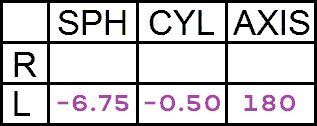
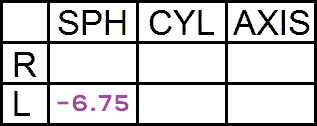
The -0.50 cylinder & axis are still dropped from the contact lens prescription, however, to compensate for it, and additional -0.25 is added to the glasses sphere. That is, you do not have to use the power cross method. Simply:
Remove the -0.50 cylinder & axis.
Add -0.25 to the glasses sphere.
Convert the new glasses sphere using a vertex distance conversion chart.
Convert the new glasses sphere using a vertex distance conversion chart.
And there you have it. You now have all the tools and knowledge necessary to convert any glasses prescription to contact lenses. But are you now ready to start prescribing contact lenses? Not quite yet! Actually, at this point we’re still in the very early stages of the contact lens fitting.
Next Steps
You know how to convert a glasses prescription to contact lenses, even if it has astigmatism, but what if contact lenses aren’t available in the numbers that you calculated?
Have you noticed that many of the conversions on the vertex distance conversion chart end in weird numbers like 0.12, 0.37, 0.62, & 0.87? Have you noticed that only certain cylinder powers and axis are available for contact lenses?
If the conversion you calculated doesn’t match what is available in contact lenses, there will be additional adjustments needed in order for trials to be ordered for the patient/client. And that’s what we’re going to learn about next!
If you have any questions about the process laid out in this article, please let me know in the comments and I’ll help you through it.