

In this post, I’m going to share with you some tips to help you make the most of your studies. Note that I chose Opticianry as an example, but these tips can be applied to any field of study. Ready? Let’s dive in!
1. Know What to Expect
Knowing what to expect from your chosen program, is mentally preparing yourself for what lies ahead, so that you are less likely to feel stressed out, confused, and frustrated down the road. This is especially important if you have been away from school for a while or are going to enter a new school system in a new country. If you are considering studying Opticianry, I recommend reading my previous posts on;
In general, you want to gather as much information as you possibly can, and there are many ways to do that.
The Website
The first and most obvious one is; read the school’s website inside and out! Usually, all schools have a website that highlights key information for new applicants and current students. You can learn about the school’s reputation, and faculty, the specific program’s curriculum, and possible career paths. You can also directly contact the program coordinator, or join a student forum if you have specific questions.
The Regulatory Body & Association
Next, look up the profession’s regulatory body website. This should be your primary reference for field-specific information, such as; regulations, and standards of practice. Professional association websites have a variety of resources available, as well. You can access educational material, updates and news on the industry, and much more. For Ontario Opticians, the College of Opticians of Ontario (COO) is the regulatory body, and the Ontario Optician Association (OOA) is the professional association. Provincial associations are usually part of national associations, like the Optician Association of Canada (OAC) for OOA.
Orientation & Open House
Make sure to attend the school’s open house and orientation days. If you happen to miss the open house, make sure you do attend the orientation day! Because it would be your first official day at the school! You will have the opportunity to;
- Get a feel for the school’s atmosphere,
- See the facilities, such as your classrooms and labs,
- Meet your program coordinator, future classmates, and some of your teachers in person,
- Ask any unanswered questions that came up during your research,
- And if the weather condition allows, you can party under the sky and eat hot dogs and veggie burgers! Yay!
Other Resources
Last but not least, take your research a step further by looking up other field-specific forums, websites, online magazines, and blogs. An example would be…ahem…The Lost Contacts 🙂 You can find useful information that might help you before, during, and after your studies! I will share with you a list of these resources in the near future.
Remember to collect any and all information you find during your research in a file; it can be a folder in your browser’s Bookmarks section, a folder on your computer, or a physical copy. Keep this collection, and use it as your reference throughout your studies.
2. Develop a Plan of Action
Now that you know what to expect, it’s time to develop a plan of action. To do so, there are a few things you need to gather;
- Your list of strengths & weaknesses (We covered this here)
- Your research collection (explained above)
- Pen & paper (or your journal)
To create your plan of action the best way is the top-down approach. I divided the study period into four general categories;
- Getting Licensed,
- Writing the Board Exam,
- Graduate,
- and Enroll.
You can assign a time-line to each category, plus definitive sub-categories that are necessary to complete, to climb the pyramid. Here’s when your research collection comes handy!
To paint a clearer picture for you, I used Opticianry as an example in the diagram below. Let’s have a look;
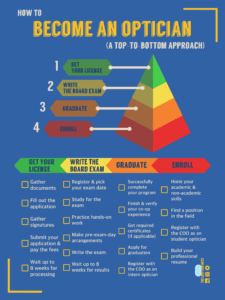
As you see, at the top of the pyramid is “registered/licensed Optician” which is where you want to land after finishing your studies. (Now, of course, getting your license is not the end of the journey, rather it’s the beginning. However, for the sake of this article, our focus is on studies, only.) From the top, we work our way backward, creating a list of requirements step by step. As you progress through school, you can update your plan to reflect your current situation and help you stay on track.
3. Prepare Your Environment
Now that you know what to expect and have your plan of action, it’s time to prepare your environment for execution! And by that I mean, submerging yourself into your field of study. Since we have limited resources, like time and energy, the best way to make the most out of them is to focus our attention. It’s not easy to do so, not at all! But there are things we can do to minimize distraction as much as possible. Let’s get down to it!
First, look at your strengths & weaknesses list.
In Choosing your field of study we talked about how to identify your strengths and weaknesses. Your time at school is the best opportunity to work on improvement areas. It is also an opportunity for you to start building your resume, by relying on your strengths to get involved in extracurricular activities.
Second, start looking for a position in the field.
If you are not currently working in your field of study, I suggest starting your job search ASAP. The position you come across during your job search, probably will not be your dream job. However, I recommend taking it even if it’s slightly/remotely related to your field. This helps to keep your mental energy more focused, and you could explore the career possibilities out there with your specific education. For instance, if you are starting to study Optometry or Opticianry, but don’t have any experience in the optical field look for jobs as a sales associate, or a frame stylist at an optical store, or a receptionist position at an Optometrist’s or Ophthalmologist’s office.
Third, connect with your teachers, classmates and other students.
Not only you will be creating an academic support system for yourself, but also you might end up making valuable connections that can help you in the future.
And finally, register with the regulatory body and professional association as a student.
As I mentioned in part 1, you will have access to valuable resources, and you get discounts and offers to attend professional events.
Summary
Today we learned the key to making the most of your studies lies in three things, and those are;
- Do your research, so you know what to expect,
- Categorize the information you collected to develop a plan of action,
- Start executing your plan, by preparing your environment to work your way up.
I hope you find this post helpful!
Feel free to share your tips for making the most out of your studies, I would love to hear your thoughts!
Talk to you in the next post!
