
Presbyopia - Featured

The Optics of Vision – Part 10: Presbyopia

In The Optics of Vision – Part 9, we learned about the function of the crystalline lens. But as I pointed out towards the end of the lesson, the crystalline lens gradually stops functioning. This results in the condition we’re going to discuss in this lesson called Presbyopia.

This being the last lesson of The Optics of Vision course, it will continue to build off of everything taught so far. I strongly recommend making sure that you have read every previous lesson before reading this one.

The Crystalline Lens & Accommodation

Recall from Lesson 9 that crystalline lens allows us to see clearly up close by automatically adjusting its curvature to give just the right amount of focusing power for the distance the eye is looking at.

Quick Accommodation Recap

Looking in the distance (further than 6m/20ft)

  • The crystalline lens is at rest (as flat as possible)
  • Takes no effort

Looking at intermediate distances (~1m/40”)

  • The crystalline lens ‘accommodates’ (gets more curved)
  • Requires minimal effort

Looking at near distances (~30cm/12”)

  • The crystalline lens accommodates even more (gets even more curved)
  • Requires significant effort

Looking at extremely near distances (~15cm/6”)

  • The crystalline lens maximally accommodates (gets as curved as it can)
  • Requires maximal effort

Takeaway: Without accommodation, we cannot see clearly up close.

Requirements for Accommodation

Functioning accommodation requires 2 things:

  1. A flexible crystalline lens
  2. Functioning ciliary muscles (the mucles that act on the crystalline lens)

For the vast majority of people, the crystalline lens is very flexible and the ciliary muscles are very strong in the first 4 decades of life (~ age 0 to 40 yrs). During this time, accommodation works so well that most of us don’t even know its happening – and thus take it for granted.

After the age of 40, the crystalline lens becomes stiff to the point that the ciliary muscles can no longer flex it. That’s when accommodation begins to fail. This is what is called presbyopia.

What is Presbyopia?

Presbyopia begins when accommodation starts to become sluggish due to changes in the crystalline lens and ciliary muscle. When presbyopia kicks in, our vision up close becomes blurry. It’s often noticed for the first time when attempting to make out small print up close such as the kind found of medicine bottles. From there, it gradually gets worse year after year until eventually, nothing within a couple of arm lengths is clear.

Presbyopia FAQ

Who Does Presbyopia Affect?

Everybody will eventually be affected by presbyopia.

When Does Presbyopia Start?

Presbyopia starts at different times for different people. On average it is at age 40, but it it not unusual for it to start in the late 30’s or even into the mid 40’s for some people.

In addition, the prescription one has for distance viewing can also impact when the symptoms of presbyopia are first felt. People are farsighted tend to notice the symptoms of presbyopia earlier than people who are nearsighted (especially if the nearsightedness is very low).

What Are The Symptoms of Presbyopia?

In the early stages (late 30’s to mid 40’s), presbyopia will cause very detailed objects that are held quite close to the eyes to be blurry, as well as difficulty seeing up close in dim lighting. Most near viewing tasks such as reading and computer work are still possible in this stage.

In mid stages (late 40’s to mid 50’s), anything held in one’s hands will be difficult to see clearly. In addition to the blur, persistently trying to ‘fight’ the blur can lead to eyestrain and headaches. Reading is very difficult in this stage but computer work is still possible.

In the late stages (late 50’s and onwards), everything within two arm’s lengths or so will be blurry. Both reading and computer work will be impossible without the use of corrective lenses.

What is the Treatment for Presbyopia?

The treatment for presbyopia is simply to wear glasses or contact lenses for reading/computer work. In the eye care industry, the things we do that require us to see clearly up close is called near work. Glasses that help with near work are called reading glasses.

Reading glasses can be as simple as a pair of glasses that are worn for near work, and removed when looking in the distance. However, for people who need glasses for the distance as well, a different type of glasses may be required. You will have heard of these as bifocal glasses.

Bifocal glasses hold lenses that carry the distance prescription throughout the entire lens except for a small segment at the bottom which holds the reading prescription. Most new presbyopes (people with presbyopia) associate bifocal glasses with their parents or grandparents and are resistant adopt them. That’s why bifocals are very rare nowadays. Instead, the go-to type of glasses for presbyopes are called progressives.

Other common names for progressive lenses are no-line bifocals, varifocal lenses & PALs (progressive addition lenses).

Progressive glasses have multiple prescription within different places in the lens. There is a distance prescription, an intermediate prescription for computer monitors and a reading prescription for hand held reading material. However some people can see well in the distance without glasses an only need help with computer work and reading. For these people there is a specialized type of progressive lenses called office progressives.

Here is a good summary of different types of progressive lenses. 

As a completely different alternative for people who don’t like glasses at all, there are contact lenses that can – to a certain extent – help people see in the distance as well as up close for reading. These are called multifocal contact lenses.

Can You Reverse Presbyopia Naturally?

Unfortunately, there is no natural cure for presbyopia in the form of eye exercises, eye drops, supplements or otherwise.

From time to time there are claims of this or that exercise program that can reverse the effects of presbyopia. Though I have not seen any concrete evidence for these methods, it would be great if they actually worked. if you have tried them, I would love for you to share your experience in the comments below.

Can You Reverse Presbyopia With Medication?

There is currently no medication to cure presbyopia.

Can Presbyopia be Reversed Surgically?

Yes and no.

When someone has their cyrstalline lens surgically removed, they are technically no longer presbyopic. Instead, they become pseudophakic, which is essentially the same thing. Unless… the surgically implanted lens that replaces the crystalline lens is something called a multifocal intraocular lens.

Additionally, there is a laser surgery for presbyopia that is producing very good results for some people. The technique is called PRESBYOND and is offered at most laser vision correction centers.

Note that PRESBYOND does not affect the crystalline lens or ciliary muscles in any way. It reshapes the corneas in order to compensate for the loss of function of the crystalline lens/ciliary muscles.

Summary

Presbyopia is the inability of our eyes to focus on near objects due to the loss of accommodation. It’s a normal age-related change and will happen to everybody once they enter their 40’s. The best treatment for presbyopia depends on many factors such as your underlying distance prescription, occupation, lifestyle, etc.

Congratulations!

If you’ve read through lessons 1-10 and you understand the material presented, you now know a lot about the eyes, optics, and how vision works. Congratulations on making it through! It really shows your dedication to becoming successful in the eye care industry.

With all of this knowledge in the bank, the next step of your training is to take The Lost Contact’s course on Optical Dispensing. I’ll see you there!

Good luck pig

The Crystalline Lens - Featured

The Optics of Vision – Part 9: The Crystalline Lens

If you thought the way the eye works was cool before, this is going to blow your mind. You’re about to learn about the crazy wonders of the the cyrstalline lens.

This lesson builds on all of the previous lessons in this course, so please make sure you are up to speed before tackling this one.

What is The Crystalline Lens?

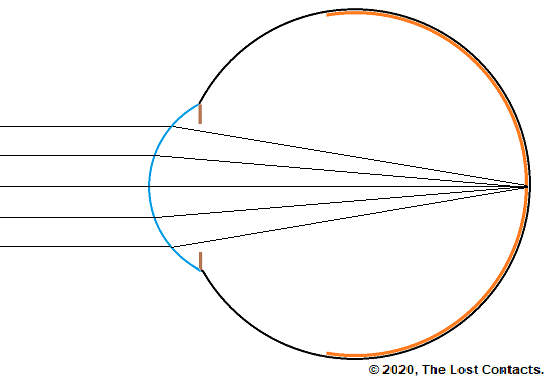
This is the ray diagram of the eye that we are familiar with now.

Ray diagram of an emmetropic eye

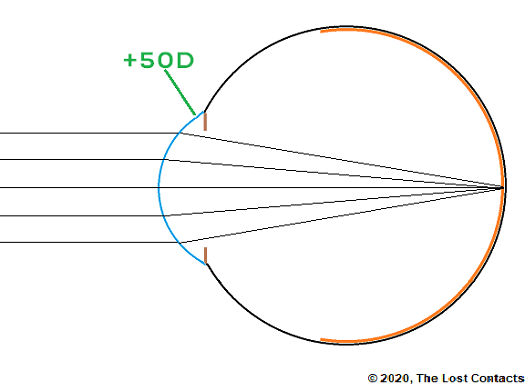
The truth is that this diagram doesn’t actually show the complete picture of how the eye focuses light. This diagram depicts the cornea as being the only lens that focuses light for the eye. In fact, there are actually two structures that act as lenses. 

  1. The cornea
  2. The crystalline lens

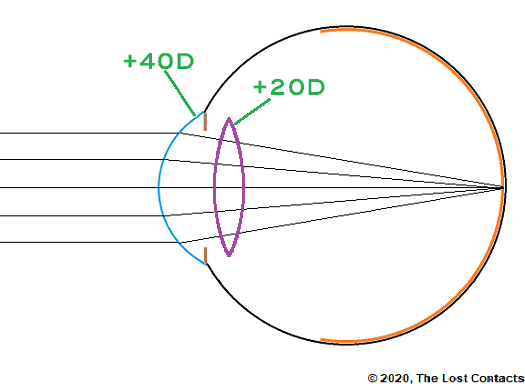
Here is a diagram that depicts both the cornea and the crystalline lens. 

Ray Diagram of the eye with labelled cornea and crystalline lens

The crystalline lens is hidden just behind the iris. You cannot see it on your own as it is transparent and it is too dark in side the eyes to see.

What is the Power of the Crystalline Lens?

In past lessons, I have used +50D to represent the strength of the cornea.Ray Diagram of the eye with no crystalline lens


This is not actually the case. In reality, the total power of the eye is closer to +60D. The cornea is about +40D and the crystalline lens is approximately +20D (at rest… more on this a little later on). 

Here is a more accurate picture of the power of the eye. Keep in mind this is still a little simplified, but this is more than enough for you to know.

Power of the corean and crystalline lens

Review of Light Vergence & Distance

Before I reveal why the crystalline lens is so fascinating, we need to do a brief review of the vergence of light emitted from different distances. 

This would be a good time to review Lesson 1: Understanding Light

Here are the key points to remember:

  • Light that is emitted by objects is always divergent.
  • As the light travels away from the object it becomes less divergent.
  • Eventually, when the light has traveled more than 6 meters (20 feet), the light becomes parallel and stays that way.  

This diagram illustrates these key points:

ray diagram showing divergent light from object becoming parallel over a distance of 20ft

Have you noticed that whenever I have drawn a ray diagram of the eye, the incoming light has always been parallel?

Ray diagram showing parallel light entering the eye
Every ray diagram of the eye in this course so far has had parallel light entering the eye.

Why is that?

The answer is because we have always assumed that the eye was at least 6 meters (20 feet) away from the object producing the light. 

So…

Q: What happens when the eye is closer than 6 metres (20 feet) away from the object it’s looking it?

A: The light rays entering the eye will be diverging (not parallel)

We are now going to study 3 diagrams that illustrate the effect of distance (between the object and the eye) on the vergence of light entering the eye and focal distance. 

*Note: These are all emmetropic eyes i.e., not nearsighted, farsighted and no astigmatism.

  1. This first eye is looking at an object situated over 6 meters (20 feet) away – hence the light reaching the eye is parallel.
  2. This results in the focal point forming on the retina.
  3. This means vision is clear
Eye looking at Distance Object
The eye looking at a distant object.
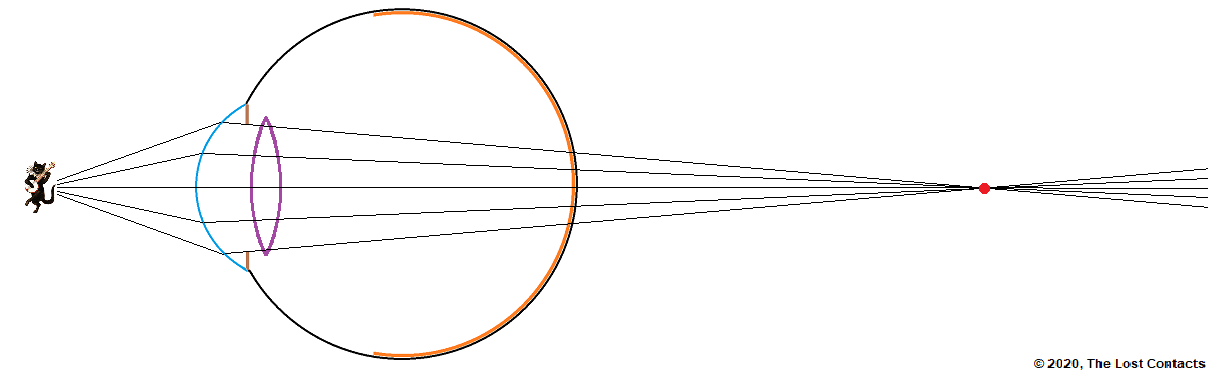
  1. This second eye is looking at an object that is less than 6 meters (20 feet) away – hence the light reaching the eye is divergent.
  2. This results in the focal point forming behind the retina.
  3. This means the vision is blurry.
Eye Looking at Near Object
The eye looking at a near object.
  1. This third eye is looking at an object the very close to the eye – hence the light reaching the eye is very divergent.
  2. This results in the focal point being formed even further behind the retina.
  3. This means the vision is very blurry.
Eye Looking at Very Near Object
The eye looking at a very near object.

Wait… What?

Am I trying to say that anytime we look at something up close the vision is blurry?!

If you are an emmetrope (you don’t wear glasses), you know that’s not true. You can see well in the distance just as well as you can see up close, right? But how can that be if these diagrams are accurate?

Because the crystalline lens is flexible and automatically adjusts its power depending on where you are looking!

This is called accommodation

Yes, let that sink in…

Mind Blown

So check it out;

When looking into the distance, the image already falls on the retina, so the crystalline lens can just relax. In this state, it is said to be at rest. 

The Crystalline Lens at Rest

When looking up close, the crystalline lens ‘knows’ that the light entering the eye is divergent, so it becomes more curved in order to increase they eye’s converging power (to offset the incoming diverging light). This keeps the focal point on the retina and the eye sees clearly. 

The Crystalline Lens Medium Curvature

When looking really close, the light entering the eye is very divergent, so the lens becomes extremely curved in order to compensate. Again, by doing so, the focal point remains on the retina and the eye sees clearly. 

The Crystalline Lens With High Curvature

When the eye is finished looking up close and switches back to looking into the distance, the crystalline lens goes back to being at rest (which means it gets flatter again). 

Accommodation

The constant adjustments that the cyrstalline lens makes in order to keep the vision clear is called accommodation. 

Speed of Accommodation

Accommodation is very fast. So fast in fact that we’re not even aware that it’s happening. When we change the distance at which we are looking, the cyrstalline lens accommodates to that distance before we have time to notice any blur in the vision. 

What Controls Accommodation

Accommodation is all controlled by a muscle that surrounds and suspend the lens in place. This muscle is called the ciliary muscle.

Here is a more in-depth explanation of the mechanism that controls accommodation:

Limits of Accommodation

Accommodation has it’s limits. Generally speaking, the limit is based on age. As we get older, our ability to accommodate gets worse. You can test the limit of your accommodation right now by looking into your palm and moving it closer to your eyes until it becomes blurry. The distance at which you are no longer able to see the details on your palm clearly is the limit of your accommodation. 

If you were to measure and record this limit every year, you would find that it gets further and further out every year.

Eventually, accommodation runs out. But more about that in the next lesson!

==> THE OPTICS OF VISION – PART 10: PRESBYOPIA <==