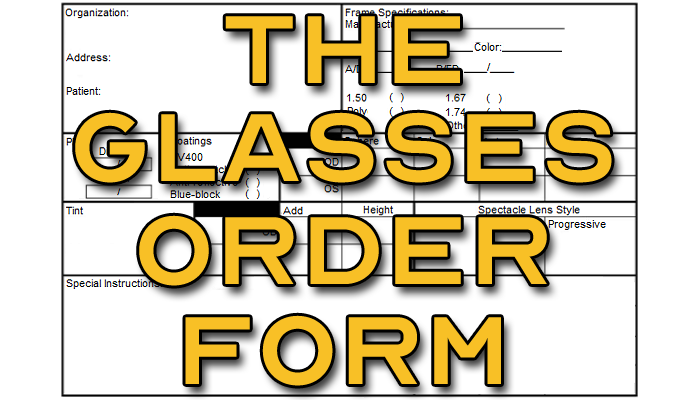
In this lesson you will learn about the process of creating an order for glasses, as well as all the information that must be gathered to properly fill out a glasses order form.
Where Are Glasses Made?
Most optical stores do not make glasses on the spot. Once they have all the information for an order, the job is sent to an edging lab via a courier. The lab workers will put the prescription lenses into the glasses frame, and then ship it back to your store as a complete pair of glasses ready to dispense to your customer.

Some offices do have equipment that allows them to make the glasses on the spot.
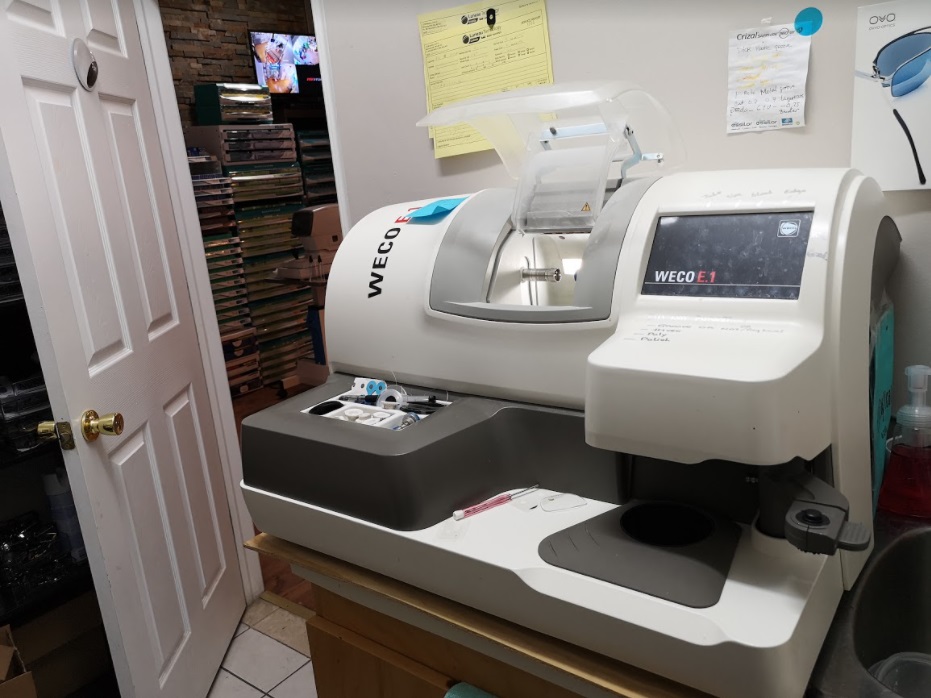
Regardless, it is your job to make sure that you collect and send all the necessary information needed by the edging lab (whether external or internal) to properly do their job.
What Information Is Required on an Order for Glasses?
Scenario:
A customer walks into your store with his/her glasses prescription and you successfully helped them select a frame that they love. What’s the next step? Are the glasses ready to be made yet?
Answer:
No. We still need to collect a lot more information.
Here is a quick checklist for what needs to be on an order form before it can be sent to the edging lab.
- Prescription information
- Frame information
- Pupillary distance measurements
- Pupil height measurements
- Spectacle Lens Style
- Lens index
- Lens coating
- Tints (if applicable)
Let’s go through each one to make sure we don’t miss anything.
The Glasses Order Form
This is an example of a glasses order form. It is not universal. Your office will have a form that looks different, so make sure you familiarize yourself with what your workplace uses.
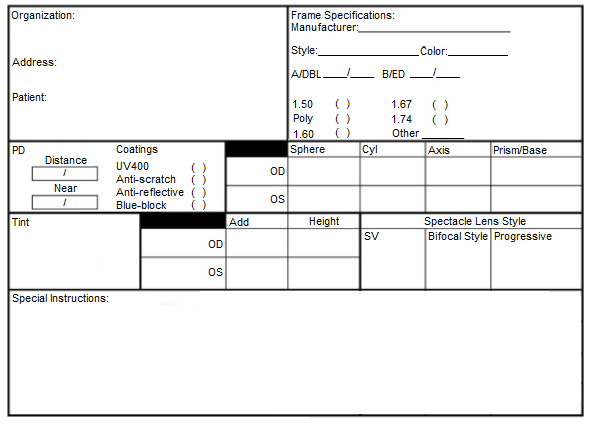
Don’t worry if it seems complicated now. We’ll fill this form out together as we go along and it’ll become very clear.
Prescription Information
Prescriptions for glasses are issued by optometrists.
If your customer doesn’t have valid glasses prescription, you will not be able to make glasses for them. If this is the case, you can book them in for an exam if your office has an optometrist, otherwise you will have to tell them to go see their optometrist and come back to you with a valid glasses prescription.
A valid prescription for glasses must have certain information on it.
A valid prescription for glasses must contain:
- The doctor’s name, practice address and phone number
- The patient’s name (who the prescription is for)
- The date the prescription was issued
- The doctor’s signature
If any of this information is missing, it is not a valid glasses prescription and cannot be used to make glasses.
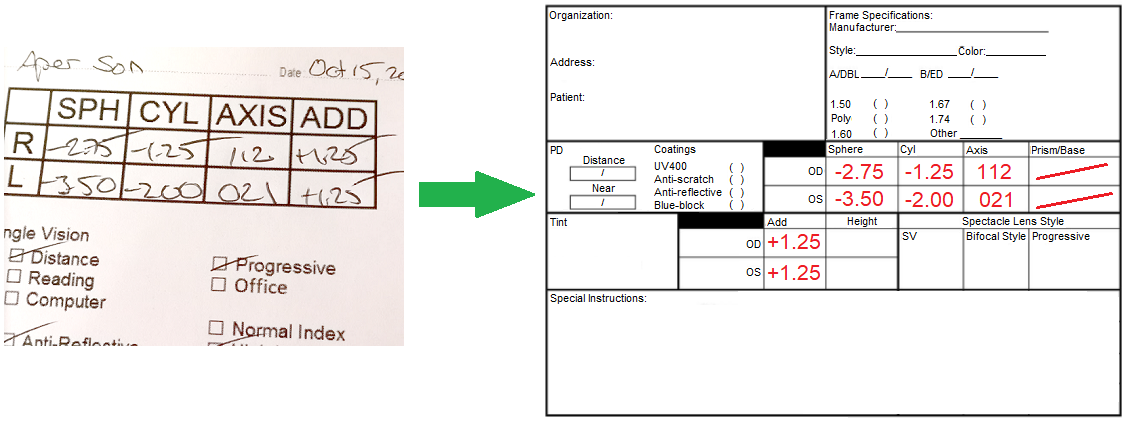
When you do have a valid prescription, you want to carefully copy all the numbers on the prescription for right and left eye onto the order form. Make sure that you write down each number from the prescription into its corresponding box on the order form.
Pay particular attention to the + or – sign before some of the numbers.
This is where it’s helpful to know a little bit about prescriptions for glasses. Sometimes, the numbers can be written very sloppy by the optometrist, so you have to use your knowledge of prescriptions to decipher them.
For example, it’s useful to know that:
- The last two digits of the Sphere and Cylinder numbers can only be 00, 25, 50 or 75
- The Sphere and Cylinder numbers are always preceded with either a + or a – sign.
- The letters ‘pl’ or ‘plano’ in the Sphere box means the Sphere is zero.
- The letters ‘ds’ in the Cylinder box means the Cylinder is zero.
- If there is no Cylinder, there cannot be an Axis.
- The Axis number can only be a number between 1 and 180.
- Often, the Axis is written with 3 digits, even if only 1 or 2 are necessary (i.e., 001, 006, 045, 088, etc.)
- The Axis number does not have a sign in front of it.
- If there is no Axis number, the Cylinder must be zero.
- The Add number is always preceded with a + sign (never a minus).
If you have absolutely no idea what is written on the prescription, remember that the doctor’s name, address and phone number must be on the prescription somewhere. You can always call their office for clarification.
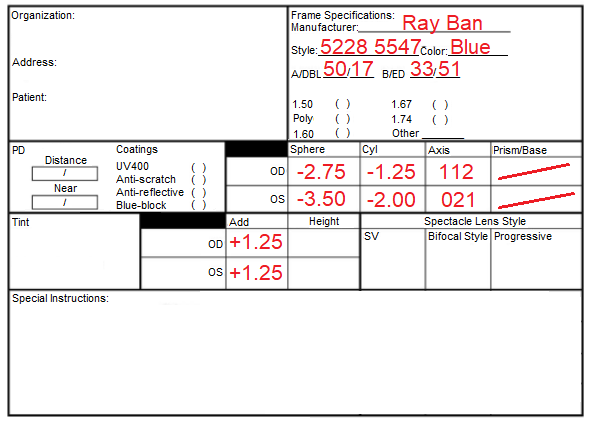
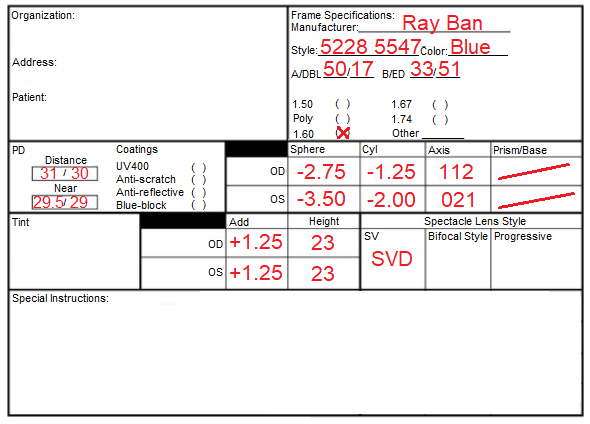
Here is what our sample glasses order form would look like with the prescription information filled in.
Frame Information
Frame information is extremely important. Remember, we are trying to put lenses into a particular glasses frame. So without knowing the size and shape of the frame it would be impossible to do.
Luckily for you, most of the information you need is written right on the frame itself. By inspecting it closely, you will find the following info:
- Brand
- Model number
- Eye size measurement
- Distance between lenses
- Temple length
Here’s an example:
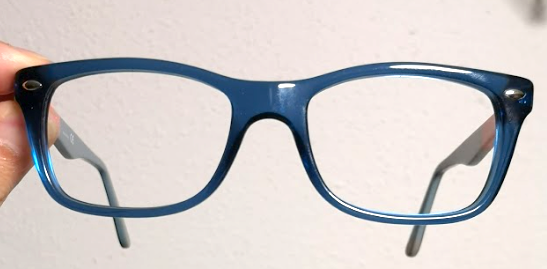
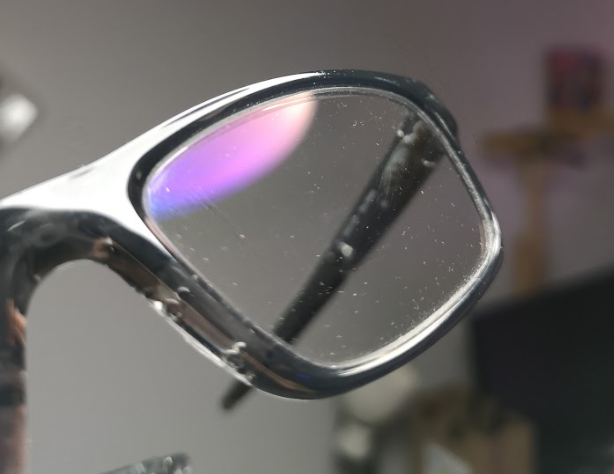
This is a Ray Ban frame. On the inside of one of the temples it is written: RB 5228 5547 50-17 140
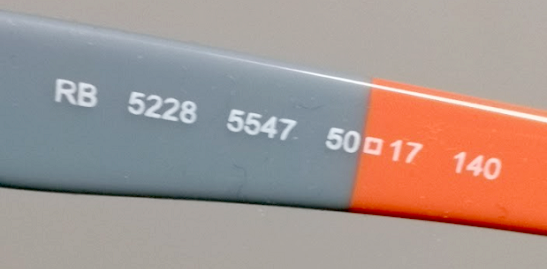
Here we see:
- Brand – RB (Ray Ban)
- Model number – 5228 5547
- Eye size measurement – 50 (also known as the A measurement)
- Distance between lenses – 17 (also known as DBL)
- Temple length – 140
A and DBL, Huh?
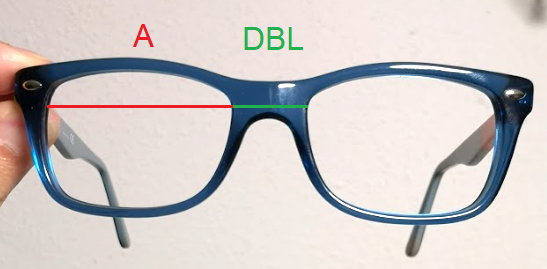
The A measurement is the horizontal length of the lens. The DBL is the distance of the space between the two lenses.
B and ED, What?
The only information we need on our glasses order form the is not printed on the frame itself is something called the B and ED measurement.
The B measurement is the distance from the top to the bottom of the lens. The ED is the longest part of the lens; usually from one corner to the opposite diagonal corner.

The A, B, ED and DBL measurements are all measured in millimeters (mm). Now, let’s fill in our glasses order form with this information. I will use 33 and 51 for the B and ED measurements respectively.
Pupillary Distance and Height Measurements
These measurements can make or break a pair of glasses. They are so important that they require an entire lesson of their own in order to understand what they represent, why we take them, and how to take them properly.
For now, we’ll keep it simple:
- The pupillary distance (PD) is the distance between the center of the left and the right pupil (measured in millimeters).
- Pupil height is the distance from the center of the pupil down to the bottom of the lens (measured in millimeters).
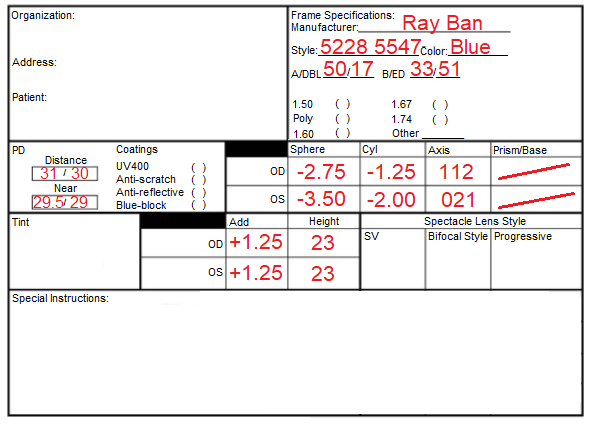
For more on these two important measurements, read this lesson. For now I will fill in the glasses order form with typical PD and height numbers.
Spectacle Lens Style
A prescription for glasses can used to used to make several different styles of glasses.
For example, the prescription on our example glasses order form can be made into all of the following styles of glasses:
Single vision distance: Glasses that contain only the distance prescription.
Single vision reading: Glasses that contain only the reading prescription.
Bifocal: Glasses that contain the distance prescription with a small segment at the bottom containing the reading prescription.
Progressive: Glasses that contain the distance prescription at the top of the lens and gradually changes into the reading prescription at the bottom.
Office progressive: Glasses that contain the computer prescription at the top of the lens and gradually changes into the reading prescription at the bottom.
Before making glasses for any customer, it is important to understand their visual needs and what style of lens type would suit those needs best. Therefore, It is important for you to understand all styles of lenses, and what advantages and disadvantages each of them offer.
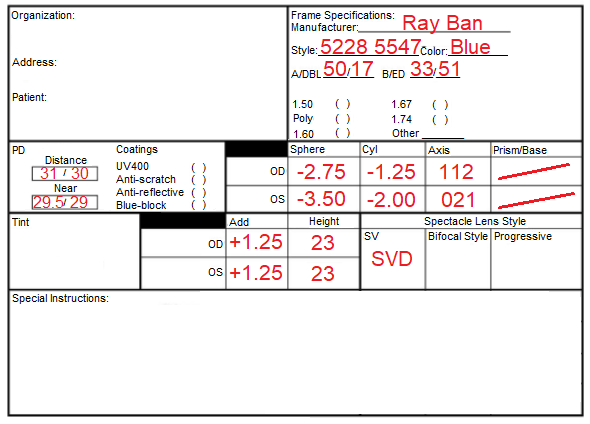
In this example we’ll keep it simple and order SVD for single vision distance glasses.
Lens Index
Lesson 1 of this course was all about the lens index. Using what you learned in that lesson, what lens index would recommend to a customer with the prescription in our example above?
Let’s break it down:
Keep in mind that we are ordering single vision distance lenses for this customer.
- The combined sphere + cylinder power for the right eye is (-2.75 + -1.25) = -4.00
- The combined sphere + cylinder power for the left eye is (-3.50 + -2.00) = -5.50
Would a 1.5 index be appropriate in this case? No, the lenses would be too thick!
Would 1.59 index (polycarbonate) be appropriate? Maybe for the right eye (borderline), but definitely not for the left eye.
Would 1.6 index be appropriate? Yes!
If you haven’t spent time familiarizing yourself with the different lens indexes and the prescription ranges they are appropriate for, I strongly recommend you do so before you learn to fill out a glasses order form.
Lens Coating
The lenses use in glasses are enhanced by applying different types of coatings to them. Without any of these coatings, our glasses would scratch very easily, they would heavily reflect light, be difficult to clean etc.
Here is a list of some common lens coatings:
- Scratch-resistant – This makes it more difficult to scracth the lenses, but does not make them scratch proof!
- Anti-reflective – This reduces the glare and reflections that are otherwise created by the lenses.
- Blue-block – This coating blocks a type of blue light that is emmitted from digital devices.
- UV 400 – This coating blocks UVA and UVB rays from passing through.
- Oleophobic – This coating prevents hard to clean smudges from getting on the lenses.
- Anti-static – This coating prevents small dust particles from sticking to the lenses.
- Anti-fog – This prevents lenses from fogging up when going from cold to hot.
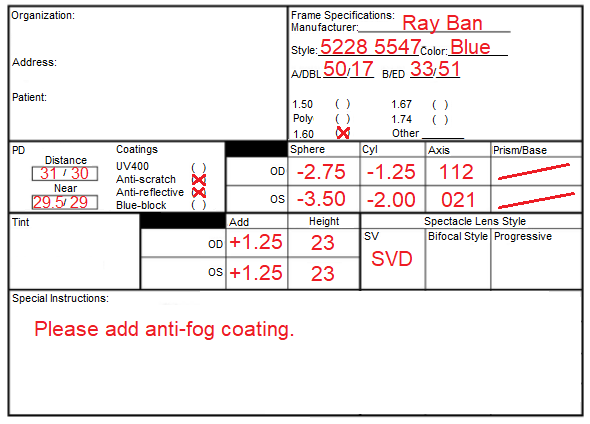
For our example glasses order, we will order scratch-resistant, anti-reflective and in the special instructions we will add anti-fog.
Tints
In Lesson 3 of this course you learned all about the different kinds of tints. If your customer requests a certain kind of tint it has to be written on the glasses order form.
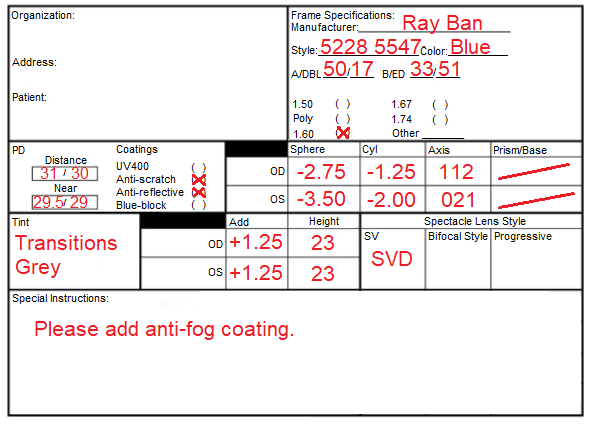
For our example, let’s order Transitions (grey).
You’re Done!
And there you have it! Now you have gathered all the information necessary to order your customer’s glasses. From here, you just fill in your office’s contact information, pack up the glasses order form and the customer’s frame, and off it goes to the edging lab.
Remember that every store has different processes and different looking glasses order forms. But regardless of what they look like, they all have to be filled in with the same information as the one we filled out in this lesson.
If you have any questions about the information that has to go on a glasses order form, let me know in the comments section below. If your question is about measuring the PD and pupil heights, then hopefully your question is answered in the lesson Introduction To Dispensing – Pupillary Distance & Heights.