Who Can Wear Contact Lenses

Knowing Who Can Wear Contact Lenses

Can everyone wear contact lenses? No. There are definitely some people who can’t wear contact lenses, but in this article, I will discuss the kinds of people who can wear contact lenses. Not only that, but there are some people for whom contact lenses are the best option for their vision, and I will go over those scenarios as well.

Who Can Wear Contact Lenses
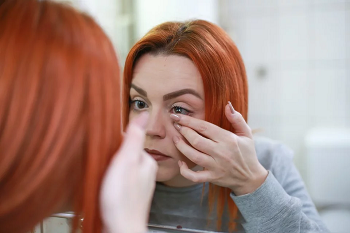
Woman inserting contact lensesThis is by far and away, the biggest category. These days, contact lenses are available in a wide range of different parameters and have become quite remarkably comfortable. This means that most people should be able to find a contact lens that works at least reasonably well.

People Who Can Wear Contact Lenses And Can Expect Perfect Vision

People with any amount of nearsightedness or farsightedness and no astigmatism can expect to be able to wear contact lenses and see perfectly well.

Rough range: Sphere: +6.00D to -10.00D, Cylinder: 0, Axis: None

People Who Can Wear Contact Lenses And Can Expect Near Perfect Vision

People who are nearsighted or farsighted in combination with low to moderate amounts of astigmatism, or people who have low to moderate amounts of astigmatism on its own, will still do very well in contact lenses.

Rough range: Sphere: +6.00D to -10.00D, Cylinder: 0 to -1.25, Axis: 001 to 180

People Who Can Wear Contact Lenses And Should Expect Somewhat Reduced Vision

When the levels of astigmatism start to get moderately high to high, the vision can still be quite good but there will be a noticeable departure from a perfect vision.

Rough range: Sphere: +6.00D to -10.00D, Cylinder: -1.25 to -2.75, Axis: 001 to 180

There are several reasons why the vision could be reduced in this prescription range:

  1. woman squinting her eyesUnstable contact lenses. With a high cylinder power, it becomes very important for the contact lens to sit perfectly aligned on the eye and never move throughout the day. Due to all of the different ways in which our eyes move throughout the day in combination with all the different head positions and eyelid-contact-lens interactions, it is nearly impossible for contact lenses for astigmatism to remain still. When they move far enough out of their ideal position, the vision will become and remain blurry until the lenses return to their ideal fit. This could take anywhere from seconds to minutes.
  2.  Falling between available parameters. Most contact lenses for astigmatism will offer an axis between 10 and 180 and in 10-degree steps. I.e., 10, 20, 30, 40, 50, and so on. However, a person’s vision may require an axis of any number between 1 and 180. I.e., 003, 017, 134, 166, 175, etc. This forces the eye doctor to have to choose the closest axis possible to the prescription, but this may not necessarily be exactly what is needed in order to see perfectly.

Who Should Wear Contact Lenses
woman holding up a contact lensFor most prescriptions, wearing glasses is the go-to solution. For most prescriptions, contact lenses can offer an alternative to glasses but are not necessarily better. However, there are certain people for whom contact lenses would actually correct the vision much better than glasses. I will discuss these situations now.

Anisometropia & Antimetropia

Anisometropia Definition

Anisometropia means that the prescriptions for the right and the left eye are considerably different. How different is considerable? It’s usually when the overall difference reaches around 1.50D or more.

For example: Right: -2.00D, Left: -6.00.
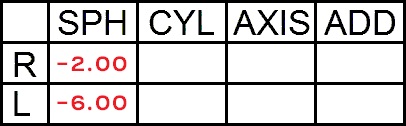
Anisometropic Prescription

Glasses are not ideal when dealing with high levels of anisometropia. I will discuss why in just a second.

Antimetropia Definition

Antimetropia is the condition where one eye is nearsighted and the other eye is farsighted. This is sometimes called ‘mixed anisometropia’.

Antimetropia, if very low doesn’t cause too many problems.

For example: Right: +0.50D, Left -0.25D.
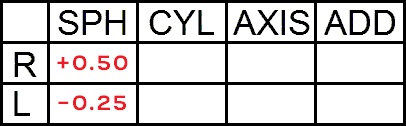
Antimetropic Prescription

However, if antimetropia and anisometropia are present together, that’s when glasses can start causing problems.

Why Aren’t Glasses Ideal For Anisometropia & Antimetropia?

In a nutshell, glasses induce visual distortions. The magnitude of these distortions depends on the strength of the glasses. When both eyes experience roughly the same levels of distortions, the brain is still able to combine the information it receives from both eyes into one coherent image of the world. However, when the distortions are vastly different, the brain cannot combine the information it is receiving from each eye; they are just too different.

The result of wearing glasses for anisometropia can range from uncomfortable vision, to double vision, eyestrain, headaches, loss of depth perception, and more.

Click here to learn more about anisometropia.

If you have a very savvy optician or optometrist, he/she can attempt to mitigate the symptoms of anisometropia by altering various properties of the glasses such as lens index, vertex distance, base curve, bevel position, etc.

Click here for more information on this type of solution.

However, a simpler solution would be to simply wear contact lenses!

Why Are Contact Lenses Ideal For Anisometropia & Anitmetropia?

Contact lenses do not produce any of the distortions in vision that glasses produce, no matter how different the prescription is between the two eyes. Why is that? Because not only do visual distortions depend on the strength of the lenses, but also the distance between the lens and the eye.

You can think of it this way:

Visual Distortions = [Strength of Lens] X [Distance Between Lens & Eye]

When using glasses for anisometropia, the strength of the lens will be different for each eye and the distance between the lens and the eye is usually about 12-14mm. This will lead to considerably different visual distortions for each and result in visual discomfort.

When using contact lenses for anisometropia, the strength of the lens doesn’t matter because the distance between the lens and the eye is always zero. That results in zero visual distortions for each eye every time.

Very High Sphere Power
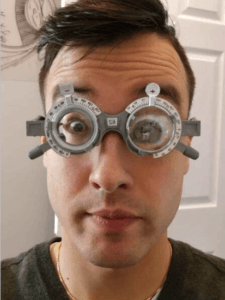
Size of Eyes through very storng myopic and hyperopic glasses
Me wearing a -20D lens on the right and +20D lens on the left. Note the way that each change the apparent size of my eyes.

When you have a very high prescription, glasses start to affect the apparent size of your eyes. Sometimes this can be distracting or unappealing.

If you have a very strong hyperopic prescription, it will make your eyes look unnaturally big.

If you have a very strong myopic prescription, it will make your eyes look unnaturally small.

Keratoconus

Keratoconus is a condition that causes the cornea to develop something known as irregular astigmatism. Glasses and regular soft contact lenses are not able to correct irregular astigmatism. In this case what is needed are hard contact lenses called RGPs (rigid gas permeable).
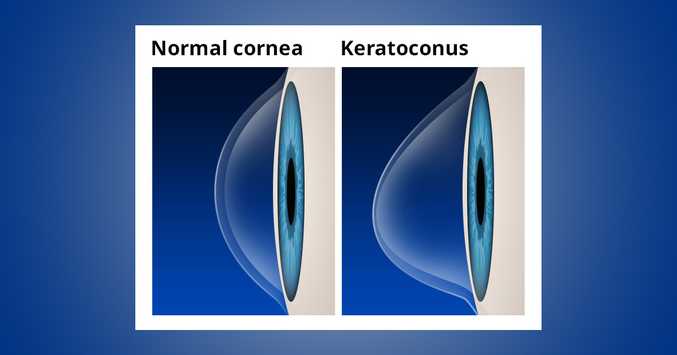
Normal Cornea VS Keratoconus

Click here to learn more about keratoconus.

Summary

There are some people that can’t wear contact lenses but as you can see now, most people can and there are even many people for whom contact lenses are the best option.

Can you think of any scenarios that I’ve missed? If so, please share them in the comments below!

Once a suitable contact lens candidate has been found, it’s time to start analyzing what power of contact lenses they will need.
==>Click here to learn how to convert a glasses prescription to contact lenses<==

The Optics of the Eye Lesson 6 Emmetropia and Myopia Featured Image

The Optics of Vision – Lesson 6: Emmetropia & Myopia

Congratulations, you’ve made it to Lesson 6 where we’re finally going to start talking about glasses! This lesson will focus mostly on nearsightedness but you will also learn about much lesser known ‘condition’ known as emmetropia.

This lesson will continue to build on everything we’ve learned in Lessons 1-5. So if you haven’t done so already, here they are:

Refractive Conditions

Refractive conditions refers to all the conditions that require us to wear glasses.

The word refraction refers to what happens to light when it passes through lenses.  

Since the cornea acts like a lens, it can be said that the cornea refracts light.

I will continue to use the term ‘refract’ in the appropriate contexts, but whenever I do, you can pretty much replace that word in your head with the word ‘focus’ and you won’t miss a beat.

As we learned in Lesson 5, if the light is refracted such that it becomes perfectly focused on the retina, clear vision will be produced.

However, if the light entering the eyes is not refracted perfectly onto the retina, vision will be blurry and the eye is said to have a refractive condition. (I.e., a focusing condition)

The 3 main refractive conditions are:

  • nearsightedness (myopia)
  • farsightedness (hyperopia)
  • astigmatism

The lack of a refractive condition is called emmetropia.

Emmetropia Vs Ammetropia

What is Emmetropia?

Emmetropia is the ‘condition’ where light focuses perfectly inside the eyes and the vision is clear.

The word emmetropia is the name of the ‘condition’ and the word emmetropic is used to describe somebody with emmetropia. I.e., He has emmetropia, he is emmetropic.

This is not a common term and you will not see it used in the day-to-day operations of an optical store or optometry clinic. Remember, emmetropic people don’t need glasses so we usually just say that they have perfect vision instead of calling them emmetropic. 

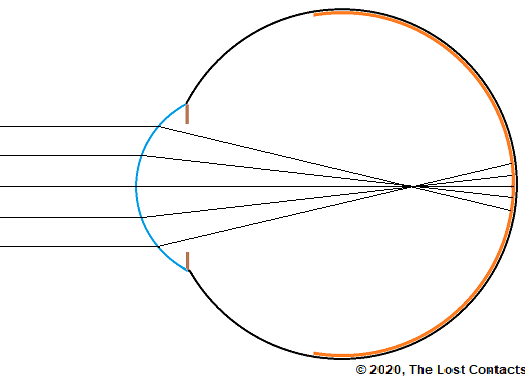
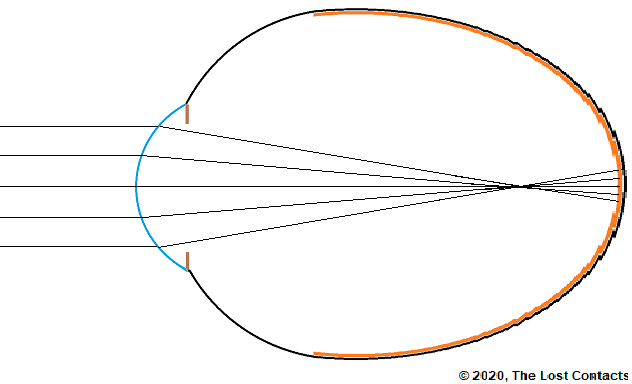
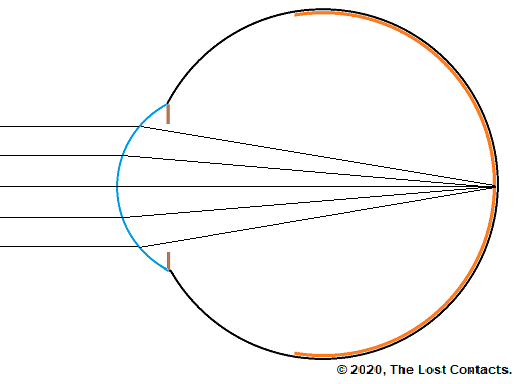
In Lesson 5, the ray diagram of the eye that we studied was in fact depicting emmetropia. Here it is again:

Ray Diagram of an Emmetropic Eye

This diagram depicts emmetropia because the incoming parallel light is perfectly refracted by the cornea to come to a focus precisely on the retina. This is what the eye needs in order to see clearly.

What is Ammetropia?

Ammetropia is an umbrella term for anything that is not emmetropia. That means that the focal point of parallel light entering the eyes does not come to a focus on the retina. There are many refractive conditions that fall under the category of ametropia and in the rest of today’s lesson we will cover one of the most common one; myopia.

Myopia

What is Myopia?

Myopia is the refractive condition that results when the focal point of parallel light entering the eye forms in front of the retina.

The word myopia is the name of the condition and the word myopic is used to describe somebody with myopia. I.e., She has myopia, she is myopia.

The more commonly used term for myopia is nearsightedness. I.e., She has nearsightedness, she is nearsighted.

Here is an example of a ray diagram of myopia:


Ray Diagram of Moderate Myopia
A ray daigram representing myopia. Note that the focal point is well in front of the retina.

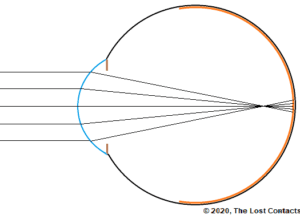
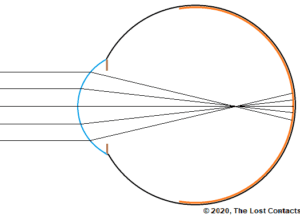
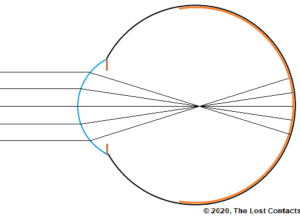
Myopia is not just a single state. It is a continuum. It can be very low if the focal point is only slightly in front of the retina, or it can be very high if the focal point is very far in front of the retina. Here are examples of 3 different levels of myopia

Ray Diagram of Low Myopia Ray Diagram of Moderate Myopia Ray Diagram of High Myopia
Low Myopia Moderate Myopia High Myopia

What Causes Myopia?

Can you think of different things that can place an eye in a state of myopia?

There are 2 possible ways.

  1. The cornea is too storng (it has too much converging power)
  2. The eye is too long and the retina is too far back

By far and away the biggest cause is #2: The eye is too long and the retina is too far back.

The 3 diagrams above are helpful in showing different severities of myopia, but they correspond more to the cornea being the cause of myopia, which is not the case in reality.

Here is a more accurate way of thinking of myopia:

Ray Diagram of Different Stages of Myopia

Note that in all 3 of the ray diagrams above, the focal length is the same. The focal point is exactly the same distance from the cornea in each case. The only thing that changes is the walls of the eye (and the retina) getting further and further back.

How to Treat Myopia

The goal when treating myopia is to put the focal point back onto the retina.

In myopia, the foal distance is not long enoug to reach the retina. Therefore, we have to increase the focal distace.

Since you’ve studied Lesson 3 on lens power, you know that stronger converging lesnses have shorter focal distances, and weaker converging lenses have longer focal distance.

So all we have to do to increase the focal distance of the eye is to lower the overall convergence of the cornea!

Another way of saying the exact same thing is: increase the overall divergence of the cornea.

Decreasing Convergence = Increasing Divergence

Increasing Convergence = Decreasing Divergence

The easiest way to decrease the convergence (increase the divergence) of the cornea is simply to add a diverging lense in front of it. A.k.a: Glasses!

Prescribing Lenses for Myopia

The job of an optometrist is to determine exatly what strength of diverging lens needs to be placed in front of a myopic eye in order to place the focal point back onto the retina.

Let’s do an excerise to give you an idea of how this works. Remeber this image:

Ray Diagram of Eye Blank Longest with Rays

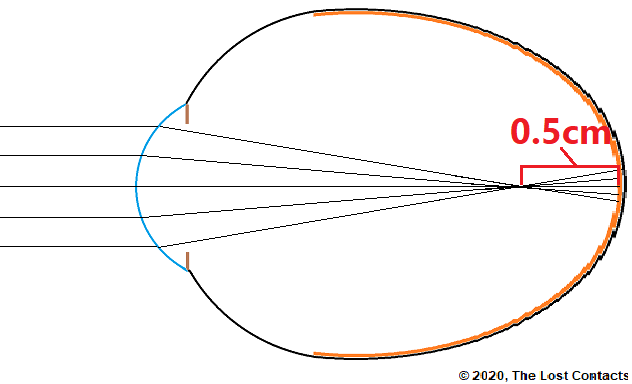
Let’s pretend this is our patient. She is myopic, but what lens will she need in order to see clearly?

In this example, we will say that the focal point is exacty 0.5cm in front of the retina.

We will also assume that the cornea has a power of +50D, which gives rise to a focal point exactly 2cm behind the cornea. If you don’t understand how that works, please review Lesson 5.

Ray Diagram of Myopia example

Calculations

The formula for lens power is:

lens power = 1 / focal distance

In this example we want the focal distance to be 2.5cm (because that’s how far the retina is from the cornea).

lens power = 1 / 0.025

lens power = +40D

This means that for the focal point to be on the retina, the cornea must have a lens power of +40D. But is has a lens power of +50D, not +40D, so what do we do?

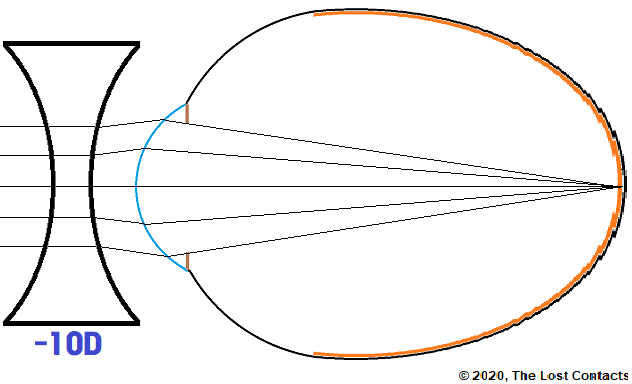
Well, since the cornea has +10D more power than we need, we will offset that by adding a -10D lens in front of the cornea.

Calculations

Total Power Needed = Power of the Cornea + Power of Glasses Needed

+40D = +50D + Power of Glasses Needed

Power of Glasses Needed = +40D – (+50D)

Power of Glasses Needed = -10D

Here is the ray diagram for the same eye with a -10D lens in front of it.

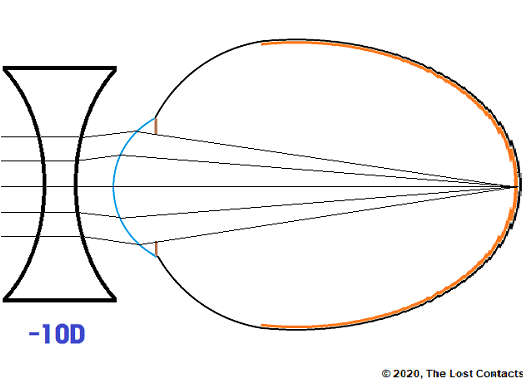
Ray Diagram of Myopic Eye Corrected With A Minus Lens


Because of the diverging power of the minus lens, it reduced the overall convergence power of the eye. This results in the focal point forming further away from the cornea. In the example above, a -10D lens is required to place the focal point exactly onto the retina.

In a nutshell, that’s what myopia is and how it is corrtected. However, during an eye exam optometrists do not do any of the calculations you saw here in this lesson. Instead, they place different lenses in front of the eyes until the vision becomes clear. When the vision is the clearest, that’s when the optometrist knows that the focal point is on the retina. The diagrams and calculations in this lesson are meant to help you better understand what is going on inside the eyes when people are nearsighted.

Pop Quiz!

I have challenging question for all of you reading through this course. Test yourself by thinking about it, re-reading this lesson and previous lessons if necessary, and leave your answer in the comments section below to see if you are correct.

Question:

Why do nearsighted people need glasses to see clearly in the distance, but don’t need to glasses to see well up close?

Hint: Think of what type of lenses nearsighted people wear, what effect these lenses have on light, and how else you can create that same effect.

Leave comment below to find out the answer!

If you’re comfortable with the concepts covered in this lesson then it’s time to start learning about hyperopia! However, if you found this lesson challenging, please re-read it a few times and leave any questions you still have about it in the comments below and I will answer them for you.

==>The Optics of Vision – Lesson 7: HYPEROPIA <==