Can everyone wear contact lenses? No. There are definitely some people who can’t wear contact lenses, but in this article, I will discuss the kinds of people who can wear contact lenses. Not only that, but there are some people for whom contact lenses are the best option for their vision, and I will go over those scenarios as well.
Who Can Wear Contact Lenses
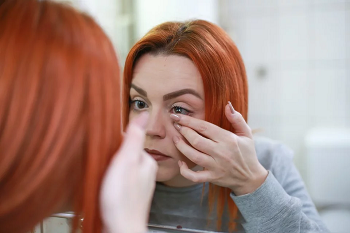 This is by far and away, the biggest category. These days, contact lenses are available in a wide range of different parameters and have become quite remarkably comfortable. This means that most people should be able to find a contact lens that works at least reasonably well.
People Who Can Wear Contact Lenses And Can Expect Perfect Vision
People with any amount of nearsightedness or farsightedness and no astigmatism can expect to be able to wear contact lenses and see perfectly well.
Rough range: Sphere: +6.00D to -10.00D, Cylinder: 0, Axis: None
People Who Can Wear Contact Lenses And Can Expect Near Perfect Vision
People who are nearsighted or farsighted in combination with low to moderate amounts of astigmatism, or people who have low to moderate amounts of astigmatism on its own, will still do very well in contact lenses.
Rough range: Sphere: +6.00D to -10.00D, Cylinder: 0 to -1.25, Axis: 001 to 180
People Who Can Wear Contact Lenses And Should Expect Somewhat Reduced Vision
When the levels of astigmatism start to get moderately high to high, the vision can still be quite good but there will be a noticeable departure from a perfect vision.
Rough range: Sphere: +6.00D to -10.00D, Cylinder: -1.25 to -2.75, Axis: 001 to 180
There are several reasons why the vision could be reduced in this prescription range:
 Unstable contact lenses. With a high cylinder power, it becomes very important for the contact lens to sit perfectly aligned on the eye and never move throughout the day. Due to all of the different ways in which our eyes move throughout the day in combination with all the different head positions and eyelid-contact-lens interactions, it is nearly impossible for contact lenses for astigmatism to remain still. When they move far enough out of their ideal position, the vision will become and remain blurry until the lenses return to their ideal fit. This could take anywhere from seconds to minutes.
- Falling between available parameters. Most contact lenses for astigmatism will offer an axis between 10 and 180 and in 10-degree steps. I.e., 10, 20, 30, 40, 50, and so on. However, a person’s vision may require an axis of any number between 1 and 180. I.e., 003, 017, 134, 166, 175, etc. This forces the eye doctor to have to choose the closest axis possible to the prescription, but this may not necessarily be exactly what is needed in order to see perfectly.
Who Should Wear Contact Lenses
 For most prescriptions, wearing glasses is the go-to solution. For most prescriptions, contact lenses can offer an alternative to glasses but are not necessarily better. However, there are certain people for whom contact lenses would actually correct the vision much better than glasses. I will discuss these situations now.
Anisometropia & Antimetropia
Anisometropia Definition
Anisometropia means that the prescriptions for the right and the left eye are considerably different. How different is considerable? It’s usually when the overall difference reaches around 1.50D or more.
For example: Right: -2.00D, Left: -6.00.
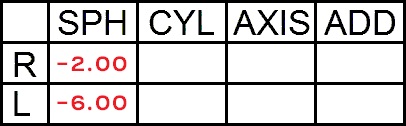
Glasses are not ideal when dealing with high levels of anisometropia. I will discuss why in just a second.
Antimetropia Definition
Antimetropia is the condition where one eye is nearsighted and the other eye is farsighted. This is sometimes called ‘mixed anisometropia’.
Antimetropia, if very low doesn’t cause too many problems.
For example: Right: +0.50D, Left -0.25D.
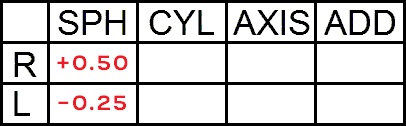
However, if antimetropia and anisometropia are present together, that’s when glasses can start causing problems.
Why Aren’t Glasses Ideal For Anisometropia & Antimetropia?
In a nutshell, glasses induce visual distortions. The magnitude of these distortions depends on the strength of the glasses. When both eyes experience roughly the same levels of distortions, the brain is still able to combine the information it receives from both eyes into one coherent image of the world. However, when the distortions are vastly different, the brain cannot combine the information it is receiving from each eye; they are just too different.
The result of wearing glasses for anisometropia can range from uncomfortable vision, to double vision, eyestrain, headaches, loss of depth perception, and more.
Click here to learn more about anisometropia.
If you have a very savvy optician or optometrist, he/she can attempt to mitigate the symptoms of anisometropia by altering various properties of the glasses such as lens index, vertex distance, base curve, bevel position, etc.
Click here for more information on this type of solution.
However, a simpler solution would be to simply wear contact lenses!
Why Are Contact Lenses Ideal For Anisometropia & Anitmetropia?
Contact lenses do not produce any of the distortions in vision that glasses produce, no matter how different the prescription is between the two eyes. Why is that? Because not only do visual distortions depend on the strength of the lenses, but also the distance between the lens and the eye.
You can think of it this way:
Visual Distortions = [Strength of Lens] X [Distance Between Lens & Eye]
When using glasses for anisometropia, the strength of the lens will be different for each eye and the distance between the lens and the eye is usually about 12-14mm. This will lead to considerably different visual distortions for each and result in visual discomfort.
When using contact lenses for anisometropia, the strength of the lens doesn’t matter because the distance between the lens and the eye is always zero. That results in zero visual distortions for each eye every time.
Very High Sphere Power
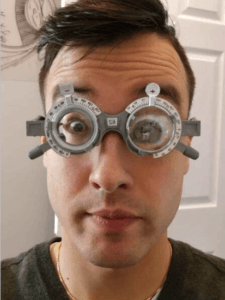
When you have a very high prescription, glasses start to affect the apparent size of your eyes. Sometimes this can be distracting or unappealing.
If you have a very strong hyperopic prescription, it will make your eyes look unnaturally big.
If you have a very strong myopic prescription, it will make your eyes look unnaturally small.
Keratoconus
Keratoconus is a condition that causes the cornea to develop something known as irregular astigmatism. Glasses and regular soft contact lenses are not able to correct irregular astigmatism. In this case what is needed are hard contact lenses called RGPs (rigid gas permeable).
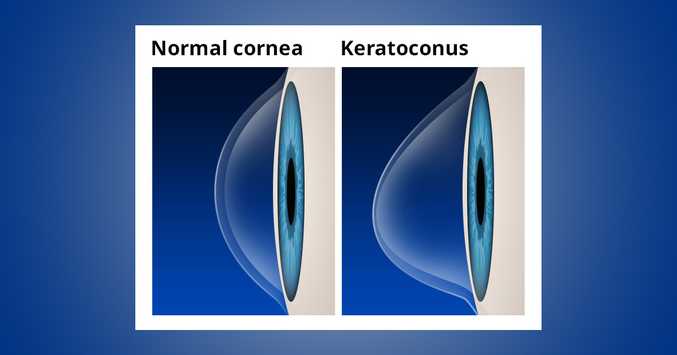
Click here to learn more about keratoconus.
Summary
There are some people that can’t wear contact lenses but as you can see now, most people can and there are even many people for whom contact lenses are the best option.
Can you think of any scenarios that I’ve missed? If so, please share them in the comments below!
Once a suitable contact lens candidate has been found, it’s time to start analyzing what power of contact lenses they will need.