
When you’re sick and need medication, you have it prescribed by your doctor and filled by your pharmacist, right? But can an optometrist prescribe medication? Optometrists are licensed doctors after all.
The short answer is yes, optometrists can prescribe medication. However, optometrists have a very defined scope of practice that – surprise, surprise – revolves largely around the eyes.
Optometrists can not prescribe all the same medications that your family doctor can. In this article I will discuss the types of conditions your optometrist can prescribe medication for and which medications are most commonly prescribed by optometrists.
Note This is not meant to be a comprehensive guide on how to treat the various eye conditions listed below. My intention with this article is to give the general public an idea of the types of conditions optometrists can prescribe medication for.
Severe Eye Allergies
Eye drops for allergy relief can readily be found over-the-counter (OTC) at any pharmacy. However, for those suffering from severe eye allergies, OTC allergy eye medication may not cut it.
Severe Eye Allergies – Treatment
Here are some of the most common medications that can be prescribed by optometrists for severe eye allergies.
They include (among others):
- Patanol (olopatadine hydrochloride ophthalmic solution) 0.1 %
- Pataday (olopatadine hydrochloride ophthalmic solution) 0.2%
- Alrex (loteprednol etabonate ophthalmic suspension) 0.2%
- Lotemax (loteprednol etabonate ophthalmic suspension) 0.5%
- FML (fluorometholone ophthalmic suspension) 0.1%
- Acular (ketorolac tromethamine) Ophthalmic Solution
Natural Eye Allergy Remedies
For those people who are just not inclined to take medication, there are some natural eye allergy remedies that may help.
These include:
- Allergen avoidance – Know what you’re allergic to and avoiding it if possible is the best way to prevent allergy symptoms.
- Cold compresses as needed throughout the day – Cold compresses help reduce eye itchiness and eyelid swelling due to allergies.
- Preservative free artificial tears – Used throughout the day to flush out any allergens that get into the eyes.
Best Preservative-Free Artificial Tears For Allergies
- Thealoz Duo by Labtician Théa
- HYLO DUAL by Candorvision
- I-DROP PUR by I-Med Pharma
Bacterial Eye Infections
Bacterial eye infections can range from mild and self-resolving to seriously vision threatening. If you suspect you have a bacterial infection it is imperative that you seek medical attention.
Bacterial Eye Infection – Treatment
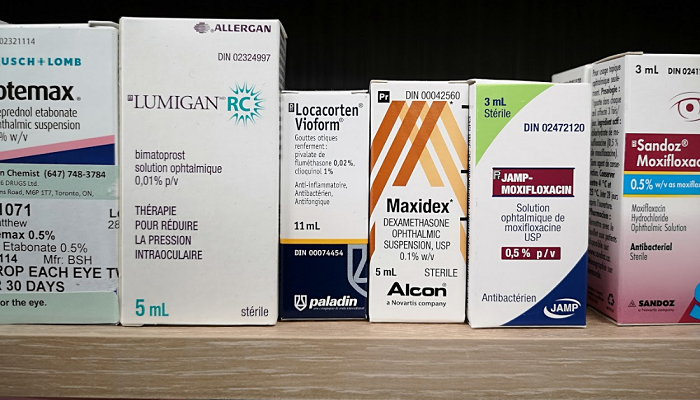
Here are some common anti-bacterial eye drops used for bacterial eye infection treatment.
They include (among others):
- Vigamox (moxifloxacin ophthalmic solution) 0.5%
- Besivance (besifloxacin ophthalmic suspension) 0.6%
- Tobrex (tobramycin ophthalmic ointment) 0.3%
- Ilotycin (erythromycin ophthalmic ointment)
- Zithromax (azithromycin)
Viral Eye Infections
While most viral eye infections don’t require medication to completely resolve, there is a unique virus that can be treated medically. This is the herpes simplex virus – and yes, it can infect your eyes.
When the herpes simplex virus infects the cornea is it called herpes simplex keratitis (HSK). HSK will cause redness and discomfort in the eyes. Occasionally, mild to severe vision reduction can occur.
Herpes Simplex Keratitis – Treatment
HSK responds well to medications like:
- Viroptic (trifluridine)
- Zirgan (ganciclovir ophthalmic gel)
- VIRA-A (vidarabine ophthalmic ointment)
- Zovirax (acyclovir)
- Valtrex (valacyclovir)
- Famvir (famciclovir)
Corneal Abrasions
Corneal abrasions are pesky incidents that can happen to anyone – and usually at the most importune of times. They are extremely uncomfortable, inconvenient and vision-impeding. Luckily, your optometrists can treat corneal abrasions by prescribing medications that will relieve symptoms until the abrasion resolves.
Corneal Abrasions – Treatment
Your optometrist may prescribe:
An agent to reduce light sensitivity and pain:
- Cyclogyl (Cyclopentolate Hydrochloride Ophthalmic Solution)
An optional additional agent to reduce pain:
- Voltaren Ophthalmic (diclofenac sodium) Solution 0.1%
- Acular (ketorolac tromethamine) Ophthalmic Solution
An agent to prevent infection:
A bandage contact lens to reduce pain.
Corneal Abrasion Healing Time
Corneal abrasions typically heal on their own in 1-2 days. Very mild ones may even heal in a few hours, however, an active corneal abrasion can completely impede your daily routine. That’s why even though they are short lasting, it is worth the trip to optometrist to get treatment.
Anterior Uveitis/Iritis
Anterior uveitis is inflammation inside the front part of the eye. Anterior uveitis symptoms tend to be redness of the eye (generally all around), pain inside the eye, and extreme light sensitivity. It is not an infection and not contagious, but it can severely interfere with your quality of life and if it drags on for too long, it can cause some serious complications.
Anterior Uveitis Treatment
To treat anterior uveitis, your optometrist may prescribe several types of medication.
An agent to reduce light sensitivity and pain:
- Cyclogyl (Cyclopentolate Hydrochloride Ophthalmic Solution)
An agent to reduce the redness and inflammation:
- Pred Forte (prednisolone acetate ophthalmic suspension) 1%
- Durezol (difuprednate ophthalmic emulsion) 0.05%
An agent to reduce eye pressure should it be needed:
- Timoptic (timolol ophthalmic solution)
For conditions like anterior uveitis, not only will your optometrist prescribe you medication, but also give you a detailed drop schedule that will need to be adjusted over time. It may range from 1 drop every half hour at the beginning all the way down to 1 drop ever few days.
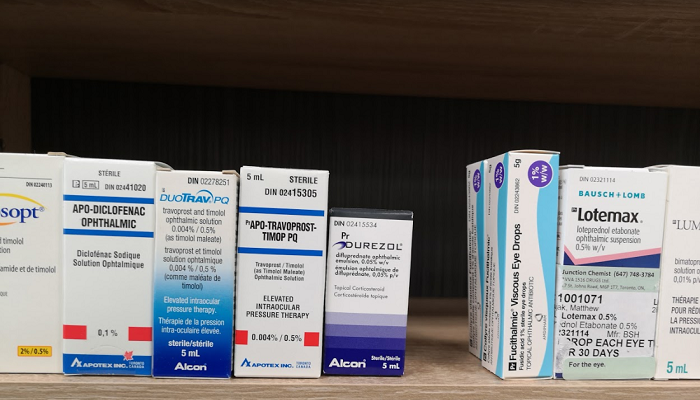
Glaucoma
Glaucoma comes in many different forms and it is often co-managed between an optometrist and an ophthalmologist. Glaucoma therapies are aimed at lowering the pressure inside the eye in order to prevent damage to the optic nerve.
The simplest way to control the pressure inside the eyes is through the use of eye pressure drops, though other types of interventions do exist.
Glaucoma Treatment – Eye Drops
- Xalatan (latanoprost)
- Lumigan (bimatoprost)
- Travatan Z (Travoprost)
- Timoptic (timolol ophthalmic solution)
- Alphagan P (brimonidine tartrate ophthalmic solution)
- Iopidine (apraclonidine)
- Trusopt (dorzolamide)
- Azopt (brinzolamide)
Glaucoma Treatment – Tablets
- Diamox (acetazolamide)
Glaucoma treatments that involve surgical intervention or the application of lasers are not performed by optometrists.

Summary
Though this has been a mere overview of some of the conditions that optometrists can prescribe medications for, I think that you can now see that the answer is clear. Can an optometrist prescribe medication? Absolutely.
Have you had an experienced with being prescribe medication from your optometrist? If so, how was it? Let me know in the comments section!