The Downsides and Benefits of Being An Optometrist - Featured

The Downsides & Benefits of Being an Optometrist

Being an optometrist can be a very rewarding career but it is not right for everybody. In this article I want to detail the downsides and benefits of being an optometrist to balance the overly rosy picture painted by optometry school websites and student outreach teams. I believe it is important for students to know what real-world optometry is like before they get into it.
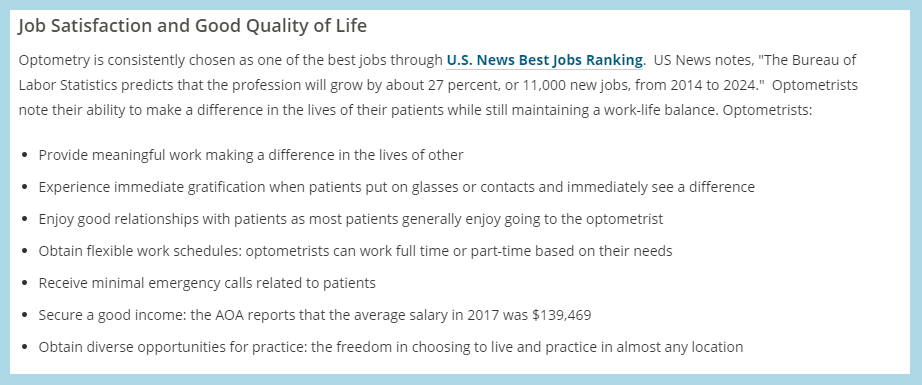
Benefits of Being an Optometrist from the New England College of Optometry
A screenshot from the New England College of Optometry website. Sound really good, but surely there are some downsides, no?

Keep in mind that I have worked my entire career in Ontario, Canada and I am just one optometrist. Everything I write reflects only my own experience in the field. I encourage anyone considering optometry as a career to speak to as many optometrists as possible before investing so heavily into it. If possible, talk to people who will speak honestly and candidly about both the good and the bad.

Benefits of Being an Optometrist

Money

A typical optometrist yearly income is well above the national average.  If you’re looking for a career that gives you the opportunity to own a home, raise a family, travel, drive a nice car, etc., then becoming an optometrist can offer you those opportunities.

The question you have of course is – exactly how much do optometrists make, right? I have written an entire article on this subject as it is not an easy question to answer.
What is an optometrist salary

Click here to read ‘What is an Optometrist Salary in Canada’

Schedule Flexibility

Being an optometrist is not a Monday-Friday 9-5 job (unless you want it to be). Optometrists have the ability to craft the work schedule that suits their needs and lifestyle the most.

For optometrist to whom their work schedule is of utmost importance, they will actually make a work schedule before even looking for a job and then find positions that fit that schedule.

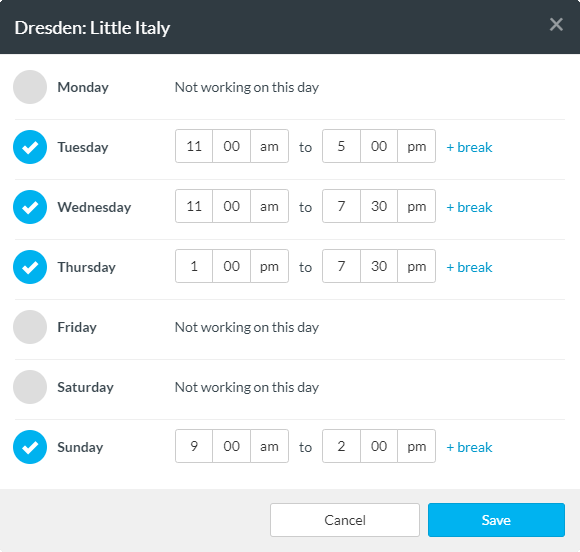
For example, if this is the desired work schedule:

Example Optometrist Work Schedule

You might find a clinic looking for an optometrist for Mondays and Fridays, but not Wednesdays and Thursdays. You would then take that opportunity and then look for a different clinic seeking an optometrist for Wednesdays and Thursdays, and so on. You might end up working in 2 or 3 different clinics on different days of the week, but you would have the exact schedule that you’re looking for.

Of course this is just an example, but it works regardless of what schedule you set for yourself.

Many Different Modes of Practice

Optometrists are not limited to a single type of work environment. There are many to choose from depending on you personal preference.

Full Scope Practice

Full Scope Optometry Practice

Benefit: Full scope optometry practices really allow an optometrist to use their full breath of knowledge and skills.

Disadvantage: Income can be heavily dependent on selling additional tests, products, glasses, contact lenses, etc.

Side-By-Side

Side By Side Optometry Office

Benefit: Tend to be very busy and pay is based on seeing patients rather than selling glasses.

Disadvantage: Lower exam fees (after owner takes a cut) means seeing 3-4 patients/hour to make good money.

Independent Optical Stores

Independent Optical Store

Benefit: You work for yourself and nobody takes a cut of your earning (except the government…)

Disadvantages: Patient volumes tend to be lower.

Area-of-Interest Practice

Vision Therapy Equipment

Benefit: Can focus on your particular area of interest within optometry, i.e., dry eye management, pediatric optometry, low vision, vision therapy, etc.

Disadvantage: Usually requires bigger investment and can take many years to build a steady flow of patients.

Ophthalmologist Office

Ophthalmology Office Uptown Eye Specialists Toronto

Benefit: Get to see many interesting cases and have access to latest technology.

Disadvantage: Will not be able to buy into the practice.
Meet Interesting People

As an optometrist you will be meeting and getting to know people every day. You will quickly realize how much you can learn just by listening to people talk. People from all over the world will be coming to see you and most of the time they are more than happy to share stories of where they come from with you.

Sometimes you even meet famous people. Everyone needs their eyes checked right? I have met several professional athletes, TV personalities, politicians, etc.

Prevent Blindness

Of course, the biggest benefit of being an optometrist is being able to use your knowledge and clinical skills to prevent people from going blind. You will be making your living by helping people retain their most valued sense; that is an honorable endeavor.

Downsides of Being an Optometrist

Unstable Income

Optometrist earn their pay by seeing patients. From month to month and year to year, the number of patients seen is never the exactly the same. This results in a somewhat unpredictable income.

Now, that’s under normal circumstances. Throw in economic shutdowns due to global pandemics and… well, that’ll put a pretty big dent in your income.

Closed due to coronavirus sign

Income Depends on Selling

Any optometrist working in a dispensing practice (a practice that does eye exams and sells glasses) will most likely have their income tied to how many glasses and additional services they can sell. Students entering optometry school who don’t know this can be in for a shock if they are not the type who like to push for sales.

Additionally, in many offices the optometrist’s income is actually controlled by the office’s support staff.

How it Works: optometrists make a recommendation to patients in the in exam room and then hand the patient off to a staff member to complete the sale. If the staff member isn’t highly trained on retail techniques, educated different lens designs and technology, glasses trends and fashion, or simply isn’t interested in making the sale, the patient will walk away and purchase glasses elsewhere, which means you lose money.

No Sick Days

Feeling sick can be quite a conundrum for optometrists. On one hand they want to stay home, recover, and not spread any bugs around. But on the other hand, if they do they will lose an entire day of pay, as well as have to anger and potentially lose an entire day’s worth of patients by cancelling on them last minute. If an optometrist is sick for several days, you can see how this problem can compound quickly.

Being sick as on optometrist is a lose-lose situation.

No Paid Vacation Days

Going on vacation as an optometrist is not cheap. Not only do you have to pay for the vacation itself, but you also have to give up any income that could have been earned on all those vacation days.

Vacation in Disney World Disney Downtown Planet Hollywood1
From my vacation in Disney World in 2014

No Benefits

Whether optometrists are practice owners or associates, they are self employed, not employees. This means that they don’t have an employer to provide them with work benefits. So no dental, vision, medication, massage therapy, physiotherapy, chiropractor, etc., etc.

Troublesome Patients

The majority of patients that optometrists see are quite pleasant and a joy to have in the office. But every optometrists has horror stories about patients that get under everyone’s skin, take up everyone’s time, act aggressively or violently, show up under the influence of drugs and alcohol, etc.

Insurance Companies Dictate Prices

Most people are covered for their eye exam by either the government, their university health plan, work benefits, personal insurance plans etc. Depending on the areas that you practice in, you may not be allowed to charge more than the what the insurance plan covers for the patient. If you do, you will simply be removed from the insurer’s doctor network and lose all the patients from that insurer.

Whatever the case, more and more optometrists are losing control over their prices to insurance companies.

Summary

While the benefits of being an optometrist are many, there are also some important downsides to know about before choosing it as a career. Surely I have missed many of this benefits and downsides here in this article, as one could write an entire book about being an optometrist. If you have any specific questions about the profession, let me know in the comments below and I will be happy to answer them.

What is an optometrist salary

What Is An Optometrist Salary in Canada?

An optometrist salary is a complicated thing that depends on many different factors. You cannot simply query it in Google, find a figure and roll with it. You will not get an accurate figure!

Screenshot of an optometrist salary No offence to Neuvoo who calculated this figure. I’m sure they have solid data, but if you really want to know what an optometrist salary is, you have to dig a lot deeper than that. In this article I will explain to you how an optometrist gets paid – and it’s a little more complicated than you might think!

What Is An Optometrist Salary?

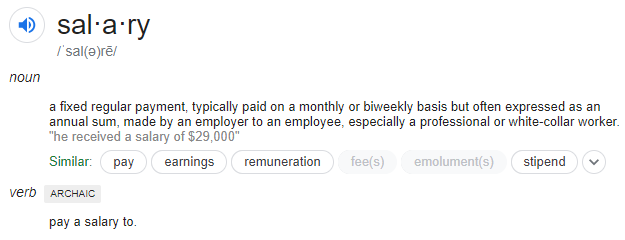
The first problem is the question itself. In Canada, the vast majority of optometrists don’t receive a salary in the strict sense of the word.

salary definition

Optometrists are not paid a fixed regular amount. Their pay depends on several factors which I will discuss with you in this article. But first, let’s ask the right question.

Rather than ‘what is an optometrist salary?’, a better question would be ‘how much do optometrists make?’

How Much Do Optometrists Make?

All optometrists have the same basic job; they examine patients. But every optometrist makes a different amount. Why is that? Well, it depends on several things. Some of them are controllable, some of them are negotiable, and some of them are just the way they are.

Controllable Factors

Work Week

One of the benefits of being an optometrist is that you can choose your own schedule. You don’t like working Monday to Friday? No problem. You want to have 3 or 4 day work weeks, you got it. An optometrist can set the schedule that suits his/her lifestyle most.

This flexibility makes it difficult to pinpoint an exact dollar amount figure that optometrists make in a year. Those optometrists who have it in them to work 7 days/week will be making a lot more than those working 3 days/week.

Example Optometrist Schedule
Example of an optometrist schedule

Work Day

Optometrists don’t all work the same hours. Some only work half days, some do long 10-12 hour days. It all depends on the optometrist and this too, will affect how much an optometrist makes.

Location

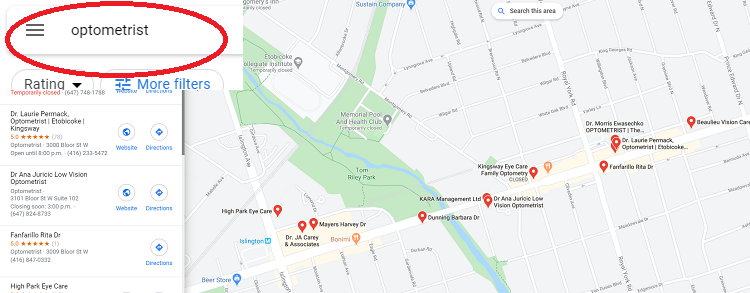
Generally speaking, optometrists get to choose where they work. If an optometrist works in an area saturated with optometrists at every street corner, they will not make as much as if they were in an area where they are the only optometrist. That’s why optometrists in small rural towns tend to make a lot more than optometrists in the big city.

Google Maps of Optometrists in a Small Area
A street densely populated with optometrists

Business Savviness

Optometrists who run their own clinics have to be business savvy in order to succeed. An optometrist could be great at giving eye exams, but if he/she does not have the right staff, purchase the right equipment, carry the right frame lines, do the right marketing, etc., then he or she will not make as much as someone who does.

Negotiable Factors

Associate Contract

Example Optometrist Contract
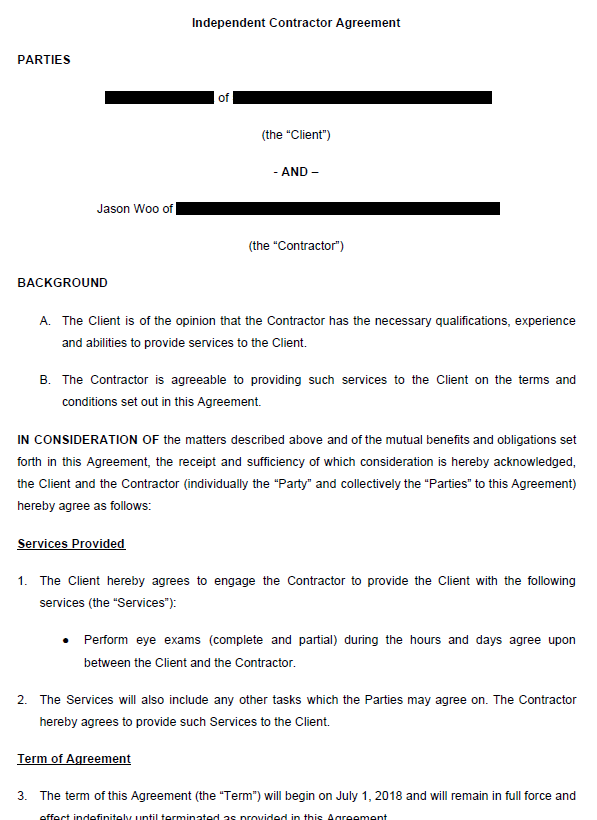
Example of (part of) an optometrist contract

When joining an already established practice, an optometrist must negotiate an agreement with the practice owner. These are called associate agreements or associate contracts, and they stipulate (among other things) how much of the exam fee the associate optometrist will get to keep and how much will go to the practice owner.

Depending on the type of clinic, an associate optometrist may take a cut of several different services rendered and products sold. Here is a list of items an optometrist could be remunerated for:

  1. Performing eye exams
  2. Selling additional tests such as; retinal imaging, optical coherence tomography (OCT) imaging, visual field tests, pachymetry, gonioscopy, corneal topography, etc.
  3. Selling additional services such as; contact lens fittings, contact lens teachings, vision therapy, dry eye therapy, low vision assessments, etc.
  4. Selling glasses and contact lenses
  5. Selling eye care products such as; eye drops, hot compress masks, vitamins, lid wipes, etc.

The commission on all the products and services mentioned above varies from contract to contract. Some optometrists may get 80% of sales, whereas others might only get 40%. It all depends on the market you are in and the practice owner you are signing the contract with.

Uncontrollable Factors

There are some things in life that we just can’t do anything about, yet, they can have a major impact on our livelihoods. In optometry, there are such things that determine how much optometrists make.

Provincial Health Plans

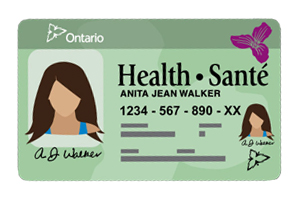
Sample OHIP cardIn Canada, one of these things is provincial health plans. Each province is a little bit different, but in Ontario for example, optometrists are not allowed to charge children or seniors for an eye exam. Rather than receiving payment from the patient, a claim must be submitted to the province for reimbursement.

That doesn’t seem too bad, so what’s the big deal, right? The big deal is that provinces do not reimburse optometrists for the full cost of the eye exam. Depending on what an optometrist charges for their eye exam, the province will generally pay back somewhere between 30-50% of the cost and the optometrist has to absorb the rest.

Some provinces allow for co-pay, others don’t.

Read this article to find out more about how this works in Ontario. 

Shifts In The Industry

The landscape of optometry is changing fast. Only a couple of decades ago, all optometrists had to contend with was competition from other optometrists in town. Nowadays, optometrists compete with online glasses and contact lens retailers from all over the world. Some companies are now even offering online eye exams. Who knows how the fast pace and ever-changing nature of the internet will affect local optometrists in the future.

Banners for Express exam online eye exam
Is this the future, or a fad?

No Benefits

However much an optometrist makes throughout the years, it needs to be taken into account that optometrists receive no dental packages, no paid vacation, no paid sick days, no retirement plan, no drug plan, etc. etc.

Whether an optometrist is a practice owner or an associate to one, they are considered to be self-employed and on their own when it comes to health care spending, budgeting for vacations, and retirement savings. On the bright side, not getting vision benefits isn’t a big loss…

So Then… What Is An Optometrist Salary?

Or, more accurately, how much do optometrists make?

As you now understand, it depends on many different things. Before we can spit out some figures, we must define certain parameters. Here are just 2 of near-endless different scenarios.


Scenario #1

Assumptions

Self-Pay Eye Exam: $100
Province-Pay Eye Exam: $45
Self-Pay Patient to Province-Pay Patient Ratio: 50/50
Average Patients Seen Per Day: 10
No Revenue From Glasses/Contacts/Product Sales
Job Type: Associate
Associate Makes: 60%
Vacation Time: 3 weeks/year + statutory holidays (10)

Pay

@ 6 days per week: $124,410 / year (before taxes)

@ 5 days per week: $103,965 / year (before taxes)

@ 4 days per week: $83,085 / year (before taxes)


Scenario #2

Assumptions

Self-Pay Eye Exam: $120
Province-Pay Eye Exam: $45
Self-Pay Patient to Province-Pay Patient Ratio: 50/50
Average Patients Seen Per Day: 10
Job Type: Associate
Associate Makes: 22% of all money generated for practice
Capture rate*: 40%
Average Glasses Sale: $500
Vacation Time: 3 weeks/year + statutory holidays (10)

*Capture rate is the percentage of patients that also buy glasses in-house

Pay

@ 6 days per week: $177,749 / year (before taxes)

@ 5 days per week: $148,538.5 / year (before taxes)

@ 4 days per week: $118,706.5 / year (before taxes)


Summary

It is impossible to say exactly (or even ballpark) how much “an optometrist” makes because every optometrist’s situation is different. An optometrist salary in Canada depends on their location, the contracts they sign, the success of their clinic, their schedule, the mix of provincially insured vs self-pay patients, the competition around them, their ability to upsell products and services, the performance of their supporting staff, ebbs & flows in the economy, and you know, worldwide pandemics, etc, etc.

If you have any specific questions about how optometrists get paid, let me know in the comments below!